In This Article
- The Answer Is Simple, But the Decision Is Not Always Simple
- What Is Medicare Part B?
- Is Part B Required by Law?
- When Should Most People Take Part B?
- When Can You Delay Part B?
- What If I Have COBRA?
- What If I Have Retiree Coverage?
- What If I Have VA Benefits?
- What If I Have TRICARE?
- Why Does Part B Have a Late Enrollment Penalty?
- Do I Need Part B for Medicare Advantage?
- Do I Need Part B for a Medicare Supplement?
- What If I Cannot Afford the Part B Premium?
- What Happens If I Refuse Part B and Change My Mind Later?
- The Big Question: Are You Still Working?
- A Simple Checklist Before You Refuse Part B
- Final Thoughts: Part B Is Optional, But the Consequences Are Not
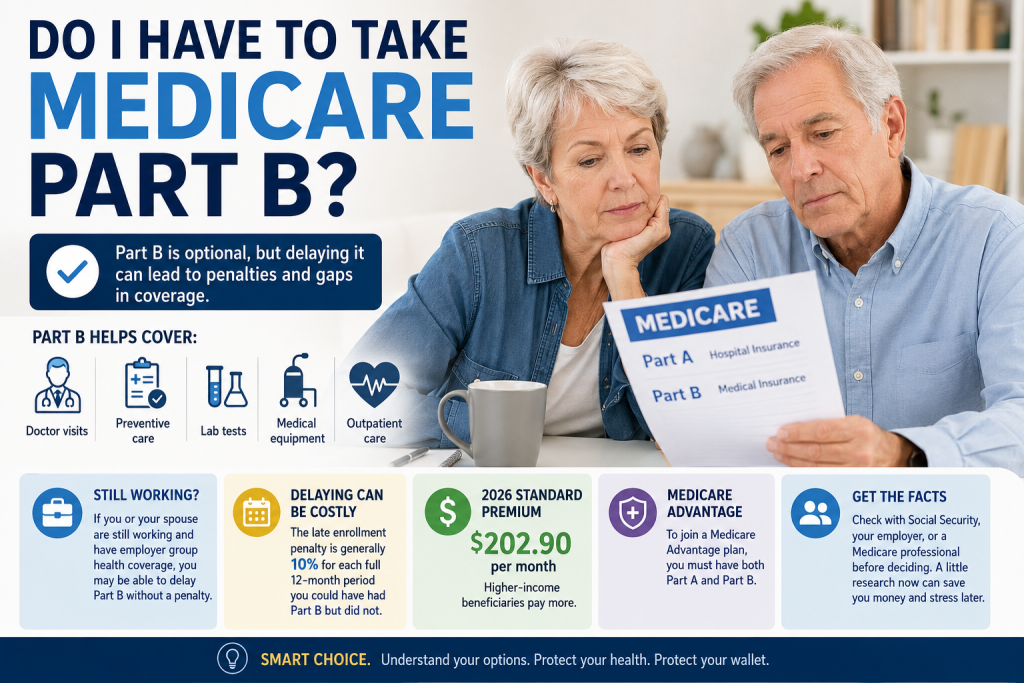
The Answer Is Simple, But the Decision Is Not Always Simple
One of the most common Medicare questions people ask is: “Do I have to take Part B?”
The honest answer is this: Medicare Part B is technically optional. Nobody from Medicare is going to come knocking on your door, confiscate your coffee, and force you to take it.
But here is the part that matters: choosing not to take Part B can be a very expensive mistake if you do not understand the rules.
Medicare Part B is the part of Medicare that helps cover doctor visits, outpatient care, preventive services, lab work, medical equipment, many screenings, and a wide range of services you normally receive outside the hospital.
Part A is hospital insurance. Part B is medical insurance.
That sounds simple, but this is where people get tripped up. Many people turn 65 and think, “I feel fine. I’m still working. I don’t go to the doctor much. Why should I pay another monthly premium?”
That question makes sense. Nobody wants another bill, especially in retirement. But Medicare is not something you want to handle casually. One wrong move can leave you with a lifetime penalty, a gap in coverage, or a nasty surprise when you finally need care.
This article explains when you should take Part B, when you may be able to delay it, and why the decision should never be made by guessing.
What Is Medicare Part B?
Medicare Part B is the medical side of Original Medicare. It helps cover doctor services, outpatient care, preventive care, ambulance services, durable medical equipment, and many medically necessary services.
In plain English, Part B is the part that follows you around outside the hospital.
You may not think about it much when you are healthy, but Part B becomes very important when you need a cardiologist, a dermatologist, an MRI, physical therapy, outpatient surgery, cancer treatment, diabetes care, or a second opinion.
Part A may help if you are admitted to the hospital. Part B helps with much of the care that happens before, after, or instead of a hospital stay.
That is why Part B is not just another government letter. It is a major piece of your health coverage.
Is Part B Required by Law?
No, Part B is not required by law for everyone.
You can refuse it. You can delay it. You can choose not to enroll.
But the better question is not, “Can I refuse Part B?”
The better question is, “What happens if I refuse Part B?”
That is where the real issue begins.
For many people, delaying Part B without having the right kind of other coverage can lead to two problems.
First, you may have to wait for a future enrollment period before you can get Part B.
Second, you may pay a late enrollment penalty for as long as you have Part B.
That penalty is not a one-time slap on the wrist. It can follow you for life. That is Medicare’s charming little way of saying, “You should have read the instructions.”
When Should Most People Take Part B?
Most people should take Part B when they first become eligible for Medicare, usually around age 65.
This is especially true if you are retired, not covered by current employer group health insurance, on individual insurance, on retiree coverage, on COBRA, or depending only on VA benefits for some of your care.
Once you are no longer covered by active employer coverage, Medicare usually expects you to enroll in Part B when eligible.
This is where many people make a mistake. They think any insurance counts. It does not.
Medicare makes a big distinction between current employer coverage and other types of coverage.
Current employer coverage usually means you or your spouse are actively working and covered by a group health plan through that employment.
Retiree coverage is not the same thing.
COBRA is not the same thing.
VA benefits are not the same thing.
Marketplace coverage is not the same thing.
This distinction is critical. It is the kind of detail that does not sound exciting, but it can save you a pile of money and aggravation.
When Can You Delay Part B?
You may be able to delay Part B without a penalty if you or your spouse are still working and you have group health coverage based on that current employment.
That is the key phrase: current employment.
Not retired employment.
Not former employment.
Not COBRA.
Not “I still have a card in my wallet.”
Current employment.
If you qualify, you may be able to delay Part B and then use a Special Enrollment Period later when that employment or employer coverage ends.
This can make sense for people who are still working at 65 and already have strong employer coverage. Why pay for Part B if your employer plan is still primary and you do not need Medicare yet?
But do not assume. Ask the employer benefits department how the plan works with Medicare after age 65. Ask whether the employer plan remains primary. Ask whether they require you to enroll in Medicare. Ask whether your spouse’s coverage would be affected.
This is not the time to rely on “my neighbor said.”
Your neighbor may be a lovely person, but that does not mean he understands Medicare coordination rules.
What If I Have COBRA?
COBRA can be a trap.
Many people leave a job and continue their employer coverage through COBRA. They assume that because COBRA looks like employer coverage, it protects them from the Part B penalty.
That assumption can be wrong.
COBRA is generally not treated the same as coverage based on current employment. Once active employment ends, your Medicare enrollment clock may start running.
This is one of the most dangerous misunderstandings in Medicare.
A person may think, “I have COBRA, so I’ll wait until COBRA ends.”
Then later they discover they missed their proper Part B enrollment window and may face a penalty or delay.
That is the Medicare version of stepping on a rake in the garage. It hurts, and it was avoidable.
What If I Have Retiree Coverage?
Retiree coverage can also be confusing.
Some former employers offer retiree health benefits. That can be valuable coverage, but it often works with Medicare, not instead of Medicare.
In many retiree plans, Medicare becomes primary once you are eligible. The retiree plan may expect you to have Part A and Part B. If you fail to enroll, the retiree plan may not pay the way you thought it would.
That can leave you responsible for bills that could have been avoided.
Before delaying Part B because you have retiree coverage, call the benefits administrator and ask directly:
“Do I need Medicare Part A and Part B for this retiree coverage to pay properly?”
Get the answer in writing if possible. Your future self may want proof.
What If I Have VA Benefits?
VA benefits are extremely important for veterans, but VA benefits and Medicare are separate systems.
VA coverage generally applies to care received through the VA system or authorized VA care. Medicare covers care from Medicare providers outside the VA system.
A veteran may feel, “I use the VA, so why should I pay for Part B?”
That can be a reasonable question, but there is risk in relying only on VA access. What if you need a non-VA specialist? What if you are traveling? What if the nearest VA appointment is delayed? What if you want civilian care?
Without Part B, your choices outside the VA may be limited and expensive.
This does not mean every veteran must make the same decision. But it does mean veterans should think carefully before refusing Part B.
The goal is not replacement. The goal is protection and flexibility.
What If I Have TRICARE?
TRICARE has its own rules, and for many people with TRICARE For Life, Medicare Part A and Part B are required to keep full TRICARE coverage after becoming eligible for Medicare.
This is one area where guessing can be especially dangerous.
If you have TRICARE, contact TRICARE or your benefits office before making any decision about Part B.
Why Does Part B Have a Late Enrollment Penalty?
Medicare Part B has a late enrollment penalty because Medicare does not want people waiting until they get sick to enroll.
Insurance only works if people participate before they need expensive care. Otherwise, everyone would wait until the ambulance was in the driveway and then say, “Now I’d like coverage, please.”
The Part B penalty is generally based on how long you delayed enrollment when you were eligible but did not have qualifying coverage.
The penalty can increase your monthly premium permanently.
That word matters: permanently.
For many people, the penalty lasts as long as they have Part B.
This is why I tell seniors: do not play chicken with Medicare enrollment deadlines. Medicare usually wins.
Do I Need Part B for Medicare Advantage?
Yes. To join a Medicare Advantage plan, you must have both Medicare Part A and Medicare Part B.
Medicare Advantage is also called Part C. These plans are offered by private insurance companies approved by Medicare, but you still must be enrolled in Part A and Part B.
This surprises some people because they think Medicare Advantage replaces Medicare completely.
It does not work that way.
With Medicare Advantage, you still have Medicare. You are simply choosing to receive your Medicare benefits through a private Medicare-approved plan.
You still pay your Part B premium. Depending on the plan, you may also pay an additional plan premium, although many Medicare Advantage plans have low or even zero-dollar plan premiums.
But zero-dollar plan premium does not mean zero Medicare cost. You still must keep paying Part B.
Do I Need Part B for a Medicare Supplement?
In most cases, yes.
A Medicare Supplement, also called Medigap, is designed to work with Original Medicare. That usually means Medicare Part A and Part B.
The supplement helps pay some of the costs that Original Medicare does not pay, such as deductibles, coinsurance, and copayments, depending on the plan.
But a supplement does not replace Part B. It sits beside Medicare.
Think of Medicare as the main engine and the supplement as extra protection. You still need the engine.
What If I Cannot Afford the Part B Premium?
This is a real concern.
The Part B premium is not pocket change, especially for people living on Social Security. Many seniors are already dealing with higher grocery prices, higher utilities, higher drug costs, and the kind of inflation that makes you stare at a receipt like it just insulted your mother.
If the Part B premium is hard to afford, do not simply skip it without checking for help.
There are Medicare Savings Programs that may help pay the Part B premium for people who qualify based on income and resources. Some people may also qualify for Extra Help with prescription drug costs.
The mistake is assuming you do not qualify. Many seniors never apply because they think, “I probably make too much,” or “That program is not for me.”
Maybe. Maybe not.
Check before you walk away from help.
What Happens If I Refuse Part B and Change My Mind Later?
You may not be able to enroll immediately.
If you do not qualify for a Special Enrollment Period, you may have to wait for the General Enrollment Period, which runs from January 1 through March 31 each year. Your coverage generally starts the month after you sign up.
You may also owe a late enrollment penalty.
That means you could have both a waiting period and a higher premium.
This is why delaying Part B should be a planned decision, not a casual decision.
A planned delay means you know exactly why you are delaying, what coverage you have, whether it qualifies, when your Special Enrollment Period begins, and what forms you will need.
A casual delay means, “I’ll deal with it later.”
Medicare is not kind to “I’ll deal with it later.”
The Big Question: Are You Still Working?
For most people, the Part B decision starts with one question:
Are you or your spouse still actively working and covered by employer group health insurance from that current job?
If yes, you may be able to delay Part B.
If no, be very careful.
Retired? You probably need Part B.
On COBRA? Be careful. COBRA usually does not protect you the same way active employer coverage does.
On retiree insurance? Check the rules. Many retiree plans expect you to have Medicare.
Using VA benefits? Think about whether you want access to non-VA doctors.
Have TRICARE? Check the requirement carefully.
Planning to enroll in Medicare Advantage? You need Part A and Part B.
Planning to buy a Medicare Supplement? You generally need Part A and Part B.
A Simple Checklist Before You Refuse Part B
Before you say no to Part B, ask these questions:
Am I still working?
Is my spouse still working?
Is my health insurance based on current employment?
Will my employer plan pay primary after age 65?
Will my coverage continue if I delay Part B?
Will I qualify for a Special Enrollment Period later?
Is my coverage COBRA, retiree coverage, VA, TRICARE, Marketplace, or active employer coverage?
Could I face a late enrollment penalty?
Could I have a gap in coverage?
Do I need Part B to join the plan I want?
If you cannot answer these questions clearly, do not make the decision yet.
Final Thoughts: Part B Is Optional, But the Consequences Are Not
So, do you have to take Part B?
Legally, not always.
Practically, many people should.
The people who can safely delay Part B are usually those who are still working, or whose spouse is still working, and who have group health coverage based on that current employment.
Everyone else should be cautious.
Part B is one of those decisions that may not feel important when you are healthy, but it can become very important the moment life changes. And life does change. That is not pessimism. That is just being old enough to have seen the movie before.
The goal is not to scare you. The goal is to help you avoid an expensive mistake.
Medicare is full of letters, deadlines, rules, exceptions, penalties, and fine print. It can feel like someone spilled alphabet soup into a government handbook.
But the basic idea is this:
If you need Medicare as your main health coverage, you probably need Part B.
If you are still protected by current employer coverage, you may be able to wait.
Before you refuse Part B, get the facts. Ask questions. Check with Social Security, Medicare, your employer benefits office, or a trusted Medicare professional.
Do not guess your way through one of the most important health insurance decisions of your retirement.
A wrong guess can cost you money.
A right decision can protect your health, your wallet, and your peace of mind.

William Vargas brings over 50 years of financial and insurance expertise to every Medicare conversation. He operates MedicareSelfEnroll.com, helping seniors in Florida, New York, and North Carolina — with no pressure, no phone calls required.