In This Article
- What Is the Medicare GLP-1 Bridge?
- Which GLP-1 Medications Are Included?
- The $50 Price Is a Copayment, Not the Total Cost of Treatment
- Who May Qualify for the $50 GLP-1 Program?
- You Must Have Medicare Drug Coverage
- The Medication Must Be Prescribed for Weight Management
- BMI of 35 or Higher
- BMI of 30 to 34.99 With Certain Health Conditions
- BMI of 27 to 29.99 With Certain Cardiovascular or Metabolic Risks
- What If You Have Already Lost Weight on a GLP-1?
- Who Is Not Eligible?
- People Already Receiving a GLP-1 Through Part D
- People With Certain Conditions Already Eligible for Part D Coverage
- Having One of These Conditions Does Not Guarantee Part D Approval
- How Does the Approval Process Work?
- How Long Does Approval Last?
- Does Your Medicare Plan Need to Participate?
- Important Medical Considerations for Seniors
- Questions to Ask Your Doctor
- The Bottom Line
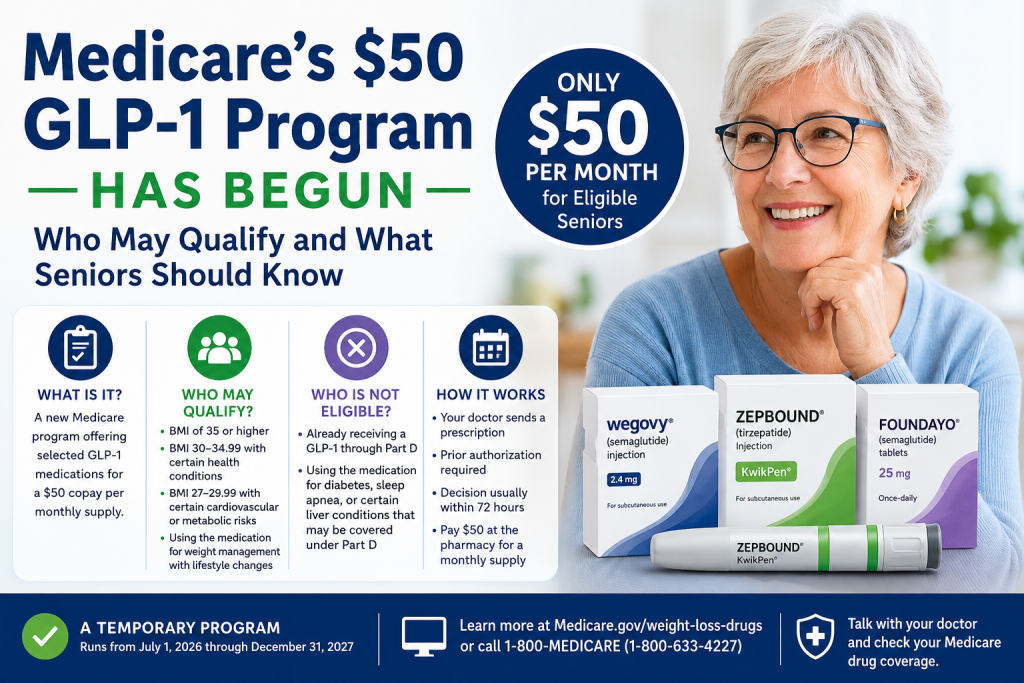
For many older Americans, the cost of GLP-1 weight-loss medications has been the biggest obstacle standing between them and treatment.
That changed on July 1, 2026.
Medicare has officially launched the Medicare GLP-1 Bridge, a temporary nationwide program that gives certain Medicare beneficiaries access to selected GLP-1 medications for a $50 copayment per monthly supply.
That is significant. Some of these medications have previously cost patients hundreds—or even more than $1,000—per month when insurance did not cover them.
But there is an important catch: not every Medicare beneficiary will qualify.
Eligibility depends on your Medicare drug coverage, why the medication is being prescribed, your body mass index, certain health conditions, and whether your Part D plan has already covered a GLP-1 medication for you.
Here is what seniors and their families need to understand before calling the doctor or heading to the pharmacy.
What Is the Medicare GLP-1 Bridge?
The Medicare GLP-1 Bridge is a temporary program administered by the Centers for Medicare & Medicaid Services, commonly called CMS.
It began on July 1, 2026, and is currently scheduled to continue through December 31, 2027.
The purpose of the program is to provide certain people with Medicare Part D access to GLP-1 medications when the drugs are prescribed specifically to reduce excess body weight or maintain weight loss.
The program operates outside the normal Medicare Part D payment system. In other words, your insurance company is not deciding whether to participate. CMS uses a central processor to handle prior authorizations, pharmacy claims, and payments.
Eligible beneficiaries pay $50 for a 28- or 30-day supply.
You can read the official CMS explanation of the program on the Medicare GLP-1 Bridge information page.
Medicare also has an online GLP-1 eligibility guide that walks beneficiaries through several basic questions.
Which GLP-1 Medications Are Included?
As of July 2026, the Medicare GLP-1 Bridge includes the following products:
- Foundayo, supplied as a tablet
- Wegovy, supplied as an injection or tablet
- Zepbound KwikPen
The program does not currently cover Zepbound single-dose pens or single-dose vials. Only the KwikPen formulation is included through the Bridge.
The list could change during the life of the program, so beneficiaries should verify current coverage before assuming a particular form of a medication will qualify.
You can also review Medicare Self Enroll’s dedicated Medicare GLP-1 information center for updates and practical guidance.
The $50 Price Is a Copayment, Not the Total Cost of Treatment
Under the program, an eligible beneficiary pays a flat $50 copayment for one monthly supply of an approved medication.
The amount is the same regardless of income.
However, there are several details seniors should understand.
The $50 payment:
- Does not count toward the Medicare Part D deductible
- Does not count toward the Part D annual out-of-pocket limit
- Is not reduced through the Part D Extra Help subsidy
- Cannot be placed into the Medicare Prescription Payment Plan
- Applies only to a single monthly supply
The Bridge does not offer 60-day or 90-day fills.
This means the medication may be dramatically more affordable, but the payment is separate from the normal Part D cost structure. CMS specifically states that the $50 does not count toward a beneficiary’s true out-of-pocket Part D spending.
To better understand how regular prescription coverage works, read What Is Covered Under Medicare Part D Drug Plans?.
Who May Qualify for the $50 GLP-1 Program?
Eligibility is not based simply on being overweight or having Medicare.
A beneficiary must satisfy several requirements.
You Must Have Medicare Drug Coverage
You generally must be enrolled in an eligible form of Medicare Part D coverage, such as:
- A standalone Medicare prescription drug plan
- A Medicare Advantage HMO with prescription coverage
- A Medicare Advantage PPO with prescription coverage
- A Medicare Advantage HMO Point-of-Service plan
- A Special Needs Plan with prescription coverage
- An eligible employer or union Medicare drug plan
- The Limited Income Newly Eligible Transition program
Some Medicare plan types do not qualify unless the beneficiary also has a separate eligible Part D drug plan.
For example, certain private fee-for-service plans, PACE organizations, cost plans, and other specialized arrangements may not qualify on their own. Medicare recommends calling 1-800-MEDICARE when a beneficiary is uncertain about the type of drug coverage they have.
The Medication Must Be Prescribed for Weight Management
The Medicare GLP-1 Bridge is designed for people using one of the approved medications to:
- Reduce excess body weight
- Maintain weight reduction
- Participate in an ongoing lifestyle program involving nutrition and physical activity
A doctor or other authorized medical provider must certify that the medication is being used along with structured lifestyle changes.
This is not meant to be a prescription-only approach where diet, physical activity, muscle preservation, and follow-up care are ignored.
For older adults, that lifestyle component is especially important. Weight loss without sufficient protein, strength training, and medical supervision can increase the risk of losing muscle along with fat.
BMI of 35 or Higher
A beneficiary may qualify if their body mass index was 35 or higher when they began GLP-1 treatment.
No additional qualifying medical condition is required under this category.
BMI is a calculation based on height and weight. It is not a perfect measurement of health, but it is the measurement CMS is using for this program.
Your doctor can calculate and document your BMI.
BMI of 30 to 34.99 With Certain Health Conditions
A beneficiary with a BMI between 30 and 34.99 may qualify when they also have at least one specified health condition.
Those conditions include:
- Heart failure with preserved ejection fraction
- High blood pressure that remains uncontrolled despite treatment
- Chronic kidney disease at stage 3a or higher
- Prediabetes
- A previous heart attack
- A previous stroke
- Symptomatic peripheral artery disease
CMS defines uncontrolled hypertension more specifically for providers. In general, it means blood pressure remains above the required level despite concurrent treatment with two blood-pressure medications.
BMI of 27 to 29.99 With Certain Cardiovascular or Metabolic Risks
People with a BMI between 27 and 29.99 may qualify when they have at least one of the following:
- Prediabetes
- A previous heart attack
- A previous stroke
- Symptomatic peripheral artery disease
A BMI below 27 does not currently satisfy the Bridge’s clinical eligibility requirements.
What If You Have Already Lost Weight on a GLP-1?
This is one of the most important details in the program.
CMS says eligibility is based on whether you met the clinical requirements when you first began GLP-1 therapy, not necessarily your current weight.
For example, suppose a person started taking a GLP-1 medication in 2024 when their BMI was 37. By July 2026, their BMI has fallen to 33.
That person may still qualify if the prescribing provider can document and certify that their BMI was at least 35 when treatment began.
This rule recognizes a common-sense reality: the medication may be the reason the person’s weight and BMI have improved. Medicare does not automatically punish successful treatment by requiring the person to regain weight before qualifying.
Who Is Not Eligible?
Several groups are excluded from the Medicare GLP-1 Bridge.
People Already Receiving a GLP-1 Through Part D
A beneficiary generally cannot use the Bridge if a Medicare Part D plan has already paid for a GLP-1 medication for them during 2026.
They should continue obtaining the medication through their existing Medicare drug plan.
The Bridge is not meant to replace existing Part D coverage or move a covered patient from their plan into the $50 demonstration.
People With Certain Conditions Already Eligible for Part D Coverage
The program also excludes people whose GLP-1 medication is being prescribed for certain conditions that can already be covered under Medicare Part D.
These include:
- Type 2 diabetes
- Moderate-to-severe obstructive sleep apnea
- Certain forms of fatty liver disease, including noncirrhotic metabolic dysfunction-associated steatohepatitis
This sounds backward at first. Someone may think, “I have sleep apnea and obesity, so shouldn’t that make me more qualified?”
Under the Bridge rules, the answer may be no. That is because Medicare considers the medication potentially coverable through the person’s regular Part D plan for the medically accepted condition.
For example, Zepbound may be covered by a Part D plan for an eligible patient with obesity and moderate-to-severe obstructive sleep apnea. Wegovy may also be covered under Part D for certain patients with established cardiovascular disease.
Those beneficiaries must work through their drug plan’s formulary, prior authorization, coverage determination, or exception process rather than using the Medicare GLP-1 Bridge.
Having One of These Conditions Does Not Guarantee Part D Approval
Here is where Medicare becomes Medicare—there is always another layer.
Being excluded from the Bridge because a condition is potentially covered under Part D does not necessarily mean your plan will instantly approve the medication.
The drug could still be:
- Subject to prior authorization
- Subject to step therapy
- Placed on a high formulary tier
- Excluded from the plan’s formulary
- Approved only after additional medical documentation
- Available through a formulary exception request
Therefore, beneficiaries should not assume that “not eligible for the Bridge” means “automatically covered by the plan.”
Call your plan and ask exactly how the prescribed drug is covered, what diagnosis is required, whether prior authorization is needed, and what your copayment will be.
How Does the Approval Process Work?
The first step is to speak with your doctor or another qualified medical provider.
Your provider must determine whether a GLP-1 medication is medically appropriate and whether you appear to satisfy the Bridge criteria.
If so, the general process is:
- Your provider sends a prescription for an eligible medication to the pharmacy.
- The claim is routed to the Medicare GLP-1 Bridge central processor.
- A prior authorization request is sent to the prescriber, usually electronically or by fax.
- Your provider submits the required clinical information.
- A decision is generally communicated within 72 hours after the completed request is submitted.
- You receive a letter explaining whether the medication was approved.
- If approved, you pick up a monthly supply and pay $50.
The pharmacy may need your Medicare Beneficiary Identifier, which is the Medicare number printed on your Medicare card.
If you do not have the card with you, the pharmacy may be able to locate your Medicare number using the last four digits of your Social Security number. Only provide this information to a legitimate pharmacy or authorized Medicare representative.
Medicare fraud does not take vacations. Be suspicious of unsolicited callers, social media advertisers, or websites claiming they can “guarantee” approval.
How Long Does Approval Last?
Once approved, the prior authorization generally remains valid through December 31, 2027, provided you remain on the same approved medication.
A new authorization is not normally required simply because your dosage changes.
However, changing from one GLP-1 medication to another may require a new prior authorization.
CMS also states that there is no formal Bridge appeal process. If a request was denied because information was incorrect or incomplete, the provider may submit the request again with corrected or additional documentation.
Does Your Medicare Plan Need to Participate?
No.
This is one of the unusual and potentially helpful features of the Medicare GLP-1 Bridge.
Eligible Medicare beneficiaries do not have to wait for their Part D insurance company to voluntarily join the program. The Bridge operates outside the traditional Part D payment flow, using a central CMS processor.
However, you must still have an eligible form of Medicare Part D drug coverage.
This is not a replacement for maintaining prescription drug insurance.
Important Medical Considerations for Seniors
The $50 price will understandably receive most of the attention. But cost is only one part of the decision.
GLP-1 medications can cause side effects, including:
- Nausea
- Vomiting
- Diarrhea
- Constipation
- Reduced appetite
- Abdominal discomfort
- Dehydration
They may not be appropriate for every patient.
Older adults should also pay close attention to muscle loss. When appetite falls sharply, people may eat less protein and lose lean muscle tissue. For seniors, losing too much muscle can affect balance, strength, mobility, and independence.
Patients should discuss nutrition, hydration, protein intake, resistance exercise, current medications, kidney health, and potential drug interactions with their medical team.
Do not buy questionable compounded products or unofficial “research” versions online simply because they are cheaper. The new Medicare program may provide a safer and more affordable path for people who qualify.
Questions to Ask Your Doctor
Before requesting a prescription, consider asking:
- Do I meet the Medicare GLP-1 Bridge eligibility criteria?
- What was my BMI when treatment began?
- Do I have a qualifying medical condition?
- Is the drug being prescribed for weight management or another covered diagnosis?
- Could my Part D plan already cover this medication?
- Which approved medication is most appropriate for me?
- How will we protect my muscle while I lose weight?
- What side effects should I report immediately?
- How often will my weight, kidney function, blood pressure, and nutrition be monitored?
Medicare Self Enroll also offers a practical GLP-1 doctor discussion guide that can help you prepare for the appointment.
The Bottom Line
The Medicare GLP-1 Bridge represents a major change in access to weight-management medications.
Beginning July 1, 2026, qualifying Medicare beneficiaries with Part D coverage may be able to obtain selected GLP-1 medications for $50 per monthly supply.
But this is not universal Medicare coverage for every senior who wants to lose weight.
Eligibility depends on:
- Having the right type of Medicare Part D coverage
- Using the medication for weight management
- Meeting specific BMI and health-condition requirements
- Not already receiving a GLP-1 through Part D
- Completing the prior authorization process
- Participating in an ongoing nutrition and physical activity program
The smartest first step is not to call an advertisement or order medication from an unknown website. It is to speak with your doctor, check your Medicare drug coverage, and use Medicare’s official eligibility resources.
You can also compare your current Medicare Advantage or Part D options privately through MedicareSelfEnroll.com.
No pressure. No obligation. Just the information you need to make a more informed decision.
Medicare Self Enroll is an independent educational and insurance resource and is not affiliated with Medicare, CMS, Medicaid, or any federal government agency. This article is for general informational purposes and is not medical advice. Medication eligibility, coverage, prior authorization requirements, and costs may change. Consult your doctor, Medicare plan, pharmacy, or 1-800-MEDICARE for guidance specific to your situation.

William Vargas brings over 50 years of financial and insurance expertise to every Medicare conversation. He operates MedicareSelfEnroll.com, helping seniors in Florida, New York, and North Carolina — with no pressure, no phone calls required.