In This Article
- First, Know Who Actually Enrolls You in Medicare
- Basic Information to Have Ready
- Do I Need My Birth Certificate?
- Do I Need My Social Security Card?
- The Big Documentation Issue: Employer Health Insurance
- Form CMS-40B: Applying for Medicare Part B
- Form CMS-L564: Proof of Employer Coverage
- What If My Employer Won’t Complete CMS-L564?
- What Documents Do I Need to Join a Medicare Advantage or Part D Plan?
- Your Prescription List May Be More Important Than You Think
- Make a Doctor and Hospital List Too
- If You Get Medicare Automatically, You May Not Need to Apply at All
- Don’t Forget Your Medicare Enrollment Period
- A Simple Medicare Enrollment Checklist
- The Bottom Line
Turning 65 comes with enough paperwork already.
There are Social Security decisions, retirement accounts, insurance policies, prescription lists, tax records—and somewhere in the middle of all that, Medicare shows up asking for your attention.
That can make people assume they need to assemble a folder thick enough to qualify as carry-on luggage before they can enroll.
Fortunately, Medicare enrollment is usually much simpler than that.
For many people enrolling in Medicare at 65, you won’t need to submit a mountain of documents. Much of the information Social Security needs may already be in its records. However, there are certain situations—particularly if you delayed Medicare because you or your spouse continued working—where having the right documentation becomes very important.
Here’s what to prepare.
First, Know Who Actually Enrolls You in Medicare
One common source of confusion is the difference between Medicare and Social Security.
Although Medicare administers your health coverage, enrollment in Original Medicare Part A and Part B is generally handled through the Social Security Administration.
You can learn more in our guide, How Do I Enroll in Medicare Online or by Phone?.
The Social Security Administration allows eligible individuals to apply for Medicare online. During the application, Social Security asks for basic identifying information, information about where you were born, and details about your current health insurance coverage.
So before worrying about documents, begin with the information you are likely to need.
Basic Information to Have Ready
When applying for Medicare, you should have access to basic personal information such as:
- Your Social Security number
- Your date of birth
- Your place of birth
- Your current address
- Your telephone number
- Information about your current health insurance
- Information about your spouse, when relevant
- Information about your employment or your spouse’s employment if employer coverage is involved
Social Security specifically identifies basic personal information and health insurance information as part of the Medicare application process.
For most people, knowing this information is more important than having a desk covered in official documents.
Do I Need My Birth Certificate?
Not necessarily.
People sometimes confuse applying for Medicare with applying for Social Security retirement benefits. The documentation requirements can be different.
Social Security may request proof of age, citizenship, lawful presence, or other information when its existing records aren’t sufficient.
For Social Security benefit applications, documents SSA may request include an original birth certificate or a copy certified by the agency that issued it. Ordinary photocopies or notarized copies may not satisfy certain SSA proof requirements.
But that doesn’t mean everyone enrolling in Medicare should automatically send in a birth certificate.
A better rule is:
Don’t send Social Security documents it hasn’t requested simply because you think it might need them.
Complete the application first and follow Social Security’s instructions if additional proof is required.
Do I Need My Social Security Card?
You should certainly know your Social Security number, but you may not need to physically produce your Social Security card simply to complete an online Medicare application.
Social Security already maintains your Social Security record, and its Medicare application asks for your Social Security number and other identifying information.
Still, keeping your card and other important records in a secure place is sensible.
And here’s an important security reminder: don’t carry your Social Security card around in your wallet unless you have a specific reason to do so.
Losing your grocery-store loyalty card is annoying.
Losing your Social Security card is a different afternoon altogether.
The Big Documentation Issue: Employer Health Insurance
This is where Medicare paperwork becomes much more important.
Many people continue working beyond age 65, or receive health insurance through a spouse who continues working.
Depending on the circumstances, they may delay Medicare Part B and enroll later using a Special Enrollment Period.
If you’re in that situation, Medicare needs to establish that you had qualifying group health coverage based on current employment.
The important phrase is current employment.
Retiree insurance, COBRA and other forms of coverage don’t necessarily follow the same Medicare enrollment rules as active employer group coverage.
That’s why anyone approaching 65 while covered through work should understand the rules before automatically delaying Medicare.
You can read more in our Medicare enrollment guidance at MedicareSelfEnroll.com.
Form CMS-40B: Applying for Medicare Part B
If you already have Medicare Part A and later want to enroll in Medicare Part B, you may need Form CMS-40B, Application for Enrollment in Medicare Part B.
CMS states that this form is intended for people who already have Medicare Part A and want to enroll in Part B.
You can obtain the official form from the Centers for Medicare & Medicaid Services.
This is particularly relevant to people who took premium-free Medicare Part A at 65 but delayed Part B because they remained covered through an employer.
Form CMS-L564: Proof of Employer Coverage
If you delayed Part B because you or your spouse had employer group health coverage based on current employment, another document becomes particularly important:
Form CMS-L564 — Request for Employment Information.
The purpose of this form is to establish that you had group health plan coverage based on current employment.
You complete part of the form, and your employer generally completes the section verifying the employment and health coverage.
Social Security says that someone applying for Part B during a qualifying Special Enrollment Period may need both:
CMS-40B — Application for Enrollment in Medicare Part B
and
CMS-L564 — Request for Employment Information.
You can find CMS-L564 on the official CMS website.
This is one piece of Medicare paperwork worth paying attention to.
If you delay Part B because you are working, don’t wait until several years later to discover that proving your old health coverage has become difficult.
Companies merge.
Human resources departments change.
Records get archived.
People retire.
Keep records showing your employer coverage.
What If My Employer Won’t Complete CMS-L564?
Don’t assume you’re stuck.
Social Security’s guidance allows other forms of evidence in certain situations when an employer cannot complete the form. SSA guidance discusses written notification from the employer and other evidence of group health coverage when appropriate.
That could make older records useful, including documents showing:
- Employer health plan enrollment
- Coverage dates
- Employment dates
- Insurance premiums deducted from payroll
- Insurance identification
- Employer correspondence
The exact evidence Social Security accepts depends on your situation, so if the employer verification process becomes difficult, contact Social Security rather than guessing.
What Documents Do I Need to Join a Medicare Advantage or Part D Plan?
Once you have Medicare, enrolling in a private Medicare plan is a different step.
To join a Medicare Advantage or Medicare prescription drug plan, you will normally need the information from your Medicare record, particularly:
- Your Medicare Number
- Your Medicare Part A effective date
- Your Medicare Part B effective date, when applicable
- Your home address
- Other basic enrollment information
Medicare says that to join a Medicare plan, you generally need your Medicare Number and the start dates of your Part A and/or Part B coverage. That information is shown on your Medicare card.
If you’ve enrolled in Medicare but haven’t received your physical Medicare card yet, don’t panic.
You may be able to find your Medicare Number through your my Social Security account, and Medicare will also include it in the welcome package it sends you.
Once you have Medicare Parts A and B, you can also compare Medicare Advantage, Medigap and Part D options available in your area.
Your Prescription List May Be More Important Than You Think
Your prescription list isn’t required to establish your basic eligibility for Medicare Part A and Part B.
But it becomes extremely important when choosing Medicare prescription coverage.
Before comparing Medicare Advantage plans that include prescription coverage or standalone Part D plans, make a current list containing:
- Exact medication name
- Dosage
- How frequently you take it
- Quantity
- Preferred pharmacy
Don’t write down simply “blood pressure pill.”
There may be dozens of medications that fit that description.
The more exact your list, the more meaningful your plan comparison becomes.
Make a Doctor and Hospital List Too
Again, this isn’t required to enroll in Original Medicare.
But if you’re considering Medicare Advantage, it’s extremely useful.
Write down:
- Primary care physician
- Cardiologist
- Orthopedist
- Oncologist
- Ophthalmologist
- Other important specialists
- Preferred hospital
- Preferred medical system
Medicare Advantage plans may use provider networks, so this information can help you evaluate available plans rather than choosing one based primarily on premiums or extra benefits.
You can use MedicareSelfEnroll.com’s plan comparison resources to review available Medicare Advantage and prescription drug plan options.
If You Get Medicare Automatically, You May Not Need to Apply at All
Here’s another reason not to panic over paperwork.
Some people are automatically enrolled in Medicare Part A and Part B.
Medicare explains that whether you need to actively sign up can depend on whether you’re already receiving Social Security retirement or disability benefits before becoming eligible for Medicare.
Social Security also notes that people already receiving qualifying Social Security retirement or disability benefits may be automatically enrolled rather than having to complete a separate Medicare application.
So the first question shouldn’t always be:
“What documents do I need?”
It should be:
“Do I actually need to apply?”
Don’t Forget Your Medicare Enrollment Period
Having the correct documents doesn’t help much if you miss the correct enrollment period.
For most people approaching age 65, Medicare provides an Initial Enrollment Period surrounding their 65th birthday.
Different rules can apply if you’re still working and covered by a qualifying employer group health plan.
That’s why it’s wise to understand your enrollment timing several months before turning 65 rather than waiting until the last minute.
Read our related guide, Missing Your Medicare Initial Enrollment Period Can Cost You for Life.
Medicare also provides an official interactive guide explaining when you can sign up for Medicare.
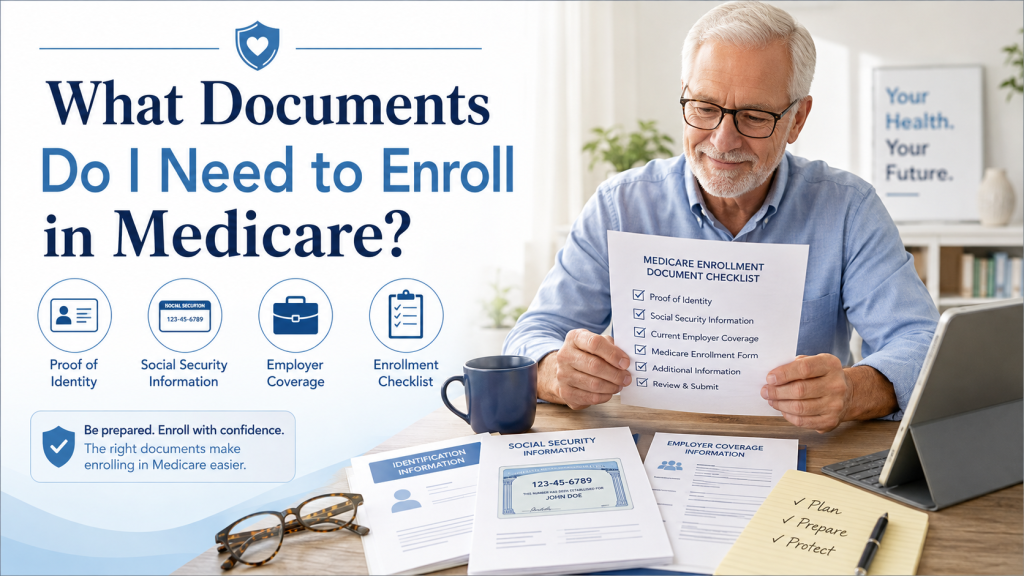
A Simple Medicare Enrollment Checklist
You don’t need a filing cabinet.
But before starting your Medicare enrollment, it’s useful to assemble one simple folder—paper or digital—containing:
Personal information
Social Security number, birth date, address and contact information.
Current insurance information
Employer insurance, spouse’s insurance or other health coverage information.
Employment coverage documentation
Especially important if you’re delaying Part B after age 65.
CMS-40B
If you’re later enrolling in Medicare Part B under circumstances requiring the form.
CMS-L564
If you’re establishing employer group coverage for a Special Enrollment Period.
Medicare card
Once issued, keep your Medicare Number and Part A and B effective dates available.
Prescription list
For comparing drug coverage.
Doctor and hospital list
Particularly useful when comparing Medicare Advantage plans.
The Bottom Line
Medicare enrollment paperwork is usually less intimidating than people expect.
If you’re enrolling around age 65 under ordinary circumstances, much of the process involves supplying information Social Security already knows or can verify.
The situation becomes more documentation-sensitive when you’ve delayed Medicare Part B because you or your spouse continued working.
That’s when records of employer coverage—and forms such as CMS-40B and CMS-L564—can become very important.
The best approach isn’t to collect every piece of paper you’ve accumulated since the Eisenhower administration.
It’s to know which Medicare enrollment situation applies to you, gather the documents that support that situation and start early enough to resolve any questions before you need your Medicare coverage to begin.
Once you’re enrolled in Medicare, the next decision is how you want to receive your coverage.
At MedicareSelfEnroll.com, you can learn about Medicare, compare available coverage options and make decisions privately at your own pace.
We Don’t Sell You Plans. We Help You Find Yours.
MedicareSelfEnroll.com is not affiliated with or endorsed by the U.S. government or the federal Medicare program. Medicare rules and individual circumstances vary. Always verify enrollment requirements and deadlines with Medicare or the Social Security Administration.

William Vargas brings over 50 years of financial and insurance expertise to every Medicare conversation. He operates MedicareSelfEnroll.com, helping seniors in Florida, New York, and North Carolina — with no pressure, no phone calls required.