In This Article
- Medicare Does Not Automatically Cover Every Medication
- The Two Main Ways to Get Medicare Drug Coverage
- What Is a Formulary?
- Drug Tiers: Why the Same Medication May Cost More in One Plan
- Prior Authorization: The Plan May Need to Approve It First
- Step Therapy: Try This First Before That
- Quantity Limits: The Plan May Limit How Much You Can Get
- Medicare Part B vs. Part D: Why Some Drugs Are Covered Differently
- What About Insulin?
- What About Vaccines?
- What Is the 2026 Out-of-Pocket Cap for Part D?
- What Is the Deductible?
- Why Your Pharmacy Matters
- What If My Medication Is Not Covered?
- What Is Extra Help?
- The Biggest Mistake: Choosing a Plan Without Checking Your Drugs
- Can My Drug Coverage Change During the Year?
- When Can I Change My Drug Plan?
- Practical Checklist: How to Know If Medicare Covers Your Medication
- Final Answer: Does Medicare Cover My Prescription Medications?
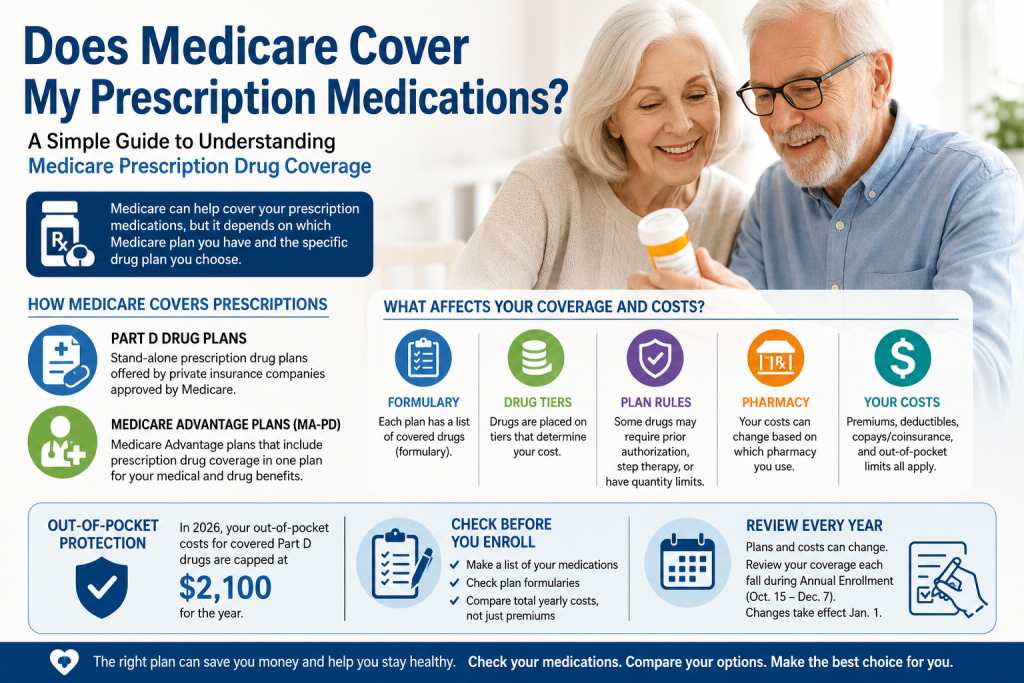
One of the most common questions people ask when they first approach Medicare is simple:
“Will Medicare cover my prescriptions?”
The honest answer is: maybe, but not automatically.
Medicare can cover prescription medications, but the coverage depends on which part of Medicare you have, which drug plan you choose, whether your medication is on that plan’s formulary, what pharmacy you use, and whether the plan has special rules like prior authorization or step therapy.
That may sound like a lot, but do not worry. This article will walk through it in plain English.
Medicare prescription coverage is not one big universal drug card. It is more like a menu. You have to pick the right plan, and the wrong plan can cost you money. Sometimes a lot of money.
That is why prescription drug coverage should be checked before you enroll in a Medicare plan, not after.
Medicare Does Not Automatically Cover Every Medication
Original Medicare includes Part A and Part B. Part A generally covers hospital care. Part B generally covers doctor visits, outpatient services, preventive care, and some medications given in a medical setting.
But most everyday prescriptions you pick up at the pharmacy, such as blood pressure pills, cholesterol medicine, diabetes pills, inhalers, antidepressants, thyroid medication, and many others, are usually covered through Medicare Part D.
Medicare Part D is prescription drug coverage offered by private insurance companies approved by Medicare. Medicare.gov explains that Part D helps pay for brand-name and generic drugs, but it is optional coverage and is offered through private companies approved by Medicare.
That word “optional” is where people get into trouble. Optional does not mean unimportant. Optional means you have to choose it.
The Two Main Ways to Get Medicare Drug Coverage
Most people get Medicare prescription drug coverage in one of two ways.
The first way is through a stand-alone Medicare Part D prescription drug plan. This is often used by people who have Original Medicare, sometimes with a Medicare Supplement plan, also called Medigap.
The second way is through a Medicare Advantage plan that includes prescription drug coverage, often called an MA-PD plan. In this case, your medical coverage and drug coverage are bundled together in one Medicare Advantage plan.
Medicare.gov says Medicare drug coverage is optional coverage that helps pay for prescription drugs and is available to people with Medicare through private insurance companies.
Here is the practical point: you do not just ask, “Does Medicare cover my medication?” You ask, “Does this specific Medicare drug plan cover my medication?”
That is the difference between a smart decision and an expensive surprise.
What Is a Formulary?
Every Medicare drug plan has a list of covered medications. This list is called a formulary.
If your medication is on the formulary, the plan may cover it. If it is not on the formulary, the plan may not cover it unless you get an exception.
Medicare.gov explains that a plan’s drug list is called a formulary and may include brand-name drugs, generic drugs, biological products, and biosimilars. Plans must include at least two drugs in the most commonly prescribed categories and classes, but plans can choose which specific drugs they offer.
That last sentence matters.
Two Medicare drug plans can both be legal, both be approved, and both be available in your county, but one may cover your medication better than the other.
That is why choosing a drug plan without checking your medication list is like buying shoes without checking the size. You might get lucky, but your feet may file a complaint.
Drug Tiers: Why the Same Medication May Cost More in One Plan
Even if your medication is covered, the cost may vary depending on what “tier” the drug is placed in.
Drug plans usually group medications into tiers. A generic drug may be in a lower-cost tier. A preferred brand-name drug may cost more. A non-preferred brand or specialty drug may cost much more.
A plan may cover your medication, but it may place it in a high-cost tier. Another plan may cover the same medication at a lower tier.
That is why you cannot stop at “covered.” You need to ask:
What will I actually pay?
A medication being covered does not mean it is free. It means the plan has rules for paying part of the cost.
Prior Authorization: The Plan May Need to Approve It First
Some medications require prior authorization.
That means your doctor may have to explain to the plan why you need the medication before the plan agrees to cover it.
This can happen with expensive drugs, brand-name drugs, specialty medications, or drugs that have safety concerns.
Prior authorization does not always mean the plan will deny the medication. It means the plan wants additional approval first. But for the patient, it can feel like Medicare turned into a paperwork Olympics.
Before enrolling in a plan, check whether your medication requires prior authorization. That one detail can save a lot of aggravation.
Step Therapy: Try This First Before That
Some plans use step therapy.
Medicare.gov describes step therapy as a type of prior authorization that may require you to try a less expensive drug on the plan’s formulary before moving up to a more expensive drug.
In plain English, the plan may say:
“Before we pay for Drug B, you need to try Drug A first.”
Sometimes this makes sense. Sometimes it can be frustrating, especially if you already tried the first medication years ago or had side effects.
If your current medication has step therapy, ask your doctor and the plan what documentation may be needed.
Quantity Limits: The Plan May Limit How Much You Can Get
A drug may also have a quantity limit.
For example, the plan may cover only a certain number of pills, inhalers, pens, patches, or doses within a certain period of time.
This is common with drugs where safety, cost, or overuse is a concern.
Again, this does not always mean the medication is unavailable. But it does mean you should know the rule before you enroll.
Medicare Part B vs. Part D: Why Some Drugs Are Covered Differently
This is where people get confused.
Some drugs are covered under Medicare Part B instead of Part D. These are often medications given in a doctor’s office, outpatient clinic, infusion center, dialysis facility, or other medical setting.
Examples may include certain injections, infusions, chemotherapy drugs, some immune drugs, and some medications used with durable medical equipment.
Part D usually covers many outpatient prescription drugs you pick up at a pharmacy. Medicare.gov says if you join a drug plan, you should check the plan’s formulary to see which outpatient drugs it covers.
So if your medication is given by a doctor or at a facility, it may fall under Part B. If you pick it up at the pharmacy and take it at home, it may fall under Part D. But there are exceptions, so always verify.
What About Insulin?
Insulin has special cost protections under Medicare.
CMS states that for covered insulin products under Part D, cost sharing is limited based on rules that include a $35 monthly cap or certain percentage calculations depending on the insulin and pricing rules.
For many beneficiaries, this has been a major improvement. But you still need to check whether your specific insulin is covered by your plan and whether your pharmacy is in-network.
Never assume all insulin is treated the same by every plan. Medicare rules help, but plan details still matter.
What About Vaccines?
Many adult vaccines are covered under Medicare Part D with no cost-sharing when they are recommended by the Advisory Committee on Immunization Practices. Medicare’s 2026 handbook also notes important Part D protections, including capped out-of-pocket costs for covered Part D drugs.
Common vaccines may include shingles, RSV, Tdap, and others depending on age, risk, and current recommendations.
Some vaccines are covered under Part B, such as flu shots, COVID-19 vaccines, pneumococcal shots, and hepatitis B shots for certain people. Others may fall under Part D.
The key point is simple: vaccines can be covered, but the part of Medicare that covers them depends on the vaccine.
What Is the 2026 Out-of-Pocket Cap for Part D?
For 2026, Medicare’s official handbook states that yearly out-of-pocket drug costs for covered Part D drugs are capped at $2,100. Once you reach that limit, you do not pay a copayment or coinsurance for covered Part D drugs for the rest of the calendar year.
This is a very important protection for people with expensive prescriptions.
But notice the phrase covered Part D drugs.
If the drug is not covered by your plan, or if you use a medication outside plan rules, those costs may not count the way you expect. That is why checking the formulary still matters.
What Is the Deductible?
Some Medicare drug plans have a deductible. That means you may pay the full cost of certain medications until you meet the deductible.
For 2026, Medicare.gov says the Part D late enrollment penalty uses a national base beneficiary premium of $38.99, and Medicare cost rules are updated annually. Medicare’s 2026 handbook and related materials also show that Part D drug costs and limits can change year to year.
Many plans do not apply the deductible to every drug tier. For example, some lower-tier generics may be covered before the deductible. But this depends on the plan.
This is why the cheapest premium is not always the cheapest plan. A plan with a low premium but poor coverage for your medications can cost more over the year.
Why Your Pharmacy Matters
Medicare drug plans have pharmacy networks.
Your medication may cost less at a preferred pharmacy and more at a standard pharmacy. Some plans also offer mail-order pharmacy options.
This means two people with the same plan and the same medication may pay different amounts depending on where they fill the prescription.
When comparing plans, do not only enter your medications. Also enter your preferred pharmacy. If you use a small local pharmacy, make sure it is in the plan’s network.
A plan that looks good on paper may not look so good once your pharmacy is added.
What If My Medication Is Not Covered?
If your medication is not covered, you may have several options.
Your doctor may switch you to a covered alternative.
Your doctor may request a formulary exception.
You may pay cash using a discount program, although that may not count toward your Part D out-of-pocket costs.
You may compare plans during an enrollment period and choose one that covers your medication better.
You may qualify for Extra Help if your income and resources are limited.
A formulary exception is when you or your doctor asks the plan to cover a medication that is not normally covered or to lower the cost-sharing tier. The plan can approve or deny the request.
Do not assume “not covered” is always the final answer. But also do not assume the exception will be approved. Get the facts.
What Is Extra Help?
Extra Help is a Medicare program that helps people with limited income and resources pay for Part D costs. It may help with premiums, deductibles, and prescription copays.
For people who qualify, Extra Help can make a major difference.
If you struggle to afford medications, do not just skip doses. That is dangerous. Ask about Extra Help, state pharmaceutical assistance programs, manufacturer assistance programs, and lower-cost alternatives.
Medication only works if you can actually take it.
The Biggest Mistake: Choosing a Plan Without Checking Your Drugs
Many people choose a Medicare plan because the premium is low, the TV commercial sounds good, a neighbor likes it, or the plan includes dental benefits.
That can be a mistake.
Your neighbor’s plan may be terrible for your medications. Your medications may be completely different from theirs.
Before you enroll, make a complete medication list:
Medication name.
Dosage.
How often you take it.
Whether it is brand-name or generic.
Preferred pharmacy.
Whether you use mail order.
Then compare plans based on the total yearly cost, not just the monthly premium.
This is where Medicare gets sneaky. A plan may have a $0 premium but still cost more because your drugs are expensive under that plan.
Can My Drug Coverage Change During the Year?
Yes, plan formularies can change, but there are rules about when and how plans can make changes.
CMS provides ongoing formulary guidance for Medicare prescription drug plans and reviews drug coverage policies under Medicare.
Plans may change formularies from year to year, and sometimes during the year under certain rules. That is why the Annual Enrollment Period matters.
Each fall, review your Annual Notice of Change. Do not throw it in the pile of papers with the appliance manuals and mystery coupons. It may tell you whether your drug costs or coverage are changing for the next year.
When Can I Change My Drug Plan?
Most people can change Medicare drug coverage during the Annual Enrollment Period, which runs from October 15 to December 7 each year. Changes usually begin January 1.
Some people may qualify for Special Enrollment Periods, such as moving, losing other coverage, qualifying for Extra Help, entering or leaving certain institutions, or other qualifying events.
Medicare Advantage members also have a Medicare Advantage Open Enrollment Period from January 1 to March 31, but the rules depend on your situation.
Do not wait until your medication is denied at the pharmacy counter. Review your plan every year.
Practical Checklist: How to Know If Medicare Covers Your Medication
Here is the simplest way to check:
First, write down every medication you take.
Second, include dosage and frequency.
Third, check whether each drug is covered by the specific plan you are considering.
Fourth, look at the tier.
Fifth, check for prior authorization, step therapy, or quantity limits.
Sixth, compare costs at your pharmacy and mail order.
Seventh, look at the total estimated yearly cost, not just the monthly premium.
Eighth, review again every year during Annual Enrollment.
That is the whole game. Not glamorous. Not exciting. But very effective.
Final Answer: Does Medicare Cover My Prescription Medications?
Medicare can cover prescription medications, but it depends on your coverage.
Original Medicare usually does not cover most everyday prescriptions you pick up at the pharmacy. For that, you generally need Medicare Part D, either as a stand-alone drug plan or as part of a Medicare Advantage plan with prescription coverage.
Your specific medication must be on your plan’s formulary. Even then, your cost depends on the tier, deductible, pharmacy network, and plan rules like prior authorization, step therapy, or quantity limits.
The smart move is simple:
Before you enroll, check your medications.
Do not guess. Do not assume. Do not pick a plan just because the premium looks low. A Medicare plan is only a bargain if it covers the medications you actually take.
And in Medicare, the most expensive sentence is often:
“I thought it was covered.”

William Vargas brings over 50 years of financial and insurance expertise to every Medicare conversation. He operates MedicareSelfEnroll.com, helping seniors in Florida, New York, and North Carolina — with no pressure, no phone calls required.