In This Article
- Medicare Is More Than an Insurance Decision
- The Medicare Advantage Risk
- The Medigap Risk Looks Different
- Pay Now or Pay Later?
- Your Health Today Is Not the Entire Decision
- The Risk of Assuming You Can Always Switch Later
- Provider Risk Matters Too
- Prescription Drugs Create Another Layer of Risk
- Your Neighbor’s Medicare Plan May Be Terrible for You
- Do Not Let Extra Benefits Distract You From Medical Risk
- Five Questions to Ask Before Choosing a Medicare Plan
- There Is No Perfect Medicare Plan
- Education First. Enrollment Second.
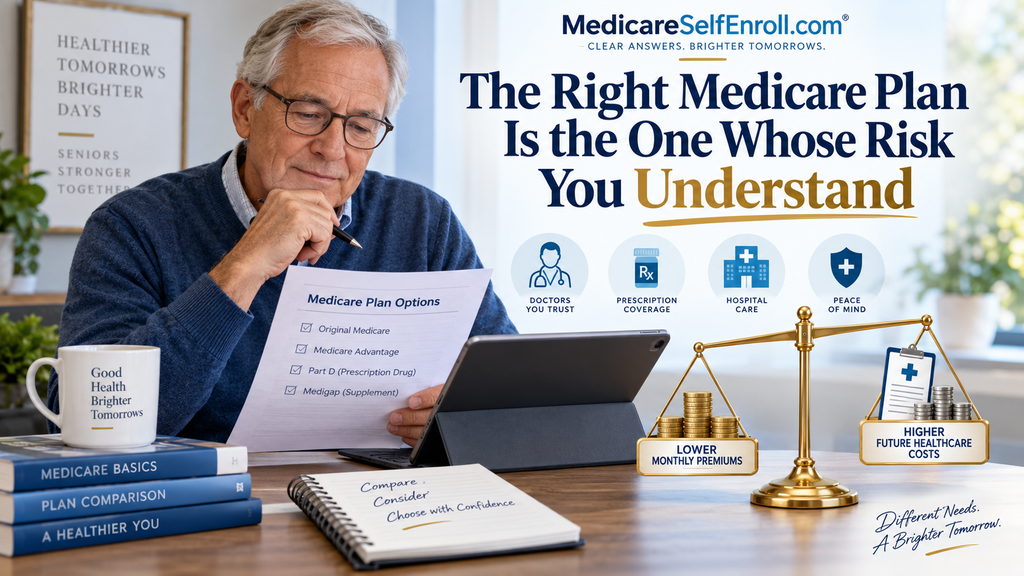
When people compare Medicare plans, they usually start with the obvious questions.
What is the monthly premium?
Does the plan include dental?
Does it cover my prescriptions?
Are my doctors in the network?
Those are important questions.
But there is another question that may be even more important:
What risk am I accepting when I choose this Medicare plan?
Every Medicare choice involves some form of financial risk.
There is no Medicare plan that eliminates every possibility of future expense, inconvenience, network change, premium increase, or healthcare surprise.
The goal is not to eliminate risk.
The goal is to understand it.
That is why the right Medicare plan is not necessarily the cheapest plan, the plan with the most benefits, or even the plan your neighbor loves.
The right Medicare plan is the one whose tradeoffs you understand and whose financial risk you are prepared to live with.
Medicare Is More Than an Insurance Decision
Medicare is usually presented as an insurance-shopping decision.
Compare premiums.
Compare benefits.
Compare companies.
Pick a plan.
But that approach can miss the bigger picture.
Medicare is also a financial planning decision.
You are deciding how you want to pay for healthcare risk over the coming years.
Would you rather pay more money every month for greater predictability?
Or would you rather pay less upfront and accept more cost-sharing when you actually use healthcare?
That is one of the fundamental differences between Medicare Advantage and Original Medicare paired with a Medicare Supplement.
We explain those differences in greater detail in our guide to Medicare Advantage versus Medigap and what seniors should understand before choosing.
Neither system is automatically better.
They simply place the financial risk in different places.
The Medicare Advantage Risk
Medicare Advantage plans can be very attractive.
Many plans have low monthly premiums, and some have a $0 plan premium. They may also include benefits such as dental, vision, hearing, fitness programs, or prescription drug coverage.
For a healthy person who uses relatively little medical care, that can be an appealing arrangement.
You may keep more money in your pocket every month instead of paying a larger insurance premium.
But you need to understand what you are accepting in exchange.
Depending on the individual plan, you may face copayments or coinsurance when you use:
- Specialists
- Diagnostic imaging
- Outpatient surgery
- Physical therapy
- Hospital services
- Ambulances
- Certain medical equipment
- Other covered services
Medicare Advantage plans also have an annual maximum out-of-pocket limit for covered Part A and Part B medical services. Once you reach your plan’s applicable limit, the plan pays 100% of covered medical services for the remainder of the calendar year. The actual limit varies by plan and may change from year to year.
That protection is important.
But so is the amount below that limit.
Imagine your Medicare Advantage plan exposes you to several thousand dollars of potential medical cost-sharing in a difficult healthcare year.
Could you comfortably handle that?
If the answer is yes, you may be comfortable accepting that risk in exchange for lower monthly premiums.
If the answer is no, the plan deserves another look.
That is why we recommend understanding your potential Medicare out-of-pocket costs before you need medical care, not after the bills begin arriving.
The Medigap Risk Looks Different
A Medicare Supplement, commonly called Medigap, handles risk differently.
Instead of potentially paying larger amounts when you use healthcare, you generally pay a separate monthly insurance premium.
Depending on the Medigap plan you choose, that can make your medical expenses much more predictable.
For some people, that predictability is worth paying for.
But Medigap has its own financial risk.
You pay the premium every month whether you use healthcare or not.
You may also need a separate Part D prescription drug plan.
And Medigap premiums can increase over time. Medicare notes that premium amounts typically increase each year, although the amount and method of increase depend on the policy and insurer.
That means a Medigap policy that feels perfectly affordable at 65 may feel very different at 75 or 85.
This is especially important for retirees living primarily on Social Security, pensions, or investment income.
The risk with Medigap may not be a sudden large medical bill.
The risk may be carrying a steadily increasing fixed monthly expense for many years.
That is still risk.
It is simply a different kind.
Pay Now or Pay Later?
One simple way to understand Medicare Advantage versus Medigap is this:
Medigap generally asks you to pay more now for greater medical-cost predictability.
Medicare Advantage may allow you to pay less upfront while accepting more cost-sharing when you use healthcare.
That is not a recommendation for one over the other.
It is a way of understanding where the financial risk sits.
A healthy 65-year-old may look at a Medigap premium and think:
“Why am I paying all of this money when I hardly ever go to the doctor?”
That is a fair question.
Another person may look at a Medicare Advantage plan and think:
“I don’t want to worry about several thousand dollars of medical copayments during a serious illness.”
That is also a fair question.
Different people can make different decisions and both can be correct.
Your Health Today Is Not the Entire Decision
People naturally use their current health when choosing Medicare coverage.
If you rarely see doctors, take few medications, exercise regularly, and have not been hospitalized in years, it is easy to assume your healthcare costs will remain low.
Hopefully they will.
But Medicare coverage should not be chosen solely around today’s health.
The better question is:
What happens financially if my health changes?
Nobody turns 65 with a guarantee that their healthcare needs will remain the same for the next 10 or 20 years.
A person who sees one doctor today may later need cardiology, orthopedics, physical therapy, cancer treatment, outpatient procedures, imaging, or recurring specialist care.
That does not mean you should choose Medicare coverage based on fear.
It means you should understand what your coverage would look like during a difficult healthcare year.
That is the difference between worrying about the future and planning for it.
The Risk of Assuming You Can Always Switch Later
There is another Medicare risk that deserves more attention.
Future flexibility.
Some beneficiaries enter Medicare Advantage thinking:
“I’ll use Medicare Advantage while I’m healthy. If my health becomes worse later, I’ll switch to Original Medicare and buy a Medigap policy.”
That may be possible in some circumstances.
But it should not be assumed.
Federal Medicare rules provide a six-month Medigap Open Enrollment Period that begins when you are enrolled in Part B and meet the applicable age requirements. Outside that protected period, an insurer may in many situations use medical underwriting unless you qualify for a guaranteed-issue right or additional protections under state law.
Some states provide stronger Medigap consumer protections than federal law requires, so your state matters.
This is why your initial Medicare decision can have consequences beyond the first year.
We also explain the relationship between health history and Medigap eligibility in our article on how Medicare plans handle pre-existing conditions.
The important lesson is simple:
Never make a Medicare decision based on the assumption that you can automatically move into any coverage you want later.
Understand the rules first.
Provider Risk Matters Too
Financial risk is only one part of the decision.
There is also provider risk.
Medicare Advantage plans often operate with provider networks.
Depending on whether you are considering an HMO, PPO, or another plan structure, the rules for using doctors and hospitals can vary. Medicare provides an overview of the differences among Medicare Advantage plan types and their network arrangements.
Before enrolling, ask:
Is my primary doctor participating?
Are my specialists participating?
Is my preferred hospital participating?
What happens if I need an out-of-network specialist?
What happens if my doctor leaves the network later?
A plan with excellent benefits may not feel excellent if the healthcare system you want to use is difficult or expensive to access.
Again, the question is not whether networks are good or bad.
The question is whether you understand the network risk you are accepting.
Prescription Drugs Create Another Layer of Risk
Prescription coverage deserves its own analysis.
A Medicare plan can look wonderful until you enter your prescriptions.
Formularies vary.
Drug tiers vary.
Pharmacy pricing can vary.
Prior authorization requirements can vary.
One expensive medication can sometimes change the entire economics of a Medicare plan.
That is why Medicare’s official Plan Finder allows beneficiaries to enter their prescriptions and pharmacies while comparing plan costs.
We also recommend reviewing prescription coverage independently from medical benefits.
Our article on recent Medicare drug changes and what they mean for beneficiaries explains why formularies, tiers, prior authorization, and pharmacy choice continue to matter even as Medicare prescription protections change.
Never assume that because two Medicare plans look similar medically, their prescription costs will also be similar.
Your Neighbor’s Medicare Plan May Be Terrible for You
This is one of the easiest Medicare mistakes to make.
Someone tells you:
“I love my Medicare plan.”
Good.
They may have an excellent plan.
For them.
But they do not necessarily have:
Your doctors.
Your prescriptions.
Your health conditions.
Your income.
Your travel habits.
Your hospital preferences.
Or your tolerance for financial risk.
Choosing Medicare because your friend likes their plan is a little like buying their shoes because they say they’re comfortable.
Excellent shoes.
Wrong feet.
Medicare should be personal.
Do Not Let Extra Benefits Distract You From Medical Risk
Dental benefits are useful.
Hearing benefits are useful.
Vision benefits are useful.
Fitness benefits can be useful.
But they should not become the primary reason for choosing major medical coverage.
A $1,000 dental benefit can look very attractive.
But it may be far less financially important than:
Your hospital cost-sharing.
Your maximum out-of-pocket exposure.
Your physician network.
Your specialist access.
Or your prescription coverage.
Think about the big numbers before the little perks.
A grocery card is pleasant.
A hospital bill is serious.
Five Questions to Ask Before Choosing a Medicare Plan
Before choosing Medicare coverage, ask yourself:
1. What will I pay every month even if I never use healthcare?
That includes premiums for Medicare coverage, Medigap, and prescription coverage where applicable.
2. What could I pay during a bad healthcare year?
Look beyond the premium.
Understand deductibles, copayments, coinsurance, and maximum out-of-pocket exposure.
3. Are my doctors, hospitals, and prescriptions covered the way I expect?
Do not assume.
Verify.
4. What happens if my health changes?
Consider how the plan works when healthcare usage becomes frequent rather than occasional.
5. How easily could I change direction later?
Understand enrollment periods, Medigap protections, state rules, and other restrictions before assuming another option will always remain available.
There Is No Perfect Medicare Plan
This brings us to the uncomfortable truth.
There is no perfect Medicare plan.
There are only different combinations of benefits, costs, restrictions, protections, and risks.
One plan may reduce monthly premiums but increase cost-sharing.
Another may improve predictability but increase fixed expenses.
One may offer attractive additional benefits but have a tighter network.
Another may offer broad provider access but require more premium dollars every month.
The goal is not perfection.
The goal is fit.
Education First. Enrollment Second.
At MedicareSelfEnroll.com, we believe people should understand their Medicare choices before they are asked to enroll.
That is why our approach is simple:
Education first. Enrollment second.
You can also use Medicare’s official Plan Finder to compare Medicare Advantage and Part D plans available in your area, including estimated costs based on your prescriptions and pharmacies.
And if you want a broader explanation of the decision, start with our guide to choosing the right Medicare plan for your individual needs.
The purpose is not to find a plan someone else calls “the best.”
It is to understand what you are receiving, what you are giving up, what can cost you money, and what risks you are willing to accept.
Because the right Medicare plan is not necessarily the one with the lowest premium.
It is not necessarily the one with the longest benefit list.
And it is not necessarily the plan your friend chose.
The right Medicare plan is the one whose risk you understand — and whose risk you can financially live with.

William Vargas brings over 50 years of financial and insurance expertise to every Medicare conversation. He operates MedicareSelfEnroll.com, helping seniors in Florida, New York, and North Carolina — with no pressure, no phone calls required.