In This Article
- Medicare Usually Does Not Cover Care Outside the United States
- Are There Any Exceptions?
- What About Emergency Care?
- What About a Cruise?
- What About Medicare Advantage?
- What About a Medicare Supplement Plan?
- What About Prescription Drugs?
- Should You Buy Travel Medical Insurance?
- What If You Live Outside the United States?
- What You Should Do Before You Leave the Country
- The Bottom Line
Many people spend years looking forward to travel in retirement. Maybe it is a cruise, a trip to Europe, visiting family overseas, spending part of the year in another country, or finally taking that dream vacation you talked about back when airline meals were still edible.
But before you pack the suitcase, the passport, the comfortable walking shoes, and the mystery pill organizer with seven tiny doors, there is one very important question:
What happens to your Medicare when you leave the United States?
The answer is simple, but it surprises a lot of people.
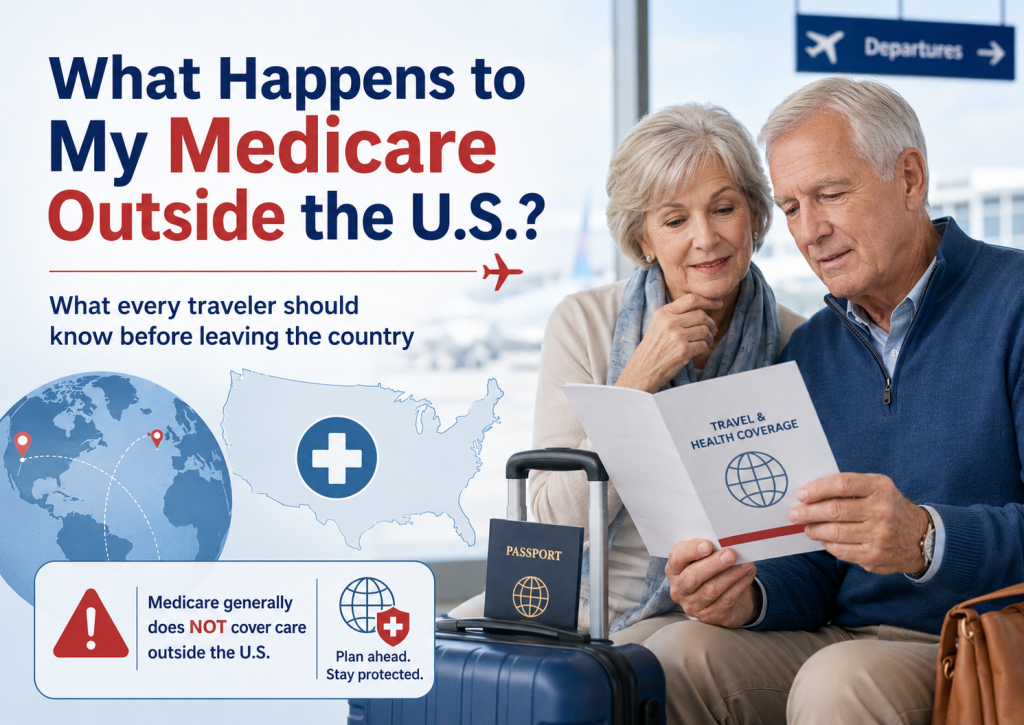
In most cases, Original Medicare does not cover health care outside the United States.
That does not mean you should never travel. It means you should understand the rules before you leave. Medicare is a wonderful program, but it is not a worldwide health insurance passport. Once you leave the United States, your coverage can become very limited.
And when it comes to medical bills in another country, “I thought I was covered” is not a strategy. It is a very expensive sentence.
Medicare Usually Does Not Cover Care Outside the United States
Original Medicare includes Part A and Part B.
Part A generally helps cover inpatient hospital care, skilled nursing facility care, hospice care, and some home health care.
Part B generally helps cover doctor visits, outpatient care, preventive services, durable medical equipment, and other medically necessary services.
But those benefits are mainly designed for care received in the United States.
According to Medicare.gov, Original Medicare generally does not cover health care you receive while traveling outside the U.S. You can read Medicare’s official explanation here: Medicare coverage outside the U.S.
For Medicare purposes, the United States includes the 50 states, Washington D.C., Puerto Rico, the U.S. Virgin Islands, Guam, American Samoa, and the Northern Mariana Islands.
Everywhere else is considered outside the U.S.
So if you are traveling in Italy, Mexico, Canada, England, France, Spain, the Dominican Republic, or almost anywhere else outside the U.S. system, you should not assume Original Medicare will pay for your medical care.
That includes doctor visits, hospital stays, emergency rooms, ambulance services, and prescriptions purchased outside the United States.
This is where retirees can get into trouble. They think Medicare works like a credit card. You just pull it out wherever you are and someone says, “No problem.”
Unfortunately, Medicare does not work that way.
Medicare outside the U.S. is more like a grocery store coupon. It may be valuable, but only where it is accepted. Try using a supermarket coupon at an airport in Paris and see how impressed they are.
Are There Any Exceptions?
Yes, but they are limited.
Original Medicare may cover care outside the U.S. in a few rare situations.
For example, if you are in the United States and have a medical emergency, but the nearest hospital that can treat you is in another country, Medicare may cover that care.
Another example may apply if you are traveling through Canada between Alaska and another U.S. state without unreasonable delay, and a Canadian hospital is closer than the nearest U.S. hospital that can treat your emergency.
There can also be situations where you live in the United States, but a foreign hospital is closer to your home than the nearest U.S. hospital that can treat your condition.
These exceptions matter, but they are narrow. They are not the same as saying, “I can travel anywhere in the world and Medicare will follow me.”
That is the important distinction.
For most regular international travel, Original Medicare is not enough.
What About Emergency Care?
This is one of the biggest misunderstandings.
Many people assume, “Even if Medicare does not cover routine care overseas, surely it covers emergencies.”
Not usually.
Original Medicare generally covers emergency care in the U.S., but emergency care outside the U.S. is covered only under rare circumstances.
That means if you fall, break a hip, have chest pain, suffer a stroke, develop a serious infection, or need emergency surgery while overseas, Original Medicare may not pay.
That is not something anyone wants to discover while sitting in a foreign hospital with a credit card in one hand and a blood pressure cuff on the other.
If you are planning to travel internationally, you should review your Medicare coverage before the trip. You can also compare Medicare plan options privately at MedicareSelfEnroll.com to see what type of coverage may fit your situation.
What About a Cruise?
Cruises need special attention.
Many seniors love cruises, and why not? You unpack once, eat too much, see several places, and pretend walking from the buffet to the elevator counts as cardio.
But Medicare coverage on a cruise can be tricky.
Medicare may cover medically necessary services on a ship in certain situations if the ship is in U.S. territorial waters. But if the ship is farther away from a U.S. port or in foreign waters, Medicare may not cover your care.
That means if you become sick or injured while cruising, you need to know what coverage you actually have.
Before taking a cruise, ask:
Does my Medicare plan cover medical care on a cruise ship?
Does my plan cover emergency care outside the U.S.?
Will I have to pay upfront?
Does the cruise line have medical services onboard?
What happens if I need to be transported to a hospital?
A cruise can be relaxing. A surprise medical bill from a floating doctor’s office is not relaxing.
What About Medicare Advantage?
Medicare Advantage plans are private Medicare-approved plans. They must cover the services Original Medicare covers, but they can also offer extra benefits.
Some Medicare Advantage plans may offer emergency or urgently needed care outside the United States. Some may include worldwide emergency coverage.
But this varies by plan.
That means you cannot assume your plan covers international travel just because another person’s plan does.
Medicare Advantage plans have their own rules, networks, copays, prior authorization requirements, and coverage limits. Some plans may reimburse you for emergency care overseas, but you may have to pay first and file paperwork later.
Before traveling, call your Medicare Advantage plan and ask these questions:
Do I have emergency coverage outside the United States?
Do I have urgent care coverage outside the United States?
Does this include cruise travel?
Do I need to contact the plan before receiving care?
Do I have to pay upfront and request reimbursement?
Is there a maximum dollar limit?
Are prescription drugs purchased outside the U.S. covered?
What documentation do I need to submit a claim?
Also ask where you can find this information in your Evidence of Coverage document.
Do not rely only on what someone says over the phone. Get it in writing if possible. Phone calls are nice, but when a bill shows up, written proof is better than “a very pleasant representative told me.”
If you are not sure whether your current plan fits your travel needs, you can review options at MedicareSelfEnroll.com. You can compare plans privately, without pressure, and without someone calling you every five minutes like you just won a sweepstakes you never entered.
What About a Medicare Supplement Plan?
A Medicare Supplement plan, also called Medigap, may help with foreign travel emergency care depending on the plan.
This is one reason some people prefer Original Medicare with a Medigap plan.
Some Medigap plans include limited foreign travel emergency coverage. Medicare.gov explains that some Medigap policies cover services Original Medicare does not cover, including emergency medical care when traveling outside the U.S. You can review Medicare’s Medigap coverage information here: Learn what Medigap covers
But there are still limits.
Many Medigap plans that offer foreign travel emergency coverage pay 80% of certain emergency care after you meet a deductible. This usually applies during the first 60 days of your trip. There is also a lifetime limit, commonly $50,000.
That may sound like a lot, but serious medical care can become expensive very quickly.
Emergency surgery, an extended hospital stay, or medical evacuation can cost far more than people expect.
So if you have a Medigap plan, do not just assume you are fully protected. Call your insurance company and ask:
Does my Medigap plan include foreign travel emergency coverage?
What is the deductible?
Does the plan pay 80% after the deductible?
Is there a lifetime limit?
Does coverage apply only during the first 60 days of travel?
Do I have to pay upfront?
How do I file a claim?
This is the kind of information you want before the trip, not after the ambulance ride.
What About Prescription Drugs?
Medicare Part D drug plans generally do not cover prescription drugs purchased outside the United States.
That matters.
If you take medication every day, do not assume you can refill your prescription overseas and have your Medicare drug plan pay for it.
Before traveling, talk to your doctor and pharmacy. Ask if you can get enough medication to last for the full trip, plus a little extra in case your return is delayed.
Keep your prescriptions in the original containers. Bring a medication list with both brand names and generic names. Some drugs may have different names in other countries.
Also, keep your medications in your carry-on bag.
Do not put essential medication in checked luggage. Checked luggage has a magical ability to visit places you never planned to go.
Should You Buy Travel Medical Insurance?
For many seniors traveling outside the U.S., the answer is yes: at least consider it.
Travel insurance is not all the same. Some travel policies focus mostly on trip cancellation, lost luggage, or flight delays. That may help if your suitcase disappears, but it may not help enough if you end up in a hospital overseas.
What you need to look for is travel medical insurance.
A travel medical policy may help cover emergency medical care, hospital care, doctor services, and medical evacuation.
Medical evacuation is especially important. If you are seriously sick or injured overseas and need to be transported back to the United States, the cost can be extremely high.
Before buying a policy, ask:
Does it cover emergency medical care?
Does it cover pre-existing conditions?
Does it include medical evacuation?
What is the maximum benefit amount?
Are there age limits?
Are there country restrictions?
Does it cover cruises?
Do I have to call the insurance company before receiving care?
Will it pay the hospital directly, or do I pay first and request reimbursement?
Do not buy travel insurance just because it is cheap. Cheap coverage that does not cover what you need is not protection. It is a souvenir.
What If You Live Outside the United States?
Traveling outside the U.S. for a few weeks is one thing. Moving outside the U.S. is another.
If you live outside the United States, Medicare generally will not cover health care you receive in that country.
Some people still keep Medicare Part B because they may return to the United States for care later. Others consider dropping Part B, but that can create problems if they return to the U.S. and want Medicare coverage again.
Dropping Part B may lead to late enrollment penalties and gaps in coverage unless you qualify for a special enrollment situation.
Before moving overseas, speak with Medicare, a qualified insurance advisor, and someone familiar with the health care system in the country where you plan to live.
Ask yourself:
Will I return to the U.S. for medical care?
Can I afford private health insurance overseas?
Does the country require proof of health coverage?
Should I keep Part B?
What happens if I become seriously ill?
This is not a small decision. It deserves careful planning.
What You Should Do Before You Leave the Country
Before traveling outside the U.S., take a few simple steps.
First, check whether you have Original Medicare only, Original Medicare with Medigap, or Medicare Advantage.
Second, call your plan or insurance company and ask about foreign travel emergency coverage.
Third, review your Evidence of Coverage, Medigap policy, or plan documents.
Fourth, consider travel medical insurance.
Fifth, bring enough prescription medication.
Sixth, carry copies of your insurance cards, medication list, emergency contacts, and travel insurance information.
Seventh, keep all medical receipts and records if you receive care overseas.
If you have to file a claim later, you may need itemized bills, proof of payment, diagnosis information, treatment records, and dates of service.
A handwritten receipt that says “doctor visit” may not be enough. Ask for detailed documentation.
The Bottom Line
Medicare is valuable coverage, but it was not designed to be full international health insurance.
Original Medicare generally does not cover care outside the United States. Medicare Advantage may offer some emergency or urgent care benefits overseas, but it depends on the plan. Medigap may help with foreign travel emergency care, but only certain plans offer it and there are limits. Part D usually does not cover prescriptions purchased outside the U.S.
So before you travel, do not guess.
Check your coverage.
Ask questions.
Consider travel medical insurance.
And know what will happen if you need care away from home.
The best time to find out what your Medicare covers outside the U.S. is before you leave — not while sitting in a foreign hospital trying to remember where you packed your reading glasses.
For help reviewing Medicare plan options privately and easily, visit MedicareSelfEnroll.com.
No pressure. No confusion. Just choices you can review at your own pace.
Know before you go — because Medicare does not automatically fit in your suitcase.

William Vargas brings over 50 years of financial and insurance expertise to every Medicare conversation. He operates MedicareSelfEnroll.com, helping seniors in Florida, New York, and North Carolina — with no pressure, no phone calls required.