In This Article
- Start Preparing About Three Months Before Your 65th Birthday
- Will Medicare Enroll Me Automatically?
- What Are Medicare Part A and Part B?
- Do I Need Medicare at 65 If I Am Still Working?
- What Happens After I Get Parts A and B?
- Option One: Original Medicare With Additional Coverage
- Option Two: Medicare Advantage
- Do I Need Prescription Drug Coverage?
- What If I Miss My Medicare Enrollment Deadline?
- How Should I Compare Plans?
- Your Simple Turning-65 Checklist
- The Bottom Line
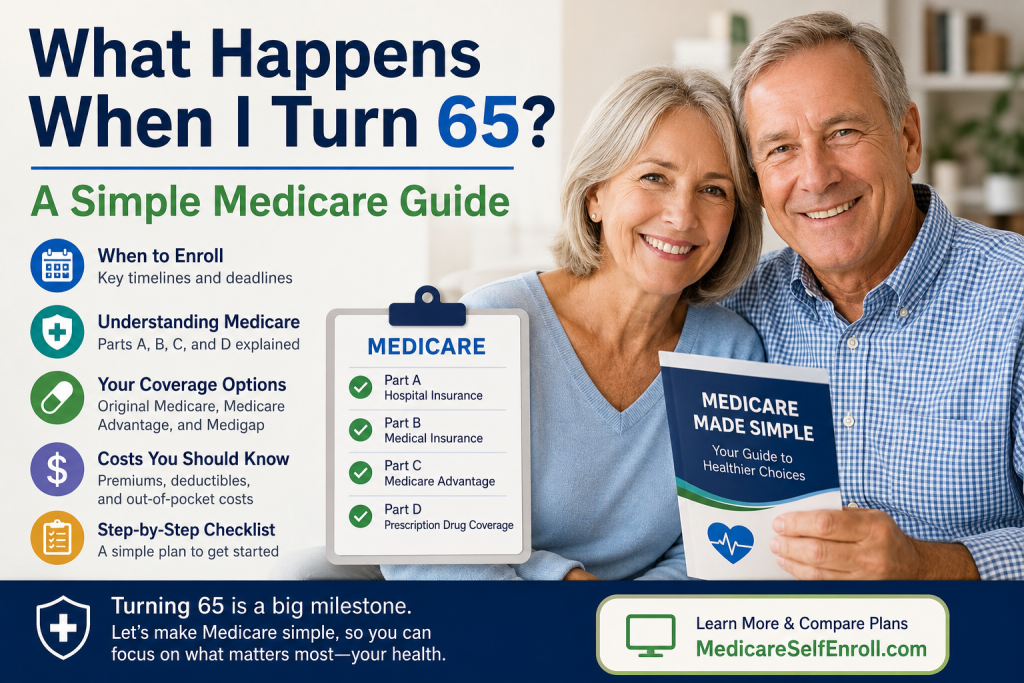
Turning 65 should come with cake, congratulations, and perhaps permission to ignore anyone who tells you to “act your age.”
Unfortunately, it also comes with Medicare paperwork.
For many people, Medicare is their first encounter with a healthcare system divided into letters: Part A, Part B, Part C, Part D—and, just to keep things interesting, Medicare Supplement plans with even more letters.
The good news is that Medicare becomes much easier to understand once you break it into a few basic decisions.
The most important thing to know is this: Turning 65 does not necessarily mean everything happens automatically. Some people are enrolled automatically, while others must take action themselves.
Here is what generally happens when you approach age 65, what deadlines matter, and how to choose coverage without feeling as though you need a law degree and a calculator.
Start Preparing About Three Months Before Your 65th Birthday
Your Medicare Initial Enrollment Period generally lasts for seven months:
- Three months before the month you turn 65
- The month you turn 65
- Three months after your birthday month
For example, if your birthday is in August, your Initial Enrollment Period generally begins May 1 and ends November 30.
Enrolling during the three months before your birthday month usually gives you the smoothest transition and helps reduce the possibility of a gap in coverage. Social Security confirms that the Initial Enrollment Period begins three months before the month you turn 65 and continues for three months afterward.
Do not wait until your birthday party to begin figuring this out. Medicare decisions are easier when you have time to compare your doctors, prescriptions, premiums, and expected healthcare needs.
Will Medicare Enroll Me Automatically?
That depends largely on whether you are already receiving Social Security benefits.
If you have been receiving Social Security retirement benefits for at least four months before turning 65, you will generally be enrolled automatically in:
- Medicare Part A, which helps cover hospital care
- Medicare Part B, which helps cover doctors and outpatient medical care
Medicare normally mails your welcome package and Medicare card about three months before your coverage begins.
If you are not collecting Social Security benefits, you will usually need to enroll yourself. This is increasingly common because many people delay Social Security beyond age 65.
Waiting to claim Social Security does not automatically mean you should wait to enroll in Medicare.
You can apply through the Social Security Administration’s Medicare enrollment system. After receiving your Medicare number and effective dates, you can begin comparing the private Medicare coverage options available in your area.
For a detailed walkthrough, read How Do I Enroll in Medicare Online or by Phone?.
What Are Medicare Part A and Part B?
Original Medicare is made up of Part A and Part B.
Medicare Part A: Hospital Insurance
Part A generally helps cover:
- Inpatient hospital care
- Skilled nursing facility care under qualifying conditions
- Hospice care
- Certain home healthcare services
Most people receive premium-free Part A because they or their spouse worked and paid Medicare taxes long enough.
However, premium-free does not mean cost-free. Medicare Part A has deductibles and cost-sharing when you use covered services. The inpatient hospital deductible is $1,736 per benefit period in 2026.
A benefit period is not necessarily the same thing as a calendar year, so someone could potentially owe more than one Part A hospital deductible in a year.
Medicare Part B: Medical Insurance
Part B generally helps cover:
- Doctor visits
- Outpatient medical services
- Preventive services
- Diagnostic testing
- Ambulance services
- Mental health services
- Durable medical equipment
- Certain medications administered in a medical setting
The standard Part B premium is $202.90 per month in 2026, although higher-income beneficiaries may pay more.
The annual Part B deductible is $283 in 2026. After the deductible, Original Medicare usually pays 80% of the Medicare-approved amount for covered Part B services, while you are responsible for the remaining 20%.
Original Medicare does not place a general annual maximum on your share of covered Part A and Part B expenses. That is one reason many beneficiaries choose additional coverage.
Do I Need Medicare at 65 If I Am Still Working?
Not always—but this is where people need to be very careful.
You may be able to delay Part B without a penalty if you have qualifying group health coverage based on your own current employment or your spouse’s current employment.
The important words are current employment.
Retiree coverage, COBRA, individual health insurance, and coverage through the Affordable Care Act Marketplace generally do not protect you from Medicare late-enrollment penalties in the same way that active employer coverage may.
Medicare specifically warns that people with COBRA should generally enroll in Medicare when eligible to avoid possible gaps and Part B penalties.
Employer size can also affect which insurance pays first. Before delaying Medicare, ask the employer benefits department:
- Is this coverage based on current employment?
- Is the employer coverage considered creditable for Medicare Part B?
- Is the prescription coverage considered creditable for Part D?
- Will the employer plan remain primary after I turn 65?
- Do I need to enroll in Part A or Part B to keep the employer coverage?
Do not rely on what a coworker did three years ago. Ask for the answer in writing whenever possible.
If you delay Part B because of qualifying employer coverage, you may qualify for a Special Enrollment Period when the job or coverage ends. Social Security says this period generally allows eligible people to enroll without penalties while covered and for a limited period after the employer coverage or employment ends.
What Happens After I Get Parts A and B?
Once you have Medicare Parts A and B, you generally face two main coverage paths.
Option One: Original Medicare With Additional Coverage
You can keep Original Medicare and consider adding:
- A standalone Part D prescription drug plan
- A Medicare Supplement Insurance policy, commonly called Medigap
Original Medicare allows you to see any doctor or hospital in the United States that accepts Medicare.
A Medigap policy helps pay some of the deductibles, copayments, and coinsurance that Original Medicare does not pay. Medigap plans are sold by private insurance companies, but the benefits of each standardized plan letter are generally defined by law.
Your federal Medigap Open Enrollment Period lasts six months and begins when you are both 65 or older and enrolled in Part B. During this period, you generally have important protections when purchasing a Medigap policy.
After that window, federal law may not guarantee that you can purchase every Medigap plan. Depending on your state and circumstances, an insurer may use medical underwriting, charge more, or decline an application.
That makes your first Medigap decision especially important.
Option Two: Medicare Advantage
Medicare Advantage, also called Part C, is another way to receive your Medicare benefits.
These plans are offered by private insurance companies approved by Medicare. You remain enrolled in Medicare, but the private plan administers your Part A and Part B benefits.
Most Medicare Advantage plans include prescription drug coverage. Many also provide additional benefits that Original Medicare does not normally cover, such as:
- Routine dental services
- Routine vision care
- Hearing benefits
- Fitness programs
- Transportation
- Over-the-counter allowances
Benefits vary greatly by plan and location.
Medicare Advantage plans usually use provider networks. Depending on the plan, you may need to use participating doctors, hospitals, specialists, and pharmacies to receive the lowest costs.
Before joining, confirm that your doctors are in the plan’s network and that your prescriptions appear on its formulary.
You can review the major differences in Medicare Advantage vs. Medigap: Which Is Better?.
Do I Need Prescription Drug Coverage?
Medicare Part D helps cover outpatient prescription medications.
You can get Part D through:
- A standalone prescription drug plan used with Original Medicare
- A Medicare Advantage plan that includes drug coverage
Part D is technically optional, but going without creditable drug coverage can result in a late-enrollment penalty if you join later.
Medicare advises people to consider Part D even if they do not currently take many prescriptions.
In 2026, no Part D plan may have a deductible higher than $615, although some plans have a smaller deductible or no deductible.
Never choose a drug plan based only on its monthly premium.
A plan with a low premium can still become expensive if:
- Your medication is not covered
- Your medication is placed on a high-cost tier
- Your pharmacy is not preferred
- The plan requires prior authorization
- The plan imposes quantity limits or step therapy
Enter the exact drug name, dosage, quantity, and pharmacy when comparing coverage.
What If I Miss My Medicare Enrollment Deadline?
Missing your Initial Enrollment Period can create several problems:
- A delay in coverage
- A Part B late-enrollment penalty
- A Part D late-enrollment penalty
- Medical bills during a gap in coverage
- The need to wait for another enrollment period
The Medicare General Enrollment Period runs from January 1 through March 31 each year for certain people who missed their earlier opportunity. Coverage generally begins the month after enrollment.
The Part B penalty generally adds 10% to your premium for every full 12-month period you could have had Part B but did not enroll, unless an exception applies. In many cases, that penalty continues for as long as you have Part B.
That is not the kind of birthday present anyone wants.
How Should I Compare Plans?
There is no single Medicare plan that is best for everyone.
The right choice depends on:
- Your ZIP code
- Your doctors and hospitals
- Your prescriptions
- Your preferred pharmacies
- Your travel habits
- Your budget
- Your comfort with provider networks
- Your expected healthcare use
Start by making a list of every doctor, specialist, prescription, and pharmacy you currently use.
Then compare plans side by side.
You can use the government’s Medicare Plan Finder or privately compare Medicare plans in your ZIP code through MedicareSelfEnroll.com.
The MedicareSelfEnroll.com comparison tool allows you to review available Medicare Advantage, Medigap, and Part D options privately, check doctors and medications, and enroll online without unnecessary sales pressure.
Your Simple Turning-65 Checklist
As your 65th birthday approaches:
- Mark the beginning of your Initial Enrollment Period.
- Determine whether Medicare will enroll you automatically.
- Ask your employer whether your current coverage allows you to delay Part B.
- Apply for Parts A and B through Social Security when necessary.
- Make a complete list of your doctors and prescriptions.
- Compare Original Medicare with Medicare Advantage.
- Consider Medigap if choosing Original Medicare.
- Choose appropriate prescription drug coverage.
- Confirm your doctors, hospitals, drugs, and pharmacy before enrolling.
- Keep copies of every enrollment confirmation.
The Bottom Line
Turning 65 does not have to become a Medicare maze.
First, determine whether you need to enroll in Parts A and B. Next, decide whether you prefer Original Medicare with additional coverage or a Medicare Advantage plan. Finally, compare plans based on your actual doctors, prescriptions, costs, and priorities.
Do not choose a plan simply because a neighbor likes it, a television celebrity advertises it, or a postcard promises benefits in letters large enough to be seen from the moon.
Your healthcare needs are personal.
Take your time, compare carefully, and remember that getting a second opinion costs nothing.
You can begin by visiting MedicareSelfEnroll.com to compare Medicare plans privately and at your own pace.
This article is for educational purposes and does not provide legal, medical, tax, or individualized insurance advice. Medicare rules and plan benefits can change. Confirm current information through Medicare, Social Security, your employer benefits department, or a licensed insurance professional.

William Vargas brings over 50 years of financial and insurance expertise to every Medicare conversation. He operates MedicareSelfEnroll.com, helping seniors in Florida, New York, and North Carolina — with no pressure, no phone calls required.