In This Article
- First Question: Were You Admitted as an Inpatient?
- Why Observation Status Matters
- What Does Medicare Part A Cover in the Hospital?
- What Is a Benefit Period?
- What About Doctor Bills During a Hospital Stay?
- What If You Have a Medicare Supplement?
- What If You Have Medicare Advantage?
- Emergency Hospital Stays Are Different
- What About Skilled Nursing Care After the Hospital?
- Questions to Ask Before You Leave the Hospital
- What If Medicare Denies Coverage?
- The Bottom Line
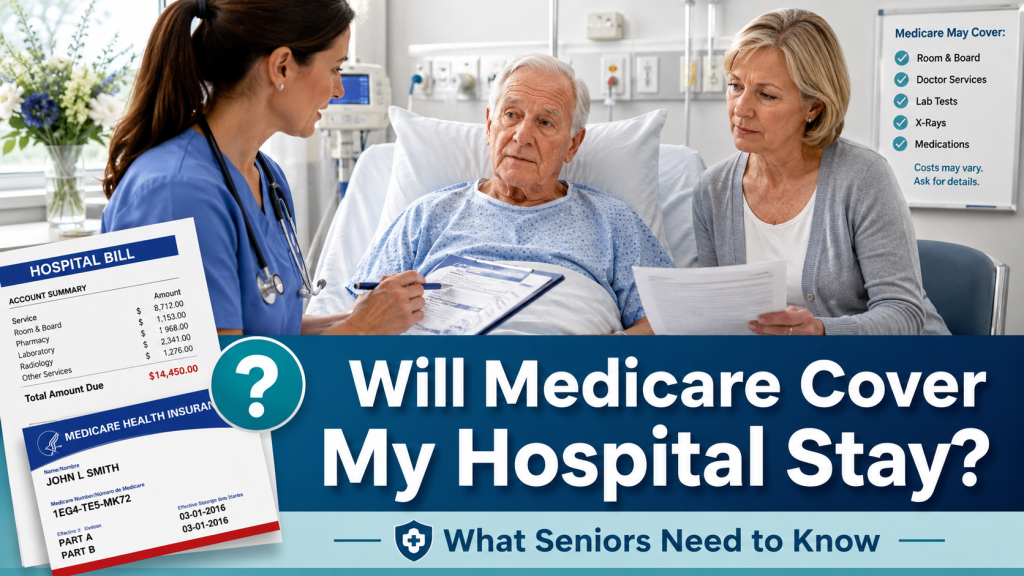
A hospital stay is stressful enough without having to wonder whether Medicare will cover it.
You are already dealing with doctors, nurses, tests, medications, discharge papers, and maybe a family member asking questions while you are trying to remember where you put your glasses. Then someone says the magic Medicare words: “covered,” “not covered,” “observation,” “inpatient,” “outpatient,” “deductible,” “copay,” and “prior authorization.”
At that point, most people would rather be handed a crossword puzzle written in ancient Greek.
So let’s slow it down.
The simple answer is: Medicare may cover your hospital stay, but the details depend on how you are admitted, what type of Medicare coverage you have, how long you stay, and what services you receive.
That is the part seniors need to understand before the bill shows up like an unwanted guest at Thanksgiving.
First Question: Were You Admitted as an Inpatient?
This is one of the most important questions you can ask in the hospital:
“Am I admitted as an inpatient, or am I here under observation?”
That one question can affect your costs, your Medicare coverage, and even whether Medicare will help pay for skilled nursing care after you leave the hospital.
With Original Medicare, an inpatient hospital stay is generally covered under Medicare Part A, also called hospital insurance. Medicare says Part A helps cover inpatient hospital care when a doctor formally admits you to the hospital and the hospital accepts Medicare. Medicare also says your inpatient or outpatient status affects how much you pay for services like X-rays, drugs, and lab tests.
Here is the tricky part: you can be in a hospital bed overnight and still not be considered an inpatient.
That sounds ridiculous, but it happens.
You may be receiving “observation services,” which usually means you are considered an outpatient, even if you are in the hospital for many hours or even overnight. In plain English, your body may be in a hospital bed, but Medicare may treat the billing differently.
That is why seniors should not assume. Ask.
Why Observation Status Matters
Observation status can surprise people because it feels like a hospital stay. You are in the hospital. You may have a wristband. You may be eating hospital food, which is proof enough that something serious is happening.
But observation status is usually billed differently from an inpatient admission.
If you are under observation, Medicare Part B may apply instead of Part A. That can mean different deductibles, different coinsurance, and different out-of-pocket costs. It may also affect whether Medicare covers a skilled nursing facility stay after you leave the hospital.
Medicare specifically warns that hospital status can affect whether Medicare will cover skilled nursing facility care after the hospital stay. Medicare also explains that if a hospital changes your status from inpatient to outpatient observation, that change can affect your bill and may affect skilled nursing facility coverage.
This is not a small detail. This is a “please ask before you get discharged” detail.
A good question for the patient or family member is:
“Has there been a formal inpatient admission order?”
Not just, “Am I staying overnight?”
Not just, “Do I have a room?”
Ask directly.
What Does Medicare Part A Cover in the Hospital?
If you are admitted as an inpatient and you have Original Medicare, Medicare Part A generally helps cover medically necessary inpatient hospital care. This can include things like a semi-private room, meals, general nursing care, drugs as part of your inpatient treatment, and other hospital services and supplies.
But “covered” does not mean “free.”
That is where many people get tripped up. Medicare may cover the hospital stay, but you may still owe deductibles, coinsurance, and charges for certain services.
For 2026, Medicare lists the Part A inpatient hospital deductible as $1,736 per benefit period. After that deductible, for days 1 through 60 of a covered inpatient hospital stay, you pay $0 coinsurance per day. For days 61 through 90, you pay $434 per day. For days 91 through 150, you pay $868 per day while using lifetime reserve days. After day 150, you pay all costs.
Now, before anyone faints into their oatmeal, many hospital stays are far shorter than 60 days. But the deductible still matters.
Also, the deductible is per benefit period, not simply once per calendar year. That is another Medicare phrase that sounds like it was invented during a committee meeting with no coffee.
What Is a Benefit Period?
A Medicare Part A benefit period begins the day you are admitted as an inpatient in a hospital or skilled nursing facility. It ends after you have been out of the hospital or skilled nursing facility for 60 days in a row.
That means you could potentially have more than one benefit period in a year.
This is one reason people should not assume hospital costs are simple. They are not. Medicare has rules, and sometimes those rules have rules wearing little hats.
What About Doctor Bills During a Hospital Stay?
Here is another surprise: even during an inpatient hospital stay, not everything is paid under Part A.
Doctor services are generally covered under Medicare Part B, not Part A. That means you may see separate bills or separate Medicare processing for doctors, specialists, surgeons, anesthesiologists, radiologists, or other providers involved in your care.
In other words, the hospital building and the doctor standing inside the hospital may not be billed the same way.
This is why someone can say, “Medicare covered my hospital stay,” and still receive bills afterward.
That does not always mean something went wrong. It may simply mean different parts of Medicare apply to different parts of the care.
What If You Have a Medicare Supplement?
If you have Original Medicare plus a Medicare Supplement, also called Medigap, your supplement may help pay some or all of the deductibles and coinsurance that Original Medicare leaves behind, depending on which Medigap plan you have.
This is one of the main reasons people buy a supplement. It can make hospital costs more predictable.
But Medigap plans are not all the same. Plan G is not Plan N. Older plans may differ from newer plans. Some people have high-deductible versions. Some have different cost-sharing.
The important point is this: if you have Original Medicare and a supplement, your hospital stay may still be covered by Medicare, while the supplement helps with the remaining approved costs.
You still need to make sure the hospital accepts Medicare and that the care is medically necessary.
What If You Have Medicare Advantage?
If you have a Medicare Advantage plan, also called Part C, your hospital coverage works differently.
Medicare Advantage plans are private plans approved by Medicare. They must cover the medically necessary services that Original Medicare covers, but they may use their own networks, copays, rules, and prior authorization requirements.
Medicare says that with Medicare Advantage, you may need approval, called prior authorization, before the plan covers certain services or items. Medicare also explains that Original Medicare usually does not require prior authorization for covered services, while Medicare Advantage plans may require it.
This matters.
If you have Medicare Advantage, your hospital costs may not look like the Original Medicare Part A deductible. Instead, you may pay a daily hospital copay, a set amount per stay, or other plan-specific cost-sharing.
Your plan may also have network rules. In an emergency, you should get emergency care right away. But for planned hospital care, network rules and authorizations can matter.
So if your hospital stay is planned, call your plan before the stay if possible. Ask:
Is this hospital in network?
Does this admission need prior authorization?
What will my inpatient hospital copay be?
Are my doctors in the plan network?
What is my maximum out-of-pocket limit?
That last question is very important. Medicare Advantage plans have an annual maximum out-of-pocket limit for covered Part A and Part B services. That can protect you from unlimited covered medical costs, but the amount varies by plan.
Emergency Hospital Stays Are Different
If you have an emergency, do not sit at home wondering whether the hospital is in network. If you think you are having a stroke, heart attack, severe breathing problem, serious fall, or other emergency, get help.
Emergency care is not the time to comparison shop like you are buying patio furniture.
But after the emergency is stabilized, questions may come up about transfers, network hospitals, follow-up care, rehabilitation, and authorizations.
That is when a family member, caregiver, or trusted advocate can be very helpful.
What About Skilled Nursing Care After the Hospital?
This is another area where seniors get caught by surprise.
Medicare may cover skilled nursing facility care after a qualifying hospital stay, but there are rules. Under Original Medicare, a qualifying inpatient hospital stay is usually required for skilled nursing facility coverage. Observation time may not count the same way.
Medicare’s skilled nursing facility information explains that Part A covers skilled nursing facility care only under certain conditions, and Medicare’s hospital status information warns that inpatient versus outpatient status may affect whether Medicare covers skilled nursing facility care after the hospital.
This is why the inpatient versus observation question is so important.
A patient may think, “I was in the hospital for three days.” But Medicare may look at the record and say, “You were under observation for part of that time.” That can affect coverage.
Again, ask before discharge.
Questions to Ask Before You Leave the Hospital
Before discharge, ask for clarity. Do not be shy. This is your health and your money.
Ask:
Was I admitted as an inpatient?
Was any part of my stay observation status?
Will Medicare Part A or Part B be billed?
Will I need skilled nursing care, home health care, or rehabilitation?
Will Medicare cover the next level of care?
If I have Medicare Advantage, has my plan approved the next step?
Are my medications covered after I leave?
Who do I call if I get a bill I do not understand?
Hospitals are busy places. Mistakes and misunderstandings can happen. You do not need to be rude, but you do need to be alert.
As I like to say, trust is nice, but paperwork is better.
What If Medicare Denies Coverage?
If Medicare or your Medicare Advantage plan denies coverage, you may have appeal rights.
Do not assume the first answer is the final answer. Denials can happen because of coding, missing documentation, medical necessity disputes, authorization issues, or status questions.
Medicare provides information about appeals, including fast appeals in hospital situations and appeals involving hospital status changes. Medicare says patients should receive “An Important Message from Medicare about Your Rights” within two days of hospital admission and before discharge, and Medicare also describes appeal rights when status changes from inpatient to outpatient observation.
If something does not look right, ask for the notice. Ask for the reason. Ask how to appeal. Get names, dates, and copies.
This is not the time to say, “Well, I don’t want to bother anyone.”
Bother them politely.
The Bottom Line
So, will Medicare cover your hospital stay?
Most likely, Medicare will cover medically necessary hospital care if the rules are met. But what you pay, and which part of Medicare pays, depends on important details.
With Original Medicare, inpatient hospital care is generally covered under Part A, but you may owe the Part A deductible and coinsurance depending on the length of stay. Doctor services may be billed under Part B.
If you are under observation, you may be treated as an outpatient, even if you spend the night in the hospital. That can affect your costs and may affect skilled nursing facility coverage afterward.
If you have Medicare Advantage, your plan must cover Medicare-covered hospital services, but your costs, network rules, and prior authorization requirements may be different from Original Medicare.
The big lesson is simple:
Do not wait until the bill arrives to ask questions.
Ask whether you are inpatient or observation. Ask what Medicare will cover. Ask what your plan requires. Ask about discharge care. Ask about appeal rights.
A hospital stay is hard enough. Medicare confusion should not make it worse.
And remember, if you are comparing Medicare plan options, the goal is not pressure. The goal is clarity. You want to know how your plan works before life decides to test it.
That is why reviewing your Medicare choices matters.
Because when you are sitting in a hospital bed, the last thing you want is a surprise bill tapping you on the shoulder saying, “Remember me?”

William Vargas brings over 50 years of financial and insurance expertise to every Medicare conversation. He operates MedicareSelfEnroll.com, helping seniors in Florida, New York, and North Carolina — with no pressure, no phone calls required.