In This Article
- Medicare Advantage Is Not One Big Network
- HMO Plans: Usually Network First
- PPO Plans: More Flexibility, But Still Check Carefully
- Your Primary Doctor Is Not the Only Doctor to Check
- The Magic Question to Ask the Doctor’s Office
- What If My Doctor Leaves the Plan Later?
- Emergency and Urgent Care Are Different
- Referrals and Prior Authorizations
- What About Original Medicare and a Supplement?
- A Simple Checklist Before You Enroll
- The Bottom Line
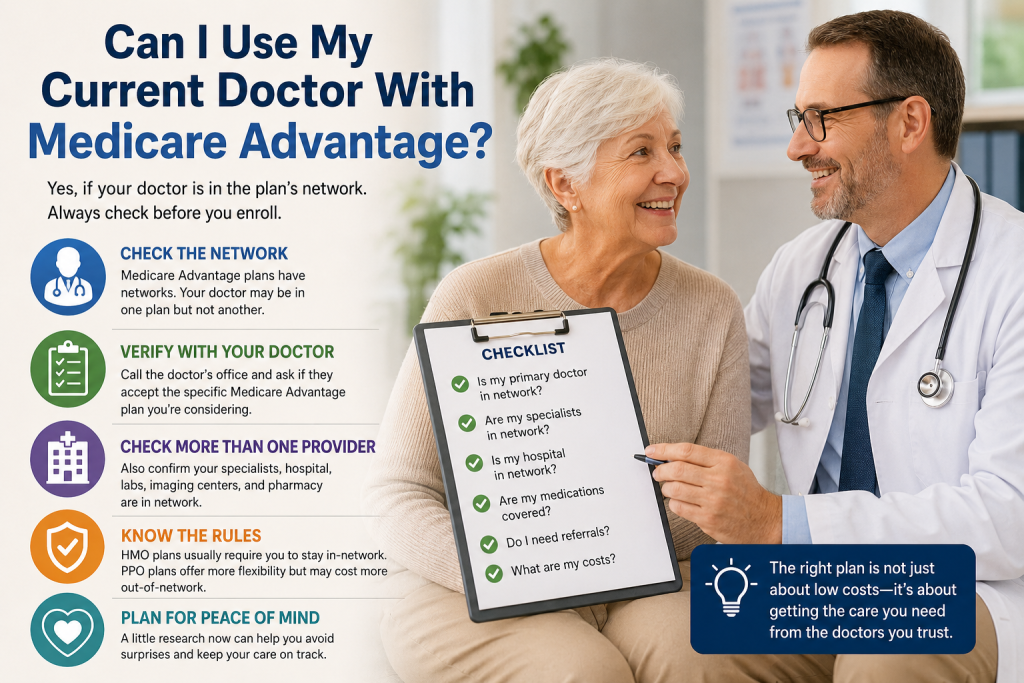
One of the first questions people ask when they look at Medicare Advantage is simple:
“Can I keep my doctor?”
And that is exactly the right question.
Not the free dental. Not the gym membership. Not the TV commercial with the smiling couple riding bicycles like they just discovered eternal youth. The real question is whether the doctors, hospitals, specialists, and pharmacies you actually use will work with the plan you are considering.
Because Medicare Advantage is not just “Medicare with extras.” It is Medicare delivered through a private insurance company that has its own rules, its own network, and its own way of managing care. Medicare Advantage plans are approved by Medicare and must cover Medicare Part A and Part B services, but they usually work through provider networks.
So the honest answer is:
Maybe. It depends on the plan, the doctor, the type of Medicare Advantage plan, and whether your doctor is in that plan’s network.
That may not sound as comforting as “yes,” but it is the truth. And with Medicare, truth beats surprises every time.
Medicare Advantage Is Not One Big Network
A common mistake is thinking that if a doctor accepts Medicare, that doctor automatically accepts every Medicare Advantage plan.
That is not how it works.
Original Medicare is the federal program. If a doctor accepts Medicare, you can generally use that doctor under Original Medicare. But Medicare Advantage plans are different. They are run by private insurance companies that contract with Medicare. Each plan may have its own network of doctors, hospitals, labs, imaging centers, and specialists.
That means your doctor may accept Original Medicare but not accept the specific Medicare Advantage plan you are looking at.
That little detail can create a very big headache.
It is like saying, “This restaurant accepts credit cards.” Fine. But does it accept your card? That is the question. Medicare Advantage works the same way. The doctor may accept some Medicare Advantage plans and not others.
So before enrolling, you must check the exact plan name, not just the insurance company name.
For example, a doctor might take one company’s PPO plan but not that company’s HMO plan. Or the doctor may take one plan in one county but not another plan in a neighboring county. Medicare Advantage is local. Counties matter. Networks matter. Plan names matter.
This is why guessing is dangerous.
HMO Plans: Usually Network First
Many Medicare Advantage plans are HMOs, which stands for Health Maintenance Organization.
With an HMO, you generally must use doctors, hospitals, and other providers in the plan’s network, except in certain situations like emergency care, urgent care, or dialysis outside the plan’s service area. Medicare explains that with HMO plans, you generally must get care from providers in the plan’s network.
That means if your current doctor is not in the HMO network, you may not be able to keep using that doctor under the plan.
There may be exceptions, but you should not build your healthcare strategy around exceptions. That is like planning your retirement around winning bingo every Friday night. Nice if it happens, but don’t bet the house on it.
With an HMO, the first question is:
Is my doctor in the network?
The second question is:
Is my hospital in the network?
The third question is:
Are my specialists in the network?
And if you have a condition that requires regular care, such as heart disease, diabetes, cancer follow-up, kidney disease, neurological issues, or joint problems, this becomes even more important.
A low premium does not help much if the doctor you trust is not available to you.
PPO Plans: More Flexibility, But Still Check Carefully
A PPO stands for Preferred Provider Organization.
A Medicare Advantage PPO generally gives you more flexibility than an HMO. Medicare’s plan comparison information notes that PPO plans typically allow you to use out-of-network providers, usually at a higher cost, as long as those providers accept the plan’s terms.
That sounds better, and sometimes it is.
But don’t hear “PPO” and automatically think, “I can go anywhere.” That is another Medicare trap with a welcome mat.
With a PPO, you usually pay less when you use in-network providers. You may be able to use out-of-network providers, but your costs can be higher. Also, the provider must be willing to bill the plan and accept the plan’s payment terms. Some doctors do not want to deal with certain out-of-network Medicare Advantage arrangements.
So with a PPO, the question is not only:
Does my doctor accept Medicare?
The better questions are:
Is my doctor in network?
If not, will my doctor still see me out of network under this PPO?
What will my cost be if I go out of network?
Does the plan have a separate out-of-network maximum?
That last question matters. PPO plans may have different cost limits for in-network and combined in-network/out-of-network services. In plain English: going out of network may give you more choice, but it can also cost more.
Flexibility is good. Expensive flexibility is still expensive.
Your Primary Doctor Is Not the Only Doctor to Check
Many people only check their primary care doctor. That is a start, but it is not enough.
You should also check:
Your cardiologist.
Your orthopedic doctor.
Your eye doctor, especially if you have cataracts, glaucoma, macular degeneration, or diabetic eye issues.
Your endocrinologist.
Your neurologist.
Your cancer specialists.
Your hospital.
Your preferred urgent care center.
Your physical therapy office.
Your lab.
Your imaging center.
Your pharmacy.
Why check all of this? Because healthcare is not one doctor sitting in a room with a stethoscope. Healthcare is a whole team. If one key part of the team is out of network, you can run into problems.
A plan may include your primary doctor but not your favorite hospital. Or it may include the hospital but not the specialist you rely on. Or your specialist may be in network, but the imaging center they use may not be.
That is how seniors get blindsided.
And frankly, the healthcare system does not always make this easy. Provider directories can be confusing, incomplete, or outdated. Recent reporting has raised concerns about inaccuracies in Medicare Advantage provider tools and directories, with experts advising beneficiaries to confirm directly with doctors’ offices before relying on online listings alone.
So yes, use the website. Use Medicare.gov. Use the plan directory. But do not stop there.
Call the doctor’s office.
The Magic Question to Ask the Doctor’s Office
When you call your doctor’s office, don’t simply ask:
“Do you take Medicare?”
That question is too broad.
Ask this instead:
“Do you accept this exact Medicare Advantage plan for the coming plan year?”
Then give them:
The insurance company name.
The exact plan name.
Whether it is HMO or PPO.
Your county.
The plan year.
Why the plan year? Because networks can change from year to year. A doctor who accepted a plan last year may not accept it next year. A hospital contract can change. A medical group can leave a network. The insurance company may change its service area or benefits.
In Medicare, “last year” is ancient history. Things change.
Also, ask the doctor’s office:
“Are you in network with this plan, or would you only see me out of network?”
That distinction matters, especially with PPOs.
And if the person on the phone sounds unsure, ask for the billing department. The front desk may be wonderful, but the billing department usually knows which plans are accepted because they deal with the claims.
What If My Doctor Leaves the Plan Later?
This is another important question.
Doctors can leave Medicare Advantage networks. Plans can change contracts. Medical groups can change relationships. Sometimes the doctor’s office may stop accepting a plan. Sometimes the plan may stop contracting with the provider.
If that happens, the plan may notify you, but you should not assume every notice will be clear, fast, or easy to understand. Medicare Advantage members should review plan notices carefully, especially the Annual Notice of Change that arrives before the Annual Enrollment Period.
If your doctor leaves the network, your choices may include:
Finding another in-network doctor.
Using out-of-network benefits if you have a PPO and the provider accepts the arrangement.
Changing plans during an appropriate enrollment period.
Using a Special Enrollment Period if one applies.
Filing a grievance or complaint if the plan directory was wrong or the plan did not provide proper access.
This is where people need to be proactive. Do not wait until you are sitting in the doctor’s office and someone says, “Your plan is no longer accepted.” That is not a good day. That is a “why didn’t I bring snacks?” day.
Emergency and Urgent Care Are Different
Now let’s be clear about emergencies.
Medicare Advantage plans must cover emergency and urgently needed care, even if you are outside the plan’s network. Medicare’s HMO information notes that network restrictions generally do not apply to emergency or urgently needed care. Medicare also explains that Medicare Part B covers urgently needed care.
So if you are having chest pain, stroke symptoms, serious breathing trouble, severe injury, or another real emergency, do not sit there wondering whether the hospital is in network.
Get care.
Networks matter for routine care, planned care, specialists, surgeries, follow-ups, and ongoing treatment. Emergencies are treated differently.
But once the emergency is over, follow-up care may need to move back into the plan’s network. That is where people can get confused. The emergency room visit may be covered, but the next steps may need plan approval, referrals, or in-network providers.
Again, the devil is not just in the details. In Medicare, the devil has an office, a fax machine, and a prior authorization form.
Referrals and Prior Authorizations
Using your current doctor is one issue. Getting services approved is another.
Some Medicare Advantage plans require referrals to see specialists, especially HMOs. Some do not. Many Medicare Advantage plans require prior authorization for certain services, procedures, imaging, hospital stays, therapies, or expensive treatments.
That does not mean the plan is bad. It means you need to understand the rules before you need the care.
Ask:
Do I need to choose a primary care physician?
Do I need referrals for specialists?
Does my doctor know how to work with this plan?
Does the plan require prior authorization for common services?
How does the appeal process work if something is denied?
People sometimes blame the doctor when the issue is really the plan rules. Other times they blame the plan when the issue is that the doctor’s office did not submit the paperwork correctly. Either way, the patient gets stuck in the middle.
That is why choosing a Medicare Advantage plan should not be done casually.
What About Original Medicare and a Supplement?
This is where people need to understand the trade-off.
With Original Medicare, you can generally see any doctor or hospital in the United States that accepts Medicare. If you add a Medicare Supplement, also called Medigap, you may reduce your out-of-pocket costs, depending on the plan you buy. But Medigap usually has a monthly premium, and you typically need a separate Part D prescription drug plan.
Medicare Advantage may have lower premiums and extra benefits, but it usually comes with networks, plan rules, and managed care.
Neither choice is perfect.
Original Medicare plus a supplement may offer broader provider access but usually costs more monthly.
Medicare Advantage may offer lower monthly costs and extra benefits but may limit your provider choices.
The right answer depends on your doctors, your medications, your budget, your travel habits, your health conditions, and your tolerance for network rules.
This is not about fear. It is about fit.
A Simple Checklist Before You Enroll
Before joining a Medicare Advantage plan, check these items:
Is my primary doctor in network?
Are my specialists in network?
Is my preferred hospital in network?
Are my medications covered?
Are my pharmacies preferred?
Is the plan an HMO or PPO?
Do I need referrals?
Are there prior authorization rules?
What is the maximum out-of-pocket cost?
What happens if I travel?
What happens if my doctor leaves the network?
Can I get confirmation from the doctor’s billing office?
This may sound like a lot, but it is better to do the homework before you enroll than to learn the hard way later.
A Medicare plan is not just a card in your wallet. It is the rulebook for how you get care.
The Bottom Line
So, can you use your current doctor with Medicare Advantage?
Yes, if your doctor accepts the specific Medicare Advantage plan you choose.
With an HMO, your doctor generally needs to be in the plan’s network for routine care.
With a PPO, you may have more flexibility, but in-network care usually costs less, and out-of-network care depends on the provider accepting the plan’s terms.
Do not assume. Verify.
Check the plan directory. Check Medicare.gov. Call the insurance company. Most importantly, call your doctor’s billing office and ask about the exact plan name for the exact year.
The goal is not just to get a plan. The goal is to get a plan that works with your real life.
Your doctor matters. Your hospital matters. Your prescriptions matter. Your budget matters. And your peace of mind matters.
Medicare Advantage can be a good fit for many people. But only if the network fits the person.
Because when you are sick, the last thing you want is a surprise.
At that point, you do not want a brochure. You want your doctor.

William Vargas brings over 50 years of financial and insurance expertise to every Medicare conversation. He operates MedicareSelfEnroll.com, helping seniors in Florida, New York, and North Carolina — with no pressure, no phone calls required.