In This Article
- The Part D Out-of-Pocket Limit Is $2,100 in 2026
- The $2,100 Limit Is Not the Same as a $2,100 Deductible
- Medicare’s First Negotiated Drug Prices Took Effect
- The Medicare Prescription Payment Plan Continues
- The New Medicare GLP-1 Bridge Began July 1, 2026
- Formularies, Drug Tiers and Prior Authorization Still Matter
- Your Pharmacy Can Affect Your Costs
- Extra Help Can Still Make a Major Difference
- What Beneficiaries Should Do Before Open Enrollment
- The Bottom Line
Prescription drug coverage has become one of the most important—and confusing—parts of Medicare.
For years, beneficiaries have dealt with rising drug prices, complicated formularies, deductibles, coverage stages, pharmacy networks, prior authorization rules, and unexpected costs at the pharmacy counter. The rules could become so confusing that picking up a prescription sometimes felt like negotiating the purchase of a used car.
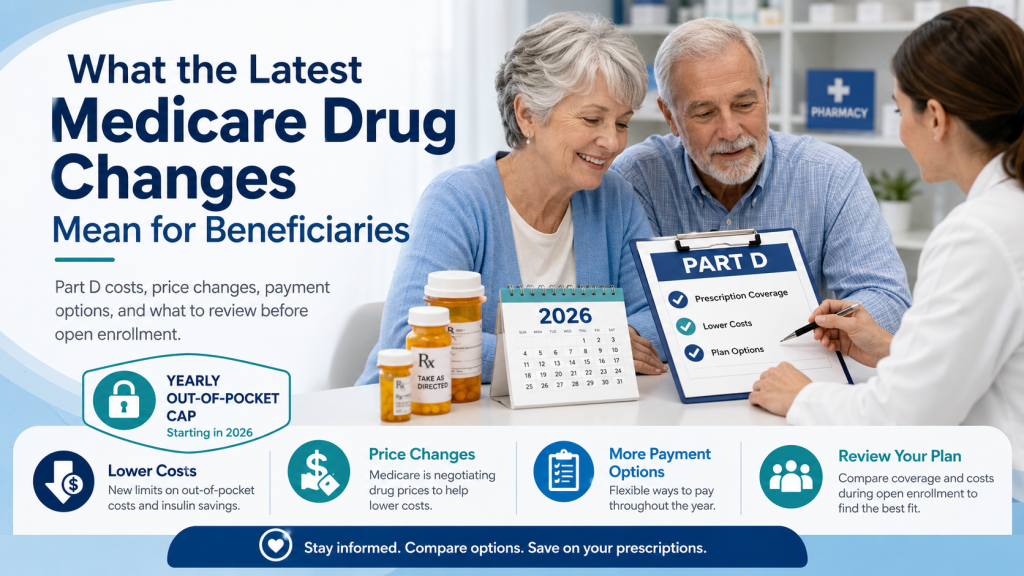
Several major Medicare drug changes are now taking effect in 2026. These include a $2,100 annual out-of-pocket limit for covered Part D medications, negotiated prices for certain expensive drugs, the continued Medicare Prescription Payment Plan, and a new Medicare GLP-1 Bridge for some qualifying beneficiaries.
These changes could reduce costs and make certain medications more accessible. However, they do not mean every drug is covered, every prescription is inexpensive, or every beneficiary will benefit in the same way.
Here is what Medicare beneficiaries and their families need to understand.
The Part D Out-of-Pocket Limit Is $2,100 in 2026
The most important broad change is the annual limit on what beneficiaries pay out of pocket for medications covered by their Medicare Part D plan.
In 2025, the limit was $2,000. For 2026, it increased to $2,100 because the amount is adjusted annually. Once a beneficiary reaches that limit through qualifying out-of-pocket spending, the beneficiary generally pays nothing for additional covered Part D medications for the remainder of that calendar year.
This protection applies whether drug coverage comes through:
- A standalone Medicare Part D prescription drug plan
- A Medicare Advantage plan that includes prescription coverage
That is a major improvement for people who take expensive medications for cancer, autoimmune conditions, heart disease, diabetes, or other serious health problems.
Before the out-of-pocket limit was introduced, some beneficiaries continued paying coinsurance throughout the year. Their costs could reach thousands of dollars with no firm annual ceiling.
The new limit creates more protection, but there is an important detail: it applies only to medications covered by your Part D plan.
A medication that is excluded from the plan’s formulary may not count toward the $2,100 limit. Drugs purchased outside the plan, including medications bought with certain discount cards instead of using Part D, generally do not count either.
This is why beneficiaries should still review the formulary—not merely the premium—when choosing a Medicare drug plan.
The $2,100 Limit Is Not the Same as a $2,100 Deductible
Some beneficiaries hear “$2,100 limit” and understandably assume they must spend the entire amount before their insurance begins paying.
That is not how it works.
The amount is a maximum on qualifying annual out-of-pocket Part D spending, not a universal deductible. Your actual costs depend on your plan, medications, drug tiers, deductible, pharmacy and cost-sharing structure.
One person may spend only $200 during the year. Another may reach $2,100 in the first several months because of an expensive medication.
The limit is a financial backstop. It does not mean everyone will pay $2,100, and it does not guarantee that every prescription will have a small copayment.
Medicare’s First Negotiated Drug Prices Took Effect
For the first time, Medicare-negotiated prices for a group of high-cost Part D medications took effect on January 1, 2026.
The initial group contains ten medications used for conditions such as blood clots, diabetes, heart failure, kidney disease, arthritis, blood cancers and inflammatory diseases. They include Eliquis, Jardiance, Xarelto, Januvia, Farxiga, Entresto, Enbrel, Imbruvica, Stelara and certain NovoLog/Fiasp insulin products.
These negotiated amounts are officially called Maximum Fair Prices.
Medicare Part D plans are required to include selected drugs on their formularies when a negotiated price is in effect. CMS has also established rules intended to help ensure that plans and pharmacies provide access to those negotiated prices.
That sounds straightforward, but beneficiaries should not assume everyone taking one of these drugs will see the same dollar reduction.
What you pay can still depend on:
- Your specific plan
- The medication’s tier
- Whether you have met the plan deductible
- The pharmacy you use
- Whether you receive Extra Help
- The quantity and dosage prescribed
- The plan’s copayment or coinsurance rules
The negotiated price limits what can be charged within the Medicare system, but it is not automatically the exact price every beneficiary pays at the pharmacy.
More drugs are being added to the negotiation process in future years. CMS selected additional medications for later negotiation cycles, but those prices take effect according to future implementation schedules—not immediately simply because a drug has been selected.
The Medicare Prescription Payment Plan Continues
The Medicare Prescription Payment Plan allows beneficiaries to spread their out-of-pocket Part D costs across monthly payments instead of paying the entire amount at the pharmacy.
All Medicare prescription drug plans must offer this voluntary option.
This can be especially helpful when someone has a large prescription expense early in the year.
Suppose you face a pharmacy cost of several hundred dollars in January or February. Without the payment option, the full amount may be due when you pick up the medication. With the Medicare Prescription Payment Plan, the cost can be divided into payments billed by your plan during the remaining months of the year.
However, this program needs a large warning label:
It is a payment option—not a discount.
It does not reduce the medication’s price. It changes when the money is paid.
There is no interest for using the program, but participants must continue paying their monthly plan premium and any amounts billed under the payment arrangement.
The program may be useful for beneficiaries who face substantial drug costs early in the year but have difficulty paying a large pharmacy bill all at once. It may provide less benefit to someone whose costs are already small and evenly distributed.
The timing matters, too. Joining late in the year leaves fewer months across which the costs can be spread. Beneficiaries should contact their Part D or Medicare Advantage plan for enrollment instructions and personalized estimates.
The New Medicare GLP-1 Bridge Began July 1, 2026
One of the biggest new developments is the Medicare GLP-1 Bridge, which began on July 1, 2026.
Under this CMS demonstration, certain eligible Medicare beneficiaries with Part D coverage may receive qualifying GLP-1 medications for weight management with a $50 monthly copayment. The program is currently scheduled to continue through December 31, 2027.
This is significant because Medicare has traditionally excluded medications used solely for weight loss, even when obesity contributed to other serious health risks.
However, the $50 price is not available to everyone.
Beneficiaries must meet the program’s eligibility and clinical requirements. A medical provider must submit a prior authorization request, and the beneficiary must be enrolled in an eligible type of Medicare drug plan.
Some people may be excluded because their GLP-1 medication is already coverable under regular Part D rules for another approved medical use. CMS specifically notes that certain GLP-1 uses—such as treating type 2 diabetes or particular FDA-approved cardiovascular and sleep-apnea indications—may follow the beneficiary’s normal Part D coverage instead of the Bridge.
The Bridge also operates outside the normal Part D payment structure.
That means:
- The $50 does not count toward the $2,100 Part D out-of-pocket limit.
- The Part D deductible does not apply to Bridge prescriptions.
- Extra Help subsidies do not reduce the Bridge copayment.
- Bridge prescriptions cannot be placed into the Medicare Prescription Payment Plan.
People interested in the program should read our Medicare GLP-1 Bridge overview and take the GLP-1 doctor guide to their medical provider.
The key lesson is simple: $50 for some does not mean $50 for everyone.
Formularies, Drug Tiers and Prior Authorization Still Matter
The recent improvements do not eliminate traditional Part D plan rules.
Each plan maintains a formulary, which is its list of covered medications. Drugs are usually organized into tiers, and different tiers can have very different costs.
A plan may also require:
- Prior authorization before covering a medication
- Step therapy, which requires trying another drug first
- Quantity limits
- Use of a preferred pharmacy
- A formulary exception request
Two Part D plans with similar premiums can produce dramatically different annual costs for the same person.
One plan may place a medication on a preferred tier with a reasonable copayment. Another may place it on a higher tier, impose coinsurance, or require additional approval.
That is why comparing premiums alone is a mistake. A plan with a slightly higher monthly premium could cost less overall if it covers your specific prescriptions more favorably.
When reviewing Medicare plans available in your area, enter every medication accurately, including the dosage, quantity and frequency.
Your Pharmacy Can Affect Your Costs
Part D plans often distinguish between preferred and standard network pharmacies.
Both may participate in the plan, but the preferred pharmacy may offer lower copayments. A beneficiary can therefore pay more simply by using the pharmacy across the street instead of the preferred location two blocks away.
Mail-order pricing may also differ, and mail order is not automatically the cheapest choice.
Before changing pharmacies, compare:
- The price for a 30-day supply
- The price for a 90-day supply
- Preferred retail pharmacy pricing
- Standard retail pharmacy pricing
- Mail-order pricing
Convenience matters, but so does the actual price. Never assume that a familiar pharmacy is the least expensive under a new plan.
Extra Help Can Still Make a Major Difference
Beneficiaries with limited income and resources may qualify for Medicare’s Extra Help program.
Extra Help can reduce Part D premiums, deductibles and prescription cost-sharing. It can also protect participants from the Part D late-enrollment penalty while they receive the assistance.
Some people qualify automatically because they receive certain Medicaid or Medicare Savings Program benefits. Others must apply.
Income and resource rules can change, so beneficiaries should not assume they earn too much based on something they heard several years ago. The safest approach is to review the current requirements through Medicare’s Extra Help information or contact Social Security.
What Beneficiaries Should Do Before Open Enrollment
Medicare Open Enrollment runs from October 15 through December 7 each year. Coverage changes made during that period generally begin January 1.
Before open enrollment, beneficiaries should receive an Annual Notice of Change from their current plan. Do not toss it onto the kitchen counter and allow it to become part of the furniture.
Review it carefully for changes involving:
- Monthly premiums
- Deductibles
- Drug formularies
- Drug tiers
- Copayments and coinsurance
- Prior authorization
- Pharmacy networks
- Mail-order rules
A plan that worked well this year may not be the best choice next year.
Beneficiaries should make a complete medication list and compare the estimated total annual cost—not merely the monthly premium. They should also confirm that their preferred pharmacies remain in the plan’s network.
Our guide to choosing the right Medicare plan explains the broader comparison process, including doctor networks, prescriptions and total expected costs.
The Bottom Line
The latest Medicare drug changes offer meaningful financial protection.
The $2,100 Part D out-of-pocket limit can protect people who require expensive covered medications. Medicare-negotiated prices may lower costs for certain widely used drugs. The Medicare Prescription Payment Plan can make a large pharmacy expense more manageable by spreading it across the year. The Medicare GLP-1 Bridge may provide eligible beneficiaries with access to certain medications for $50 per month.
But none of these changes makes Medicare drug coverage automatic or simple.
Formularies still differ. Pharmacy networks still matter. Prior authorization still exists. A medication covered by one plan may be treated very differently by another.
The best protection is to review your coverage every year using your actual medications, dosages and preferred pharmacies.
Medicare is changing. Your health needs may be changing too. Your drug coverage should not remain on autopilot.
Disclosure: MedicareSelfEnroll.com is not connected with or endorsed by the U.S. government or the federal Medicare program. Plan availability, benefits, formularies, costs and pharmacy networks vary by location and plan.
Review and compare available Medicare Advantage and Part D options privately at MedicareSelfEnroll.com. Take your time, examine your medications and make an informed decision without pressure.

William Vargas brings over 50 years of financial and insurance expertise to every Medicare conversation. He operates MedicareSelfEnroll.com, helping seniors in Florida, New York, and North Carolina — with no pressure, no phone calls required.