In This Article
- The Medicare Part D Out-of-Pocket Cap Increased to $2,100
- The Maximum Part D Deductible Is Now $615
- The Medicare Prescription Payment Plan Continues
- Medicare Has Introduced New GLP-1 Coverage for Some Beneficiaries
- Part B Premiums and Deductibles Are Higher
- The Part A Hospital Deductible Has Increased
- Medicare Advantage Benefits Continue to Vary Widely
- Provider Networks and Prior Authorization Still Matter
- Your Annual Notice of Change Is More Important Than It Looks
- What Seniors Should Do Before Choosing Coverage
- The Bottom Line
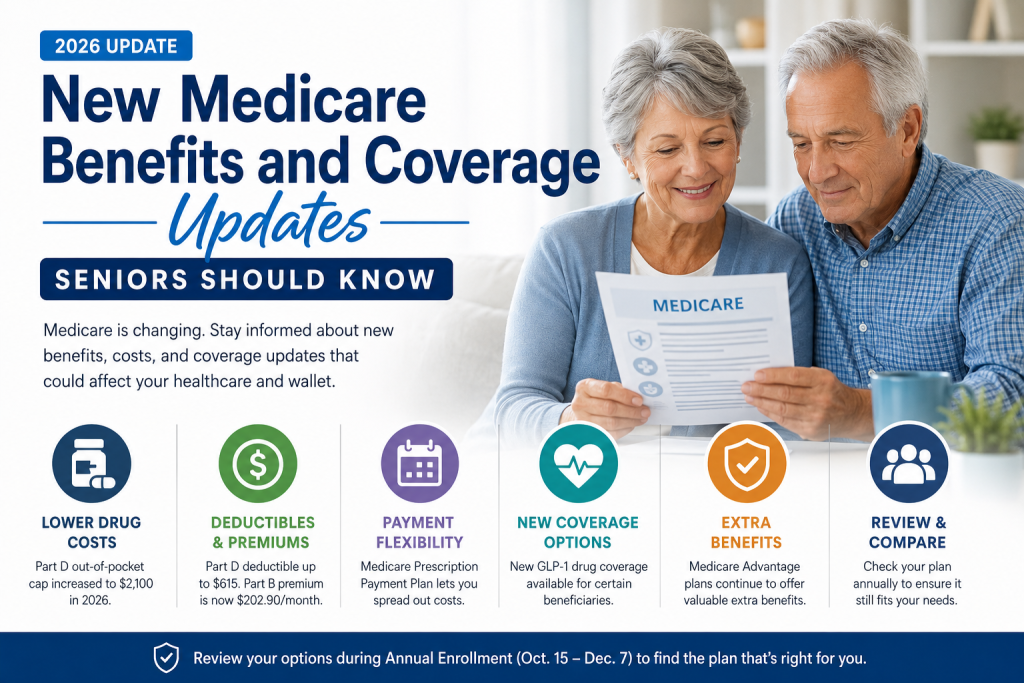
Medicare benefits are changing again—and some of the changes could affect what seniors pay at the pharmacy, which doctors they can see, how prior authorization works, and whether certain newer medications are covered.
That does not mean every Medicare beneficiary needs to change plans. It does mean that automatically renewing the same coverage without reviewing it could be an expensive mistake.
A Medicare plan that worked well last year may change its drug list, provider network, copayments, deductibles, maximum out-of-pocket limit, or supplemental benefits for the next year. Even when the plan’s name stays the same, the coverage underneath it may not.
Here are the Medicare benefit and coverage updates seniors should understand in 2026.
The Medicare Part D Out-of-Pocket Cap Increased to $2,100
One of the most important recent Medicare changes involves prescription drug costs.
In 2025, people with Medicare Part D received a new $2,000 annual limit on out-of-pocket costs for covered medications. For 2026, that limit increased to $2,100 because the cap is adjusted annually.
Once your qualifying out-of-pocket spending on Part D-covered prescriptions reaches $2,100 during 2026, you generally will not owe additional cost sharing for covered Part D medications for the remainder of the calendar year.
That is a significant protection for people who take expensive medications. However, the phrase “covered medications” matters.
The cap does not require every Part D plan to cover every drug. Each plan continues to maintain its own formulary, preferred pharmacies, drug tiers and utilization rules. A medication that is affordable under one plan may be expensive—or not covered at all—under another.
Before enrolling, review:
- Whether every medication you take is on the plan’s formulary
- The tier assigned to each drug
- Whether prior authorization is required
- Whether step therapy applies
- Whether quantity limits apply
- Which pharmacies offer preferred pricing
You can learn more in our guide to choosing the right Medicare plan for your needs.
The Maximum Part D Deductible Is Now $615
Medicare Part D plans are permitted to charge a deductible of up to $615 in 2026, although some plans have a smaller deductible or no deductible at all.
Do not judge a drug plan only by its monthly premium.
A plan with a very low premium may have:
- A higher deductible
- More expensive drug tiers
- Fewer preferred pharmacies
- Higher coinsurance on specialty medications
- A formulary that does not include one of your prescriptions
Meanwhile, a plan with a slightly higher premium could reduce what you spend at the pharmacy.
The question is not simply, “Which plan has the lowest premium?”
The better question is:
Which plan produces the lowest total annual cost for my specific prescriptions?
That calculation should include the premium, deductible, copayments, coinsurance and any restrictions that could affect access to medication.
The Medicare Prescription Payment Plan Continues
People with Medicare drug coverage can continue using the Medicare Prescription Payment Plan in 2026.
This program allows beneficiaries to spread eligible out-of-pocket prescription costs across monthly payments instead of paying the entire amount at the pharmacy at once.
It is important to understand what the program does—and what it does not do.
The payment plan:
- Can make large pharmacy expenses easier to manage
- Spreads costs across the remaining months of the calendar year
- Does not reduce the actual price of a medication
- Does not change whether a drug is covered
- Does not replace Extra Help or another assistance program
In plain English, this is a payment option, not a discount.
It may be especially helpful for someone who faces a large prescription bill near the beginning of the year. Someone who joins later in the year will have fewer months over which to spread the balance.
People with limited income and resources should also investigate Medicare’s Extra Help program, which can help pay Part D premiums, deductibles and other prescription expenses.
Medicare Has Introduced New GLP-1 Coverage for Some Beneficiaries
A major 2026 development involves certain GLP-1 medications.
Beginning July 1, 2026, Medicare introduced coverage through a new program for certain approved GLP-1 drugs, including specified forms of Wegovy, Zepbound and Foundayo. The official Medicare guidance makes clear that covered forms, eligibility requirements and program rules matter. Not every version of every medication is included.
This does not mean every Medicare beneficiary can obtain a GLP-1 medication at the same price.
Coverage may depend on factors such as:
- The medical reason the drug is prescribed
- Whether the beneficiary meets the program’s clinical requirements
- The specific medication and dosage form
- Whether the person’s Medicare plan participates
- Prior authorization and documentation
- The prescribing physician’s records
Seniors should be skeptical of advertisements suggesting that everyone on Medicare can automatically receive a GLP-1 medication for a low fixed price.
Ask the plan and prescribing physician to confirm the coverage in writing. Also verify whether the pharmacy is billing the medication under the correct Medicare benefit.
Part B Premiums and Deductibles Are Higher
The standard Medicare Part B premium increased from $185 per month in 2025 to $202.90 per month in 2026. That is an increase of $17.90 per month, or $214.80 over a full year.
The annual Part B deductible increased from $257 to $283.
Most people have the Part B premium deducted automatically from their Social Security payment. Higher-income beneficiaries may pay more because of the Income-Related Monthly Adjustment Amount, commonly called IRMAA.
The higher Part B premium applies whether someone has Original Medicare or Medicare Advantage. A Medicare Advantage plan advertising a “$0 premium” generally means the plan charges no additional plan premium. The beneficiary must ordinarily continue paying the Medicare Part B premium.
That distinction is frequently lost in television advertising.
A $0 plan premium does not mean $0 healthcare costs.
The Part A Hospital Deductible Has Increased
Most beneficiaries do not pay a monthly premium for Medicare Part A because they or their spouse paid Medicare taxes for a sufficient period while working.
However, Part A is not free when hospital care is used.
In 2026, the Part A inpatient hospital deductible is $1,736 per benefit period. A benefit period is not necessarily the same as a calendar year, so a person can potentially owe the deductible more than once under certain circumstances.
People who do not qualify for premium-free Part A may pay either $311 or $565 per month in 2026, depending on their Medicare-covered work history.
These costs help explain why many people combine Original Medicare with a Medicare Supplement policy or choose a Medicare Advantage plan that restructures hospital cost sharing.
For a closer look at the two coverage paths, read Medicare Advantage vs. Medigap: What Seniors Need to Know Before Choosing.
Medicare Advantage Benefits Continue to Vary Widely
Medicare Advantage plans may include benefits not ordinarily covered by Original Medicare, such as routine dental, vision, hearing, fitness programs, transportation or an over-the-counter allowance.
But the existence of a benefit does not tell you how valuable it is.
A dental benefit might cover preventive cleanings but provide only limited help with crowns, bridges, implants or dentures. A hearing benefit may apply only to selected devices or contracted providers. An over-the-counter allowance may expire if it is not used by a specified deadline.
Plan availability has also shifted. The average Medicare beneficiary had access to 32 Medicare Advantage prescription drug plans in 2026, compared with 34 in 2025.
More than half of eligible Medicare beneficiaries—about 55%—are now enrolled in Medicare Advantage. That growth makes careful comparison increasingly important because plan networks, costs and benefits can differ substantially by county.
Do not assume that a benefit shown in a national television advertisement is included in every plan or available in every ZIP code.
Provider Networks and Prior Authorization Still Matter
A Medicare Advantage plan may have an attractive premium and useful extra benefits, but those features will not help much if your doctors, hospital or medications are not covered properly.
Before enrolling, verify:
- Your primary care physician
- Every specialist you regularly see
- Your preferred hospital
- Your pharmacy
- Your prescription medications
- Planned surgeries, treatments or procedures
- Rules for receiving care outside the service area
Do not rely solely on an old provider directory or a receptionist saying, “We take Medicare.”
Ask whether the provider accepts the specific Medicare Advantage plan and network you are considering.
Prior authorization is another important issue. Some services, medications and procedures require the plan’s approval before they are provided. Approval is not guaranteed merely because a doctor recommends the treatment.
A lower premium can be attractive, but access rules deserve equal attention.
Your Annual Notice of Change Is More Important Than It Looks
Every Medicare Advantage and Part D plan must send members an Annual Notice of Change before the next plan year.
This document explains changes involving:
- Premiums
- Deductibles
- Copayments and coinsurance
- Prescription formularies
- Provider networks
- Service areas
- Maximum out-of-pocket limits
- Supplemental benefits
Medicare specifically advises beneficiaries to use this notice to understand changes taking effect in January.
Unfortunately, many people glance at the envelope and put it aside.
That can be costly.
Even if you are satisfied with your current plan, compare it with the upcoming year’s options. You may decide to keep it—but that decision should be based on current information, not habit.
What Seniors Should Do Before Choosing Coverage
Start with your own healthcare needs rather than an advertisement.
Make a list of your doctors, hospitals, prescriptions and expected medical services. Then compare the total financial exposure of each plan, not merely the advertised premium.
Review:
- Monthly premiums
- Medical and drug deductibles
- Doctor and specialist copays
- Hospital cost sharing
- Prescription costs
- Maximum out-of-pocket limits
- Provider networks
- Prior authorization requirements
- Dental, vision and hearing limitations
- Out-of-area coverage
The plan with the largest list of extras is not automatically the best plan. The best plan is the one that provides suitable access and financial protection for your particular situation.
The Bottom Line
Medicare coverage is becoming more complex, not less.
The new prescription drug cap, continued payment plan, emerging GLP-1 coverage and changing Medicare Advantage benefits can provide meaningful help. But every new benefit comes with definitions, eligibility requirements and fine print.
The smartest approach is simple:
Review first. Compare second. Enroll only after you understand the costs and coverage.
MedicareSelfEnroll.com helps consumers review Medicare choices privately and at their own pace. No pressure and no need to make a decision during a sales call.
Disclosure: MedicareSelfEnroll.com is not connected with or endorsed by the U.S. government or the federal Medicare program. Plan availability, benefits, costs and eligibility vary by location and individual circumstances.

William Vargas brings over 50 years of financial and insurance expertise to every Medicare conversation. He operates MedicareSelfEnroll.com, helping seniors in Florida, New York, and North Carolina — with no pressure, no phone calls required.