In This Article
- Premium Does Not Equal Cost
- The $0 Premium Can Be Misleading
- Look at Your Specialist Copay
- Look at Hospital Costs
- Then Look at the Maximum Out-of-Pocket Limit
- Your Doctors Can Change the Financial Equation
- Don’t Forget the Hospital
- Prescription Drugs Can Change Everything
- What About Dental, Vision and OTC?
- What About Part B Givebacks?
- Think About Medicare as Insurance
- Medicare Advantage Versus Medicare Supplement
- Think About Your Health Today
- Your Annual Notice of Change Matters
- Don’t Change Because of an Advertisement
- Don’t Stay Because of Habit Either
- The Five Numbers I Would Check
- Take Your Time
- Before You Choose the Cheapest Plan
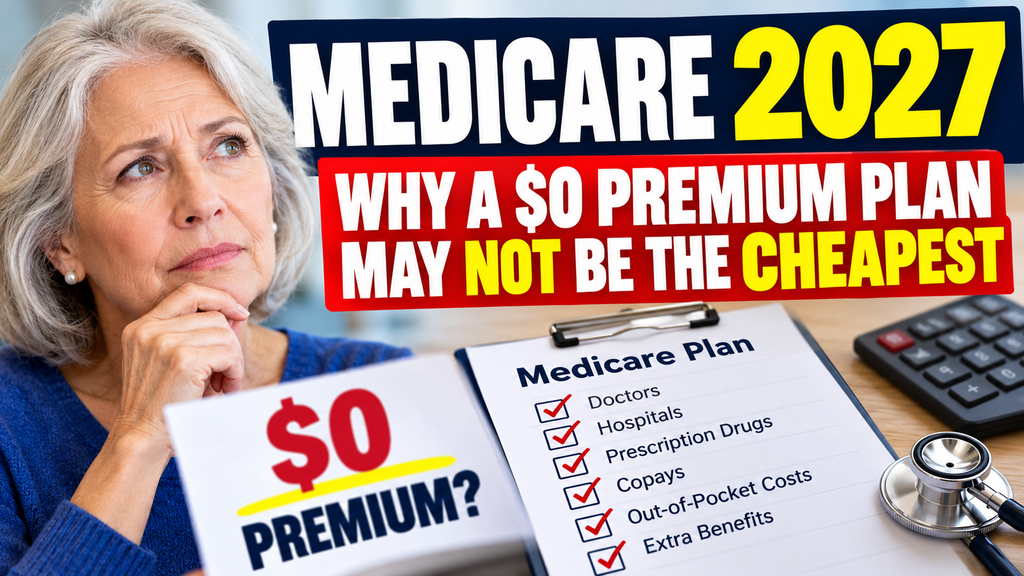
When you’re comparing Medicare plans for 2027, what’s the first number you look at?
For many people, it’s the monthly premium.
$0 sounds better than $50.
$50 sounds better than $100.
That’s understandable.
But here’s the problem:
The Medicare plan with the lowest premium isn’t necessarily the plan that will cost you the least money.
In fact, the premium may be one of the least useful numbers if you look at it by itself.
For 2027, Medicare beneficiaries need to look beyond the price on the front door and ask a much more important question:
What could this plan actually cost me if I need healthcare?
Premium Does Not Equal Cost
Let’s start with one of the most important ideas in Medicare:
PREMIUM ≠ COST
Your premium is simply the amount you pay each month to have the plan.
It doesn’t tell you what happens when you use it.
Depending on your Medicare Advantage plan, you may also have costs for:
Doctor visits.
Specialists.
Hospital stays.
Outpatient surgery.
Diagnostic tests.
Physical therapy.
Ambulance services.
Medical equipment.
Prescription drugs.
And other healthcare services.
A plan can have a very low monthly premium and still expose you to thousands of dollars in medical costs during a difficult year.
That doesn’t make it a bad plan.
It simply means you need to understand what you’re buying.
The $0 Premium Can Be Misleading
You’ve probably seen the advertisements.
“$0 premium Medicare Advantage plan.”
There’s nothing inherently wrong with a $0 premium Medicare Advantage plan.
For the right person, it may be an excellent choice.
But $0 premium does not mean $0 healthcare costs.
You generally must continue paying your Medicare Part B premium.
And when you receive healthcare through a Medicare Advantage plan, you may have copayments or coinsurance depending on the service and plan.
That’s why choosing a plan simply because it has a $0 premium can be a mistake.
Ask what happens after you walk through the doctor’s door.
Look at Your Specialist Copay
Suppose you see your primary care doctor a couple of times each year.
The copay may be very low or even $0 under some plans.
Wonderful.
But what happens if you develop a heart problem?
Now you may need a cardiologist.
What if you develop a neurological problem?
Now you may need a neurologist.
What about cancer?
You could suddenly have an oncologist, radiologist, surgeon and other specialists involved in your care.
A difference of $10 or $20 in a specialist copay might not seem significant.
Until you’re seeing specialists repeatedly.
That’s why Medicare shouldn’t be evaluated based solely on how you use healthcare when you’re healthy.
Ask what the plan looks like if your health changes.
Look at Hospital Costs
Hospital coverage deserves special attention.
Don’t simply ask:
“Is the hospital covered?”
Ask:
“What will I pay?”
Depending on the plan, inpatient hospital costs may be structured as copayments for a certain number of days or in another way permitted by Medicare.
Those numbers matter.
Suppose one plan saves you several hundred dollars per year in premiums.
That looks terrific.
But if another plan provides significantly better cost sharing for services you’re likely to use, the calculation can change quickly.
This is why comparing Medicare plans isn’t as simple as comparing two price tags.
Then Look at the Maximum Out-of-Pocket Limit
This is one of the most important numbers on a Medicare Advantage plan.
And many beneficiaries barely look at it.
Medicare Advantage plans have an annual maximum out-of-pocket limit for covered Part A and Part B services.
Think of this number as a measure of your potential exposure during a bad medical year.
It doesn’t mean you’re going to spend that amount.
Most people won’t.
But ask yourself:
If something serious happened, could I afford it?
That’s a very different question from:
What’s my monthly premium?
And remember that not every expense necessarily counts toward the medical maximum out-of-pocket limit. Prescription drug costs, for example, operate under separate Medicare Part D rules.
Understanding what is and isn’t included matters.
Your Doctors Can Change the Financial Equation
Now suppose you’ve found a plan with an attractive premium.
The copays look reasonable.
The maximum out-of-pocket limit looks acceptable.
There’s one more question.
Are your doctors in the network?
This can completely change the decision.
Don’t check only your primary care doctor.
Check the specialists you use.
And check the specific plan, not merely the insurance company.
An insurance company may offer several Medicare Advantage plans.
A physician participating with one network doesn’t automatically mean that physician participates with every plan offered by that company.
Provider networks can also change.
For 2027, verify the doctors who actually matter to you.
Don’t Forget the Hospital
Here’s another mistake people make.
They check the doctor but forget the hospital.
Suppose your cardiologist participates in your plan.
Great.
Where does your cardiologist admit patients?
What hospital would you want to use if you needed surgery?
What hospital is closest to you?
What if you routinely cross into another county for medical care?
Medicare doesn’t happen on a map.
It happens wherever you actually receive healthcare.
Check the hospital.
Prescription Drugs Can Change Everything
Now let’s talk about medications.
Two Medicare Advantage plans can look very similar medically and produce very different prescription drug costs.
Before choosing your 2027 coverage, make a complete medication list.
Include the exact drug name.
Dosage.
How often you take it.
And your preferred pharmacy.
Then compare.
Is the drug on the formulary?
What tier is it?
Is prior authorization required?
Are there quantity limits?
Would another pharmacy cost less?
This becomes particularly important if you take expensive medications.
Never assume that because a drug was covered favorably this year, it will be covered exactly the same way next year.
Check.
What About Dental, Vision and OTC?
These benefits matter.
Dental coverage can be valuable.
So can eyeglasses.
Hearing benefits.
Over-the-counter allowances.
Fitness programs.
Transportation.
And other supplemental benefits.
But here’s where people can get distracted.
Imagine Plan A gives you a larger OTC allowance than Plan B.
Sounds good.
But Plan B includes your doctors, your hospital and better cost sharing for the services you actually use.
Which is more valuable?
Probably Plan B.
Don’t let a relatively small extra benefit determine a decision involving potentially thousands of dollars in healthcare.
Start with healthcare.
Then look at the extras.
What About Part B Givebacks?
A Part B giveback can certainly be attractive.
Who doesn’t like getting money back?
But once again, don’t evaluate it in isolation.
Suppose one Medicare Advantage plan reduces part of your Part B premium.
Before choosing it, check:
Your doctors.
Your hospitals.
Your medications.
Your specialist copays.
Your hospital costs.
Your maximum out-of-pocket limit.
And your other benefits.
A giveback is a benefit.
It isn’t the entire plan.
Think About Medicare as Insurance
Insurance is unusual.
We’re buying something we hope we don’t need very much.
If you stay healthy all year, the least expensive plan may look brilliant.
But insurance isn’t primarily designed for the year when nothing happens.
It’s there for the year when something does.
Cancer.
A stroke.
A heart attack.
A fall.
A hip replacement.
An unexpected diagnosis.
That’s when the structure of your Medicare coverage becomes much more important.
This doesn’t mean you should automatically buy the plan with the richest benefits or highest premium.
It means you should understand your financial exposure.
Medicare Advantage Versus Medicare Supplement
The same principle applies when comparing Medicare Advantage with Original Medicare plus a Medicare Supplement policy.
A Medicare Supplement may involve a substantially higher monthly premium.
You may also need separate prescription drug coverage.
At first glance, Medicare Advantage may therefore appear much less expensive.
But these approaches manage healthcare expenses differently.
With Medicare Advantage, you may pay lower premiums but have copays and coinsurance as you receive services, subject to the plan’s rules and medical maximum out-of-pocket protection.
With certain Medicare Supplement plans, you pay more in predictable premiums in exchange for reducing many of the unpredictable costs associated with Original Medicare covered services.
Neither approach is automatically right for everybody.
The question is:
Which financial structure works for you?
That’s why I often say Medicare is not just a medical decision.
Medicare is a financial decision.
Think About Your Health Today
Your current health matters.
What doctors are you seeing?
What medications are you taking?
What medical procedures might you need?
How frequently do you use healthcare?
Those are reasonable questions.
But there’s another question.
What happens if my health changes?
None of us can predict that perfectly.
That’s what insurance is for.
You don’t need to plan for every possible catastrophe.
But you should understand how your coverage responds when you need more healthcare than you expected.
Your Annual Notice of Change Matters
If you already have a Medicare Advantage plan, don’t automatically assume you need to change it for 2027.
Your current plan may still be your best choice.
But don’t automatically keep it either.
Review your Annual Notice of Change.
Look at what’s changing.
Premium.
Copays.
Drug coverage.
Provider network.
Maximum out-of-pocket exposure.
Dental.
Vision.
OTC.
And the benefits you personally use.
Then compare those changes against your needs.
The purpose of Annual Enrollment isn’t to change plans every year.
It’s to make sure your existing plan still fits.
Don’t Change Because of an Advertisement
During Medicare enrollment season, you’re going to see plenty of advertising.
Television.
Mail.
Phone calls.
Internet ads.
Maybe even somebody telling you about a wonderful plan their neighbor has.
Be careful.
Your neighbor doesn’t have your doctors.
Your neighbor doesn’t take your medications.
Your neighbor doesn’t necessarily use your hospital.
And your neighbor doesn’t have your financial situation.
The best Medicare plan for your neighbor could be the wrong Medicare plan for you.
Medicare is personal.
Don’t Stay Because of Habit Either
There’s another side to this.
Some people have been in the same plan for years.
They know the insurance card.
They know the company.
Everything feels familiar.
So they automatically renew.
That can also be a mistake.
Plans change.
Networks change.
Benefits change.
Your health changes.
Your medications change.
Your financial situation changes.
Familiar doesn’t automatically mean appropriate.
The Five Numbers I Would Check
Before keeping or changing a Medicare Advantage plan for 2027, look at these five areas:
Your monthly premium.
Your specialist copay.
Your hospital cost sharing.
Your maximum out-of-pocket limit.
Your prescription drug costs.
Then check your doctors and hospitals.
Those pieces will tell you much more than the advertisement.
Take Your Time
One of the biggest changes in Medicare shopping is that seniors no longer have to depend entirely on someone sitting across the kitchen table explaining plans.
You can educate yourself.
You can ask questions.
You can compare.
You can check your doctors.
You can check your medications.
And you can make the decision when you’re ready.
That’s the philosophy behind MedicareSelfEnroll.com.
Education first. Enrollment second.
Learn.
Ask.
Compare.
Decide.
Enroll.
We don’t believe the objective should be to sell you a Medicare plan.
The objective should be to help you understand your choices.
Because once you understand them, you’re in a much better position to decide for yourself.
Before You Choose the Cheapest Plan
So when you compare Medicare coverage for 2027, don’t automatically choose the plan with the lowest premium.
And don’t automatically choose the plan with the most benefits.
Instead, ask:
Are my doctors there?
Is my hospital there?
Are my prescriptions covered?
What will I pay when I actually use healthcare?
What’s my financial exposure if I become seriously ill?
And are the extra benefits useful to me?
Then make your decision.
The cheapest Medicare plan isn’t necessarily the plan with the lowest premium.
The cheapest plan may be the one that costs you the least when you actually need it.
That’s the difference between shopping for a premium and shopping for healthcare.
Medicare is changing.
The way you shop for Medicare should change also.
Before you enroll, educate yourself.
Visit MedicareSelfEnroll.com.
Learn.
Ask.
Compare.
Decide.
And enroll with confidence.

William Vargas brings over 50 years of financial and insurance expertise to every Medicare conversation. He operates MedicareSelfEnroll.com, helping seniors in Florida, New York, and North Carolina — with no pressure, no phone calls required.