In This Article
- Why Hospital Outpatient Costs Can Be So Confusing
- Proposed Lower Payments for Certain Hospital Outpatient Imaging
- A Major Proposal Affecting 340B Hospital Drugs
- Who Might Benefit From the 340B Change?
- Lower Drug Payments Do Not Mean Hospitals Simply Lose the Money
- Another Proposed Adjustment Could Affect Hospital Payments
- Prior Authorization for Additional Botox-Related Services
- Hospital Price Transparency May Get Another Makeover
- Medicare Outpatient Payment Rates Would Also Increase
- Negotiated Part D Drug Prices Are Also Expanding in 2027
- What Medicare Beneficiaries Should Do Now
- The Bottom Line
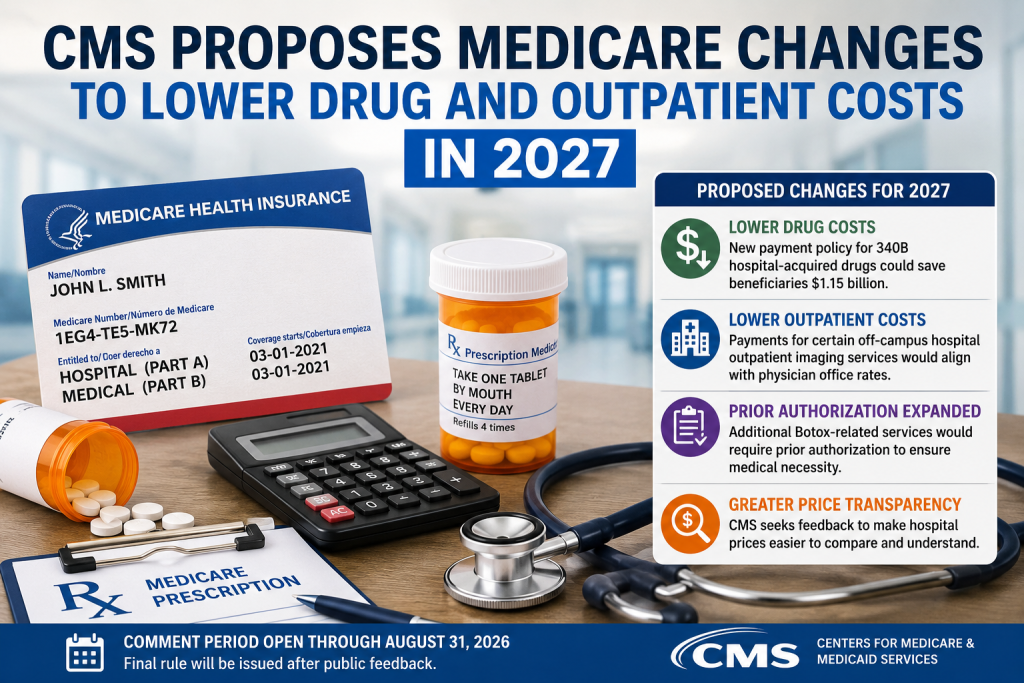
Lower drug prices. Fairer outpatient bills. Fewer location-based surprises.
The Centers for Medicare & Medicaid Services has proposed significant changes to the way Medicare pays for certain prescription drugs, imaging services and hospital outpatient care beginning in 2027.
The proposals could reduce some out-of-pocket costs for people enrolled in Original Medicare, particularly those receiving expensive medications in hospital outpatient departments or undergoing imaging at off-campus hospital facilities.
However, there is one important word beneficiaries must not overlook:
Proposed.
CMS announced the Calendar Year 2027 Hospital Outpatient Prospective Payment System and Ambulatory Surgical Center proposed rule on July 2, 2026. The agency will consider public comments before issuing a final rule. Until that happens, the proposals are not guaranteed to take effect exactly as written.
Even so, the proposal reveals where Medicare policy appears to be heading: toward reducing payments that CMS believes exceed actual costs, limiting higher charges caused solely by where a service is performed and making hospital prices easier for patients to understand.
For seniors already struggling with premiums, deductibles, coinsurance and prescription expenses, this is a development worth watching carefully.
Why Hospital Outpatient Costs Can Be So Confusing
Many Medicare beneficiaries assume that an X-ray is an X-ray and an infusion is an infusion.
Unfortunately, Medicare bills do not always work that way.
The amount Medicare pays—and the amount a beneficiary may owe—can depend heavily on where the service is delivered.
A medical test performed in an independent physician’s office may cost less than the same test performed in a hospital outpatient department. This can happen even when the equipment, procedure and medical purpose are essentially the same.
Hospital systems have also purchased physician practices and converted them into hospital-owned outpatient departments. A patient may continue visiting what appears to be the same neighborhood clinic, yet the billing classification changes.
Suddenly, the patient may encounter higher facility-related charges or cost sharing.
This is sometimes called a site-of-care payment difference. In plain English, Medicare may pay more because of the address on the building rather than because the patient received more complicated care.
CMS is proposing to narrow some of those differences in 2027.
That could be particularly important for seniors who regularly need imaging, injections, infusions or outpatient procedures.
Proposed Lower Payments for Certain Hospital Outpatient Imaging
One of the most consumer-focused parts of the proposal involves imaging services performed without contrast.
Examples may include certain X-rays, ultrasounds, CT scans or MRIs, depending on how the service is classified and billed.
CMS is proposing to pay a physician-office-equivalent rate for covered non-contrast imaging performed at certain off-campus hospital outpatient departments.
The proposal would apply to off-campus provider-based departments that currently qualify for exceptions allowing them to receive higher hospital outpatient rates.
CMS argues that beneficiaries should not face higher premiums and cost sharing simply because an imaging service is performed in a hospital-owned outpatient location rather than a physician’s office or independent facility.
The agency estimates that the change could reduce Medicare Part B spending by approximately $260 million during its first year. That estimate includes about $190 million in Medicare savings and approximately $70 million in lower beneficiary premiums. CMS also estimates that beneficiary cost-sharing obligations could fall by another $70 million.
Those are systemwide estimates, not guaranteed savings for every individual.
A person’s actual bill would still depend on the procedure, the provider, Medicare’s approved amount and whether the beneficiary has supplemental coverage.
Nevertheless, the basic principle is easy to understand:
The same routine test should not automatically cost more just because a hospital owns the building.
This issue is closely related to the broader questions discussed in our guide to understanding the real costs behind Medicare coverage. Premiums receive most of the attention, but the location and billing category of medical services can also affect what beneficiaries ultimately pay.
A Major Proposal Affecting 340B Hospital Drugs
The largest projected savings in the rule involve medications purchased by hospitals through the federal 340B Drug Pricing Program.
The 340B program allows eligible hospitals and other healthcare organizations to purchase certain outpatient drugs at substantial discounts from manufacturers.
The program was intended to help qualifying healthcare providers stretch limited resources and serve vulnerable populations.
The controversy arises because Medicare payments for these drugs have not always reflected the deeply discounted prices hospitals actually paid.
CMS conducted a hospital acquisition-cost survey from January through early April 2026. According to the agency, the survey revealed significant differences between the cost of drugs obtained through the 340B program and the cost of drugs purchased outside it.
CMS reported that, in some cases, the beneficiary’s required cost sharing—typically 20% of Medicare’s payment amount—was greater than the hospital’s entire acquisition cost for the medication.
Think about that for a moment.
A patient could theoretically be responsible for an amount larger than what the hospital paid to obtain the drug.
That is the kind of healthcare mathematics that makes ordinary people wonder whether the calculator needs medical attention.
For 2027, CMS is proposing to pay for affected 340B-acquired drugs at the drug’s average sales price minus 33.4%.
CMS estimates that this proposal could reduce Original Medicare drug payments by approximately $4.55 billion and lower beneficiary drug costs by approximately $1.15 billion during 2027.
Combined, CMS projects about $5.7 billion in reduced drug spending during the first year.
Who Might Benefit From the 340B Change?
The proposed 340B payment change would be most relevant to people receiving separately payable drugs through hospital outpatient departments.
These might include medications administered by infusion or injection for conditions such as:
- Cancer
- Rheumatoid arthritis
- Autoimmune diseases
- Macular degeneration
- Osteoporosis
- Neurological disorders
- Other serious chronic illnesses
The exact effect would depend on whether the hospital obtained the drug through the 340B program and how Medicare classifies and pays for it.
This proposal is not the same as reducing the price of every prescription filled at a neighborhood pharmacy.
It primarily concerns drugs paid through Medicare’s hospital outpatient payment system, often under Part B.
That distinction matters because Medicare drug coverage is divided between Part B and Part D.
Part B commonly covers certain medications administered by a physician or medical facility. Part D generally covers self-administered prescription drugs obtained through a pharmacy.
A beneficiary receiving an infusion in a hospital outpatient department may therefore experience a very different payment system from someone picking up pills at a retail pharmacy.
For a broader explanation of how medication costs are changing, see The New Arthritis Revolution: Better Drugs, Lower Costs, which discusses how biosimilars and Medicare negotiations are beginning to affect the price of some high-cost treatments.
Lower Drug Payments Do Not Mean Hospitals Simply Lose the Money
There is an important complication.
Federal law requires the proposed 340B policy to be implemented in a budget-neutral manner within the outpatient payment system.
That means Medicare cannot simply remove billions of dollars from drug payments and keep all the savings inside the hospital payment system.
CMS would redistribute an equivalent amount by increasing payments for non-drug outpatient services.
In other words, drug payments would decrease, while payments for other hospital outpatient services would rise.
That does not erase the projected savings for beneficiaries receiving the affected drugs. Their coinsurance is generally connected to the Medicare-approved drug payment, so lowering that payment could lower their responsibility.
However, the redistribution means the proposal is not simply a blanket reduction in all hospital spending.
This is why Medicare announcements must be read beyond the headline.
“CMS cuts drug costs” sounds wonderfully simple.
The actual policy is closer to: “CMS proposes reducing payments for certain discounted outpatient drugs while redistributing money across other services to maintain budget neutrality.”
Not quite as catchy, but much more accurate.
Another Proposed Adjustment Could Affect Hospital Payments
CMS is also proposing a separate 3% reduction to the payment conversion factor for certain non-drug hospital outpatient services beginning in 2027.
This is connected to an earlier legal dispute and subsequent remedy involving Medicare’s previous 340B payment policy.
CMS had planned to recover prior payment adjustments gradually through a 0.5% annual reduction. The agency is now proposing to accelerate that adjustment to 3% per year, with the reduction expected to continue until the required amount has been recovered—currently estimated to occur in 2029.
This part of the proposal is highly technical, but beneficiaries should understand the larger point:
Hospital payment changes can involve several moving pieces at once.
One policy may lower cost sharing for a drug, while another changes how Medicare pays for non-drug services.
It would therefore be premature to claim that every outpatient visit will become cheaper in 2027.
Some targeted expenses could fall, but the final effect will vary by service and facility.
Prior Authorization for Additional Botox-Related Services
CMS is also proposing to expand prior authorization requirements for eight additional botulinum toxin injection billing codes in hospital outpatient departments.
Botulinum toxin is widely recognized by the brand name Botox, but it is used for much more than cosmetic wrinkle treatment.
Medicare may cover botulinum toxin injections when medically necessary for conditions such as muscle spasticity, chronic migraine, cervical dystonia, overactive bladder and certain eye disorders.
CMS reported that claims volume for the affected procedures increased by 42.8% from 2017 through 2024, even though the overall volume of hospital outpatient services declined. The agency said it did not identify a clear clinical explanation for that increase.
Under the proposal, providers would need to obtain prior authorization for the additional services before Medicare would pay.
CMS estimates that the policy could produce more than $17 million in net annual savings.
The agency presents prior authorization as a way to ensure that services are medically necessary and reduce improper payments.
But beneficiaries should remain watchful.
Prior authorization can prevent waste, yet it can also delay legitimate care when the process becomes slow, confusing or overly rigid.
A senior with a painful neurological condition should not become the rope in a tug-of-war between a doctor and a billing department.
The real test will be whether CMS can reduce unnecessary services without creating unreasonable delays for patients who genuinely need treatment.
Hospital Price Transparency May Get Another Makeover
CMS is also seeking public feedback on how to improve hospital price transparency.
Hospitals have been required since 2021 to publish pricing information in machine-readable files and consumer-friendly formats.
In theory, that should allow patients to compare prices before receiving scheduled care.
In practice, the information can be inconsistent, incomplete and difficult to compare.
One hospital may describe a service differently from another. Prices may not clearly include associated fees, facility charges, laboratory services or other components of the final bill.
It is a little like comparing hotel prices when one website includes the resort fee, another hides it until checkout and a third lists only the price of the pillowcase.
CMS is requesting comments on ways to standardize hospital pricing data, improve accuracy and make consumer-facing tools more useful. The agency is also asking whether hospitals should provide clearer information about bundled and ancillary services.
For seniors, better transparency could be valuable when planning non-emergency imaging, outpatient surgery or other shoppable care.
But transparency alone does not guarantee affordability.
A clearly displayed high price is still a high price.
Medicare Outpatient Payment Rates Would Also Increase
CMS is proposing a 2.4% payment-rate increase for qualifying hospital outpatient departments in 2027.
The agency is proposing the same 2.4% update for ambulatory surgical centers that meet applicable quality-reporting requirements.
These increases are based on a projected 3.2% hospital market-basket increase, reduced by a 0.8-percentage-point productivity adjustment.
These payment increases are intended to reflect rising costs faced by medical facilities.
However, beneficiaries should not interpret a hospital payment increase as an automatic 2.4% increase in every copayment.
Medicare payment formulas, deductibles and coinsurance rules are more complicated than that.
The final 2027 Part B premium, deductible and other standard beneficiary amounts will be announced separately.
Negotiated Part D Drug Prices Are Also Expanding in 2027
Separate from the hospital outpatient proposal, Medicare’s Drug Price Negotiation Program will expand in 2027.
Negotiated prices for 15 additional Part D drugs are scheduled to take effect on January 1, 2027.
The selected medications include drugs used to treat diabetes, obesity, respiratory disease, cancer, digestive disorders, neurological conditions and inflammatory illnesses.
Among the selected products are Ozempic, Rybelsus and Wegovy; Trelegy Ellipta; Breo Ellipta; Otezla; Ibrance; Xtandi; Linzess; and several others.
These negotiated prices are already part of the drug-price negotiation process and should not be confused with the newly proposed outpatient payment changes.
Together, however, the two developments show that Medicare is applying pressure to drug costs through multiple channels:
- Negotiating prices for selected Part D medications
- Adjusting payments for discounted 340B outpatient drugs
- Encouraging lower-cost care settings
- Expanding scrutiny of utilization and billing
That does not mean every drug will become inexpensive. It does mean the era in which almost any price increase went unquestioned is facing greater resistance.
What Medicare Beneficiaries Should Do Now
Beneficiaries do not need to take immediate action because the outpatient provisions are still proposals.
However, several practical steps make sense.
First, ask where a scheduled test or procedure will be performed. A hospital-owned outpatient department may cost more than an independent facility.
Second, ask whether a less-expensive Medicare-approved location is available.
Third, before receiving an infusion or injection, request an estimate of your out-of-pocket responsibility. Ask whether the drug will be billed under Part B or Part D.
Fourth, review your Medicare coverage every year. Drug formularies, pharmacy networks, coinsurance and prior authorization rules can change.
Finally, never assume that the phrase “Medicare-approved” means “free.” Medicare approval confirms coverage conditions, not the absence of a bill.
The Bottom Line
CMS’s 2027 outpatient proposal could lower certain drug and imaging costs for people with Original Medicare.
The largest projected beneficiary savings would come from reducing Medicare payments for drugs hospitals purchase at substantial 340B discounts. CMS estimates that beneficiaries could collectively save approximately $1.15 billion on those drugs during 2027.
The proposal could also reduce cost sharing for certain non-contrast imaging services performed in off-campus hospital outpatient departments.
But these changes are not final.
They will not lower every outpatient bill, eliminate Part B coinsurance or guarantee that every senior pays less in 2027.
The honest conclusion is encouraging but cautious:
Medicare is beginning to challenge some of the payment differences and drug markups that have made outpatient care unnecessarily expensive.
That is progress.
But beneficiaries must continue asking three questions before non-emergency care:
What is being done?
Where is it being done?
What will I actually pay?
In modern healthcare, the location on the bill can matter almost as much as the treatment itself.
This article is for educational purposes only. Medicare proposals may change before they become final. Coverage and costs vary by beneficiary, provider, service and insurance plan.

William Vargas brings over 50 years of financial and insurance expertise to every Medicare conversation. He operates MedicareSelfEnroll.com, helping seniors in Florida, New York, and North Carolina — with no pressure, no phone calls required.