In This Article
- The Main Proposal: A 2.4% Overall Payment Increase
- Why Home Health Agencies May Still Be Concerned
- What Medicare Home Health Care Actually Covers
- Palliative Care Could Receive Greater Attention
- Faster Quality Information for Patients and Families
- Stronger Action Against Fraudulent or Unqualified Providers
- Durable Medical Equipment Changes
- What Families Should Do Now
- The Bottom Line
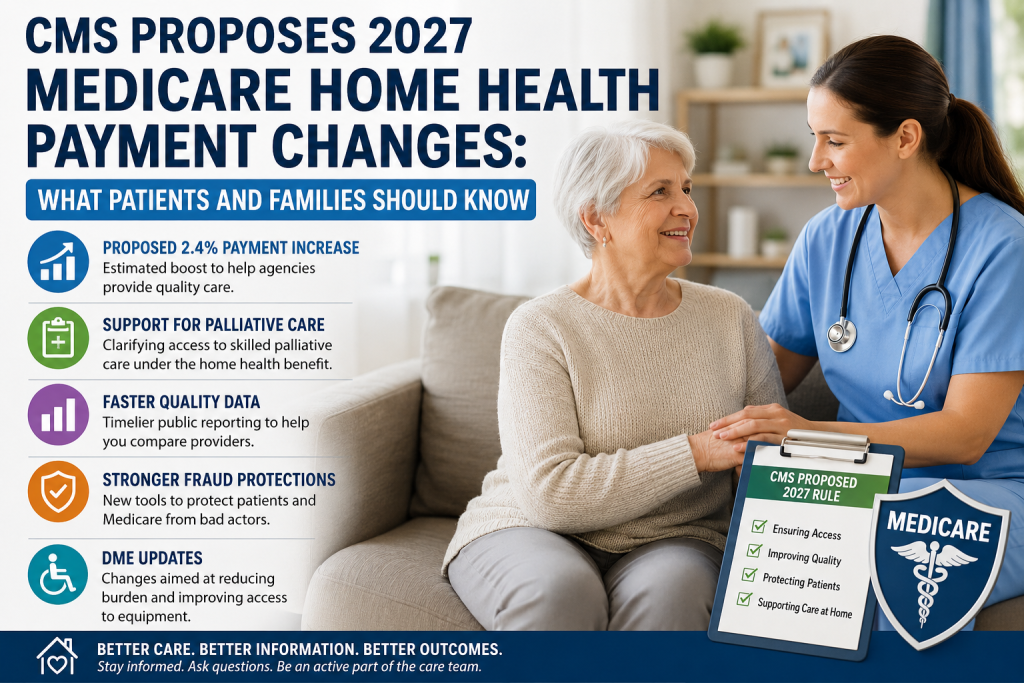
Medicare home health care can mean the difference between recovering safely at home and returning to the hospital.
That is why the Centers for Medicare & Medicaid Services’ proposed 2027 home health rule deserves attention—not only from home health agencies, doctors, and policymakers, but also from Medicare beneficiaries and family caregivers.
On July 1, 2026, CMS released its proposed Calendar Year 2027 Home Health Prospective Payment System rule. The proposal would increase Medicare payments to home health agencies overall, revise how certain payments are calculated, speed up the public reporting of quality information, strengthen protections against fraudulent providers, and clarify how palliative care may be delivered under the existing Medicare home health benefit.
The proposal is not yet final. CMS is accepting public comments through August 31, 2026, and the agency could revise some provisions before issuing the final rule.
Here is what Medicare patients and their families should know.
The Main Proposal: A 2.4% Overall Payment Increase
CMS estimates that total Medicare payments to home health agencies would increase by approximately 2.4% in 2027, or about $420 million, compared with 2026.
That estimate consists of:
- A proposed 2.1% annual home health payment update, adding approximately $370 million
- An estimated 0.3% increase related to changes in unusually costly, or “outlier,” cases, adding approximately $50 million
Combined, these changes produce the projected 2.4% overall increase.
For patients, this does not mean Medicare will deposit more money into their bank accounts or give every beneficiary additional home health visits.
The money would go to Medicare-certified home health agencies that provide covered services. However, payment levels can indirectly affect patients by influencing whether agencies can hire nurses and therapists, accept new Medicare patients, serve rural communities, and provide care promptly.
A payment increase may help support access. But the situation is more complicated than the 2.4% headline suggests.
Why Home Health Agencies May Still Be Concerned
The proposed rule includes a continued 3% temporary payment adjustment connected to the Patient-Driven Groupings Model, commonly called PDGM.
PDGM changed the way Medicare pays for home health care when it took effect in 2020. Among other changes, it moved Medicare from a 60-day payment episode to a 30-day payment period and based payment more directly on a patient’s clinical needs, functional condition, and other characteristics.
Congress required CMS to compare its original assumptions about provider behavior with what actually happened under the new system. When CMS concluded that Medicare had paid more than intended during previous years, the agency began applying adjustments designed to restore budget neutrality.
CMS applied a 3% temporary reduction for 2026 and proposes continuing that temporary adjustment in 2027. The agency says it has calculated approximately $4.9 billion in temporary adjustments that may eventually need to be recovered, although it has not established a complete timetable for recovering that amount.
This explains why an overall 2.4% increase does not necessarily mean every home health agency will feel financially comfortable.
Payment effects will vary by agency, patient mix, geographic area, wage levels, and the types of cases an agency handles. Some agencies could fare better than others.
For beneficiaries, the real question is not simply whether payments rise or fall. It is whether a Medicare-certified agency is available when care is needed.
What Medicare Home Health Care Actually Covers
Medicare home health care is not the same as unlimited household assistance or round-the-clock caregiving.
For eligible beneficiaries, Medicare may cover medically necessary, part-time or intermittent services such as:
- Skilled nursing care
- Physical therapy
- Speech-language pathology
- Continued occupational therapy
- Medical social services
- Certain home health aide services when the patient is also receiving qualifying skilled care
- Certain medical supplies used as part of the home health treatment plan
Medicare may cover home health care under Part A or Part B. Under Original Medicare, beneficiaries generally pay nothing for covered home health services, although they usually pay 20% of the Medicare-approved amount for covered durable medical equipment such as walkers, wheelchairs, or hospital beds.
A patient generally must be under the care of a doctor or another allowed healthcare professional, need qualifying skilled services, receive care through a Medicare-certified home health agency, and meet Medicare’s homebound requirements.
Being homebound does not necessarily mean a person can never leave the house. It generally means leaving home requires considerable effort, assistance, or special transportation, or that leaving home is medically inadvisable.
Medicare home health coverage can help a person recover, maintain their current condition, or slow further deterioration. It is not limited only to patients who are expected to make a complete recovery.
For a broader review of upcoming Medicare developments, see What Medicare Beneficiaries Should Know About Recent CMS Announcements.
Palliative Care Could Receive Greater Attention
One of the most meaningful patient-focused portions of the proposed rule concerns palliative care.
CMS states that skilled palliative care may be furnished and billed under the existing Medicare home health benefit when a patient otherwise qualifies for home health coverage. CMS also plans to provide additional examples and guidance after publication of the final 2027 rule.
Palliative care is specialized care intended to reduce symptoms, pain, stress, and the burden of serious illness.
It is important not to confuse palliative care with hospice.
Hospice generally focuses on comfort when a patient is believed to be approaching the end of life and elects the Medicare hospice benefit. Palliative care may be appropriate much earlier and can be provided while a person continues receiving treatment for the underlying illness.
For example, a patient being treated for cancer, heart failure, lung disease, kidney disease, or another serious condition may need skilled help managing pain, shortness of breath, medication side effects, weakness, wounds, or other symptoms at home.
CMS says the home health benefit can serve as an important part of the care continuum for people who need palliative services during serious illness or near the end of life.
For families, clearer guidance could make it easier to understand when skilled palliative services may fit within Medicare-covered home health care.
However, eligibility rules would still apply. The proposal does not create unlimited home-based custodial care, 24-hour nursing, housekeeping, meal preparation, or ongoing personal assistance unrelated to a skilled plan of care.
Faster Quality Information for Patients and Families
Choosing a home health agency is often done at a stressful moment.
A hospital may be preparing to discharge a patient. A spouse may suddenly need wound care. A parent may require physical therapy after surgery. Families may be handed a list of agencies and asked to make a decision quickly.
CMS currently collects clinical assessment information from home health agencies through the Outcome and Assessment Information Set, known as OASIS.
Under the proposed rule, CMS would shorten the final OASIS data-submission deadline from approximately 4½ months to 45 days. CMS estimates this could make publicly reported quality information available as much as three months sooner.
That matters because old information can hide recent improvement—or recent decline.
Medicare’s Care Compare system publishes home health quality information, including measures related to patient outcomes, evidence-based care practices, claims data, patient experiences, and star ratings.
More timely reporting could help patients compare agencies using information that better reflects current performance.
Still, families should not rely on a star rating alone. CMS itself advises using ratings together with other available information because ratings summarize only certain aspects of care.
When comparing home health agencies, ask:
- How soon can care begin?
- Does the agency have enough nurses and therapists?
- Does it provide the specific service the patient needs?
- How are urgent problems handled after normal business hours?
- Will the same clinicians return consistently?
- How does the agency communicate with the doctor?
- Is the agency in the patient’s Medicare Advantage network?
- What do the quality and patient-experience ratings show?
People with Original Medicare generally have more flexibility to use any Medicare-certified home health agency that accepts them. Medicare Advantage members may need to use agencies that participate in their plan’s network.
This is another reason beneficiaries should review their Medicare coverage carefully. Read New Medicare Benefits and Coverage Updates Seniors Should Know for additional information.
Stronger Action Against Fraudulent or Unqualified Providers
The proposed rule also contains several Medicare program-integrity provisions.
CMS proposes expanding its authority to deny or revoke Medicare enrollment for providers and suppliers that present serious concerns. The agency could act when a provider is located in a limited geographic area with an excessive concentration of providers associated with a high risk of fraud, waste, or abuse.
CMS also proposes broader authority to recover payments retroactively when a provider or supplier was not in compliance with Medicare requirements. Additional provisions would expand the circumstances in which a provider could face a reapplication bar after being denied enrollment.
Fraud prevention may sound like an administrative matter, but it has direct consequences for patients.
Fraudulent home health operations may bill Medicare for care that was never provided, pressure beneficiaries to accept unnecessary services, misuse Medicare identification numbers, or create false medical records.
Patients should be cautious when someone:
- Offers “free” home health care that was never ordered
- Requests a Medicare number before explaining the service
- Pressures the patient to sign incomplete paperwork
- Claims Medicare requires the patient to use one particular agency
- Sends clinicians the patient did not expect
- Bills for visits that never occurred
- Offers gifts or cash in exchange for Medicare information
Never give a Medicare number to an unsolicited caller merely because the caller claims to represent Medicare. Verify the agency, speak with the prescribing doctor, and review Medicare Summary Notices for unfamiliar services.
Durable Medical Equipment Changes
The proposed rule also addresses durable medical equipment, prosthetics, orthotics, and supplies, commonly shortened to DMEPOS.
CMS proposes clarifying that when a patient needs an identical replacement for certain equipment, a new order would still be required, but a new face-to-face medical encounter would not necessarily be required solely to support Medicare payment for the replacement item.
The proposal would also implement a statutory expansion involving certain external infusion pumps, associated home infusion drugs, and related supplies when specific criteria are met.
For some patients receiving complex treatments at home, these provisions could reduce unnecessary administrative steps and support access to appropriate equipment.
Remember, however, that Original Medicare generally applies 20% coinsurance to covered durable medical equipment after the applicable Part B deductible. Medicare Advantage costs and supplier-network requirements vary by plan.
What Families Should Do Now
No immediate action is required simply because CMS issued this proposal. The 2027 policies are not final, and most would not take effect before January 1, 2027.
Families can still prepare.
First, understand what Medicare home health care does and does not cover. Do not wait until a hospital discharge to learn the difference between skilled home health care, custodial care, private-duty caregiving, hospice, and long-term care.
Second, use Medicare’s provider comparison information before an emergency whenever possible. Identify several highly rated Medicare-certified agencies in your area and ask your doctors or local hospital which agencies reliably accept referrals.
Third, Medicare Advantage members should check which home health agencies participate in their plan network. A highly rated agency is not very useful if the plan will not cover it.
Fourth, keep records. Write down the dates of visits, names of clinicians, services provided, and any missed appointments. Compare those notes with Medicare statements and plan explanations of benefits.
Finally, speak up if covered care is being ended too soon. A home health agency generally must provide a Notice of Medicare Non-Coverage at least two days before covered services end, giving the beneficiary information about appeal rights.
The Bottom Line
CMS’s proposed 2027 rule would increase overall home health payments by an estimated 2.4%, continue a 3% temporary PDGM-related adjustment, improve the timeliness of public quality information, encourage appropriate palliative care under the home health benefit, strengthen action against problematic providers, and revise several equipment and enrollment policies.
The proposal does not guarantee that every community will have enough home health nurses, therapists, and aides. It also does not expand Medicare into an unlimited long-term caregiving program.
But the rule could influence how quickly patients receive care, which agencies remain available, how families compare providers, and how Medicare handles serious illness in the home.
The most important word is proposed.
CMS may change the rule after reviewing public comments submitted by August 31, 2026. Patients, caregivers, home health agencies, clinicians, and advocacy organizations should watch for the final rule later in 2026.
Medicare rules are complicated enough to make a healthy person need a nurse.
The practical response is to stay informed, verify coverage before care begins, compare available agencies, and never assume that Medicare home health care and long-term custodial care are the same thing.
For more Medicare news, CMS updates, fact checks, and enrollment education, visit MedicareSelfEnroll.com.
This article is for educational purposes and is not medical, legal, or insurance advice. Coverage depends on eligibility, medical necessity, provider participation, and the terms of a beneficiary’s Medicare coverage.

William Vargas brings over 50 years of financial and insurance expertise to every Medicare conversation. He operates MedicareSelfEnroll.com, helping seniors in Florida, New York, and North Carolina — with no pressure, no phone calls required.