In This Article
- CMS Updated Its Medicare Enrollment Guidance for 2026
- Medicare Enrollment Still Requires a Valid Election Period
- Why Comparing Plans Every Year Still Matters
- Medicare Plan Finder Added New Comparison Features for 2026
- Provider Directories Still Need to Be Verified
- CMS Is Streamlining Enrollment for 2027
- Medicare Star Ratings Are Also Changing
- Compare Total Costs, Not Just Premiums
- Drug Comparison Requires More Than Checking the Formulary
- Medigap Rights Deserve Special Attention
- A Better Comparison Process
- What Beneficiaries Should Do Now
- The Bottom Line
Choosing Medicare coverage has never been as simple as selecting the plan with the lowest advertised premium.
A plan may look attractive until you discover that your doctor is outside its network, one of your prescriptions is placed on an expensive formulary tier, or an important benefit comes with restrictions that were not obvious during the initial comparison.
The Centers for Medicare & Medicaid Services, commonly known as CMS, has been updating Medicare enrollment guidance and the tools beneficiaries use to compare Medicare Advantage and Medicare Part D plans. Some changes are already being used for 2026 enrollment requests, while additional improvements are scheduled to affect the 2027 plan year.
The overall direction is clear: CMS wants beneficiaries to receive more useful information, experience fewer administrative obstacles and make more informed comparisons before enrolling.
However, better tools do not eliminate the need to examine the details carefully.
Here is what Medicare beneficiaries and their families should understand.
CMS Updated Its Medicare Enrollment Guidance for 2026
CMS issued updated Medicare Advantage and Part D enrollment and disenrollment guidance that applies to enrollment requests received on or after January 1, 2026.
The guidance includes clearer information concerning:
- Medigap guaranteed-issue rights and applicable timeframes
- Special Enrollment Periods for certain people who receive both Medicare and Medicaid
- Default enrollment procedures and their regulatory requirements
- Updated enrollment forms and notices used by Medicare plans
CMS also revised its model Medicare Advantage and Part D enrollment request forms for applications dated January 1, 2026, or later. Certain voluntary demographic questions were removed from the model forms.
These changes are largely administrative, but they matter because unclear forms, missed deadlines and misunderstood election periods can cause serious coverage problems.
A beneficiary may select an appropriate plan but still have an enrollment request delayed or rejected if the request is submitted outside a valid election period or required information is missing.
Medicare Enrollment Still Requires a Valid Election Period
CMS has not turned Medicare enrollment into an unrestricted, year-round shopping period.
To enroll in a Medicare Advantage or standalone Part D prescription drug plan, a person generally must:
- Meet the plan’s Medicare eligibility requirements
- Live within the plan’s service area
- Be lawfully present in the United States
- Submit a complete enrollment request
- Qualify for a valid election period
Medicare election periods include the Initial Enrollment Period, the Annual Enrollment Period, the Medicare Advantage Open Enrollment Period and various Special Enrollment Periods.
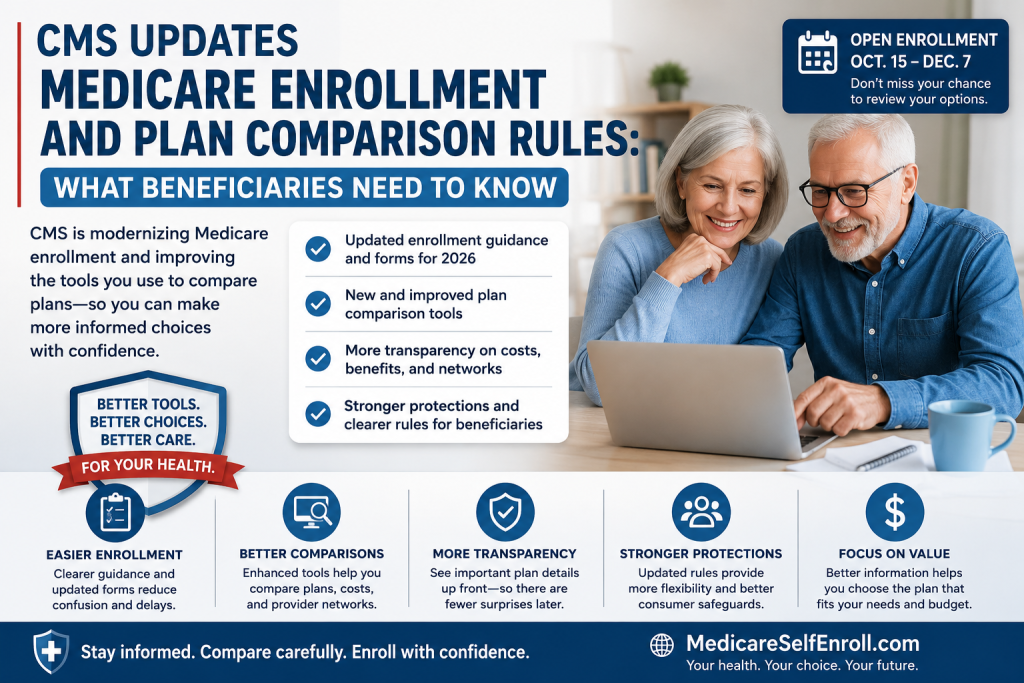
The annual Medicare Open Enrollment Period continues to run from October 15 through December 7. During this period, eligible beneficiaries may change Medicare Advantage plans, move between Medicare Advantage and Original Medicare, or change their Part D prescription drug coverage for the following year.
Beneficiaries who are satisfied with their existing coverage usually do not need to submit a new enrollment request, provided the plan continues to be offered and they remain eligible.
However, doing nothing should still be an informed decision—not an automatic habit.
Read our related guide, Do You Have to Re-Enroll in Medicare Every Year?, for a closer look at automatic renewal and annual plan changes.
Why Comparing Plans Every Year Still Matters
Medicare Advantage and Part D plans can change from one year to the next.
Changes may affect:
- Monthly premiums
- Medical deductibles
- Prescription drug deductibles
- Copayments and coinsurance
- Maximum out-of-pocket limits
- Provider networks
- Pharmacy networks
- Prescription formularies
- Drug tiers
- Prior-authorization requirements
- Supplemental benefits
- Service areas
CMS advises beneficiaries to review the Evidence of Coverage and Annual Notice of Change sent by their current plan. These documents explain how the plan will operate during the next coverage year.
Unfortunately, many people place the Annual Notice of Change in a drawer without reading it.
That can be an expensive mistake.
A plan that worked well this year may still be available next year but no longer cover an important drug in the same way. A preferred pharmacy may become standard or out-of-network. A physician may leave the plan’s provider network.
The plan name can remain the same while the financial consequences change considerably.
Our article Why More Seniors Are Comparing Medicare Plans Online explains why annual comparison is becoming an important part of Medicare planning.
Medicare Plan Finder Added New Comparison Features for 2026
CMS introduced several improvements to Medicare.gov and Medicare Plan Finder for the 2026 plan year.
These improvements included:
- Better tools for comparing whether plans include a beneficiary’s current providers
- More detailed information about supplemental benefits
- Additional filters based on individual preferences and healthcare needs
- Enhanced Medicare account security
- Expanded prescription-cost comparison features
- Development of an artificial-intelligence-powered prescription cost estimator across local pharmacies
CMS stated that the goal of these updates was to simplify the process of comparing Medicare Advantage and prescription drug coverage.
The provider comparison improvement is particularly important.
For years, Medicare Plan Finder allowed people to compare premiums, drug costs, deductibles, benefits and Star Ratings, but beneficiaries often had to leave Medicare.gov and search individual plan websites to investigate provider networks.
That created a fragmented process.
A person might compare costs on one website, search for doctors on another and then call a medical office to determine whether the information was accurate.
CMS has been moving toward incorporating provider-directory information more directly into Medicare Plan Finder so beneficiaries can make a more complete comparison in one place.
Provider Directories Still Need to Be Verified
Improved provider information is welcome, but beneficiaries should not assume that an online directory is infallible.
Provider directories can become outdated when:
- A physician leaves a network
- A hospital contract changes
- A medical group changes its plan participation
- A provider relocates
- A plan’s records have not yet been updated
- A doctor accepts one product from an insurer but not another
Before enrolling, confirm provider participation with both the plan and the provider’s office.
When speaking with the doctor’s office, provide the complete plan name—not merely the insurance company’s name.
For example, asking whether a doctor “takes Company X” may not produce a reliable answer. The insurer could offer several HMO and PPO products with different networks.
Ask whether the doctor participates in the specific plan and network you are considering.
Keep notes showing:
- The date of the call
- The person you spoke with
- The plan name
- The doctor or facility checked
- The response you received
This may feel overly cautious, but Medicare decisions deserve more care than ordering a pair of shoes online.
CMS Is Streamlining Enrollment for 2027
In April 2026, CMS issued its final Medicare Advantage and Part D rule for the 2027 contract year.
The rule includes changes intended to simplify plan choices, improve quality comparisons and streamline certain enrollment procedures.
One important area involves Special Enrollment Periods.
CMS addressed circumstances in which a beneficiary’s provider leaves a Medicare Advantage plan’s network during the year. Under the previous framework, access to a Special Enrollment Period could depend on whether the network change was formally considered significant.
The updated direction is intended to make it easier for affected beneficiaries to change coverage when a provider they rely on leaves the network, rather than forcing them to remain in a plan that no longer fits their medical needs.
This does not necessarily mean that every provider departure will automatically allow every beneficiary to change plans.
Eligibility, timing and CMS requirements still matter.
Anyone affected by a midyear network change should contact the plan, 1-800-MEDICARE or a properly licensed Medicare professional before submitting a new enrollment request.
Medicare Star Ratings Are Also Changing
CMS uses Medicare Star Ratings to help beneficiaries compare the quality and performance of Medicare Advantage and Part D plans.
Plans receive ratings ranging from one to five stars.
The rating system considers areas such as:
- Health outcomes
- Preventive care
- Chronic-condition management
- Member experience
- Customer service
- Complaints
- Access to medications and healthcare services
The 2027 final rule updates the measurements used in the Star Ratings programme and places greater emphasis on areas where CMS believes meaningful differences in quality and patient outcomes remain.
Star Ratings are useful, but they should not be the only factor used to select coverage.
A highly rated plan may still exclude your physician, charge more for your prescriptions or use a network that is inconvenient for you.
Likewise, a lower-rated plan is not necessarily wrong for every beneficiary.
Quality ratings are one piece of the comparison—not the entire decision.
Compare Total Costs, Not Just Premiums
One of the most common Medicare comparison mistakes is focusing almost entirely on the monthly premium.
A plan with a £0—or, in the United States, $0—monthly premium is not a plan with no costs.
You may still pay:
- The Medicare Part B premium
- Medical copayments
- Hospital copayments
- Coinsurance
- Prescription expenses
- Out-of-network charges
- Costs for services requiring prior authorisation
- Expenses up to the plan’s annual maximum out-of-pocket limit
A higher-premium plan may sometimes produce lower total costs for someone who expects to use frequent medical care.
A lower-premium plan may be appropriate for another person.
The correct question is not:
“Which plan has the lowest premium?”
The better question is:
“Which plan gives me the most appropriate coverage at the lowest realistic total cost?”
Read Why a $0 Medicare Advantage Premium Does Not Mean Free Healthcare for more information about evaluating the complete financial picture.
Drug Comparison Requires More Than Checking the Formulary
Seeing that a medication appears on a plan’s drug list is only the beginning.
Beneficiaries should also determine:
- Which formulary tier applies
- The copayment or coinsurance amount
- Whether the drug is subject to prior authorisation
- Whether step therapy applies
- Whether quantity limits apply
- Which pharmacies are preferred
- Whether mail-order pricing is advantageous
- Whether the medication is covered throughout the year
- Whether an alternative drug may have lower costs
CMS has been improving prescription comparison tools because pharmacy selection can significantly affect out-of-pocket costs.
The same medication may have different prices at two pharmacies participating in the same plan.
Enter every regular prescription into the comparison system using the correct name, strength, quantity and refill frequency.
Do not compare plans using only one expensive medicine while forgetting the other six prescriptions you take every month.
The best comparison evaluates the complete medication list.
Medigap Rights Deserve Special Attention
CMS’s updated 2026 enrollment guidance includes clearer language concerning Medigap guaranteed-issue rights and timeframes.
This is important because moving from Medicare Advantage back to Original Medicare does not always guarantee that a person can purchase any Medicare Supplement plan without medical underwriting.
Federal guaranteed-issue protections apply in specific situations and during specific timeframes. State rules may provide additional protections.
Someone who leaves Medicare Advantage without understanding their Medigap eligibility could find themselves enrolled in Original Medicare but unable to obtain the Medicare Supplement coverage they expected.
Before making the change, verify:
- Whether a guaranteed-issue right applies
- Which Medigap plans are available under that right
- The application deadline
- Whether state protections apply
- Whether medical underwriting may be required
- When the new coverage would begin
Do not cancel existing coverage until the replacement coverage and effective date have been properly confirmed.
A Better Comparison Process
A thorough Medicare plan comparison should follow a logical order.
Begin with your healthcare needs—not with television advertising.
First, list your doctors, specialists, hospitals and preferred medical facilities.
Second, prepare a complete prescription list with dosage and refill information.
Third, estimate how frequently you expect to use medical care.
Fourth, compare:
- Premiums
- Deductibles
- Medical copayments
- Drug costs
- Provider networks
- Pharmacy networks
- Maximum out-of-pocket exposure
- Prior-authorisation rules
- Supplemental benefits
- Star Ratings
Finally, confirm important information directly before enrolling.
Advertising can tell you that a plan exists.
It cannot tell you whether that plan fits your health, medications, doctors and financial circumstances.
What Beneficiaries Should Do Now
The updated CMS rules and comparison tools are useful, but beneficiaries still need to participate actively in the decision.
Review your Annual Notice of Change.
Check your prescriptions.
Confirm your providers.
Compare estimated annual costs.
Understand the plan’s network rules.
Investigate prior authorisation requirements.
And make sure you are using a valid enrollment period.
People who want to keep their existing coverage generally do not need to re-enroll, but they should still verify that the plan remains suitable for the coming year.
The Bottom Line
CMS is making meaningful changes to Medicare enrollment procedures and plan-comparison tools.
For 2026, beneficiaries are seeing updated enrollment forms, clearer guidance and improved Medicare Plan Finder features.
For 2027, CMS is moving toward simpler enrollment processes, updated quality comparisons and greater flexibility for certain beneficiaries affected by provider network changes.
These changes can make Medicare shopping more transparent.
But no website, rating or government rule can make the decision completely automatic.
The right Medicare plan depends on where you live, which doctors you use, which medications you take, how often you need care and how much financial risk you are prepared to accept.
That is why Medicare Self Enroll believes comparison should provide more than a list of premiums.
It should provide privacy, clarity, control and confidence.
Visit MedicareSelfEnroll.com to compare Medicare plan options available in your area privately and at your own pace.
No pressure. No unnecessary sales calls. Just the information you need to make a more confident Medicare decision.
Medicare plan availability, benefits, provider networks, formularies and costs vary by plan and location. This article is for general educational purposes and is not legal, medical or individual insurance advice.

William Vargas brings over 50 years of financial and insurance expertise to every Medicare conversation. He operates MedicareSelfEnroll.com, helping seniors in Florida, New York, and North Carolina — with no pressure, no phone calls required.