In This Article
- The Biggest Protection: A $2,100 Part D Out-of-Pocket Limit
- The $2,100 Limit Is Not a Deductible
- The Drug Must Be Covered by Your Plan
- The Medicare Prescription Payment Plan Continues
- Negotiated Medicare Drug Prices Took Effect in 2026
- Why the Addition of Part B Drugs Matters
- Insulin Remains Limited to $35 per Month
- Many Recommended Adult Vaccines Cost Nothing
- Extra Help Can Reduce Costs Further
- Formularies and Pharmacies Still Determine What You Pay
- Prior Authorisation Has Not Disappeared
- Plans Can Change Every Year
- What Beneficiaries Should Do Now
- The Bottom Line
Prescription drug costs have frightened Medicare beneficiaries for years—and with good reason.
A person could choose a Medicare drug plan, pay the monthly premium faithfully and still face hundreds or even thousands of dollars at the pharmacy counter after being prescribed an expensive medication.
For beneficiaries taking drugs for cancer, rheumatoid arthritis, diabetes, heart disease or other serious conditions, the costs could continue climbing throughout the year. There was no simple point at which the bills necessarily stopped.
That is now changing.
The Centers for Medicare & Medicaid Services has implemented a collection of protections designed to make prescription costs more predictable and reduce the financial burden on people enrolled in Medicare Part D.
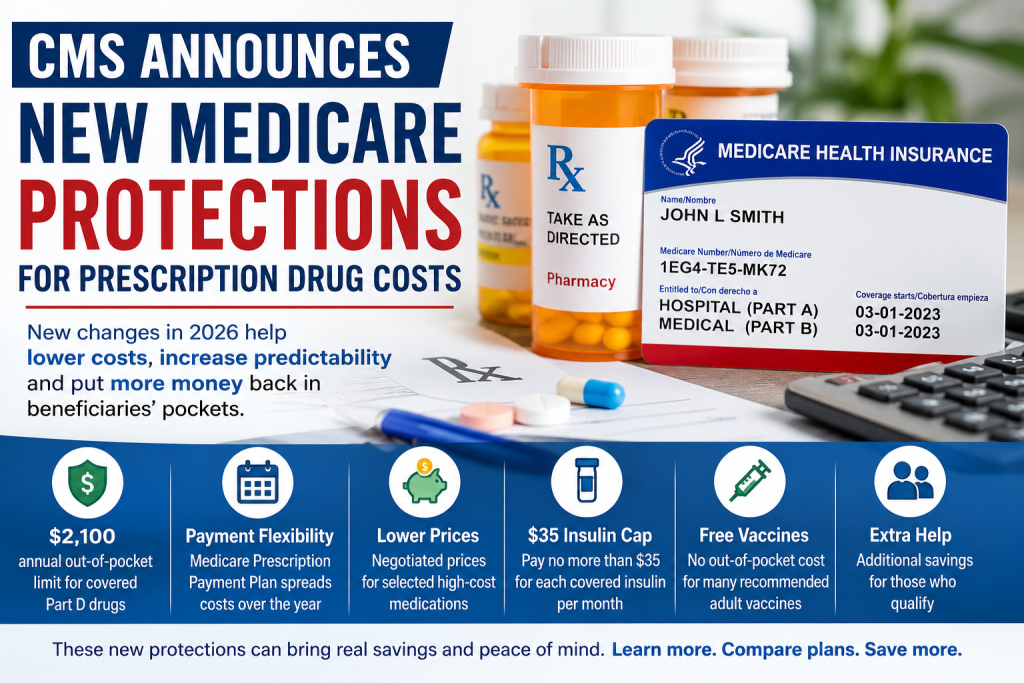
The most important protections for 2026 include:
- A $2,100 annual out-of-pocket limit for covered Part D prescriptions
- The continuation of the Medicare Prescription Payment Plan
- Negotiated prices for selected high-cost medications
- A $35 monthly limit on covered insulin products
- No out-of-pocket charge for many recommended adult vaccines
- Expanded Extra Help protections for qualifying beneficiaries
- New federal efforts to lower prices on additional Part B and Part D drugs
These changes represent real progress.
However, they do not mean every prescription is now inexpensive or that every beneficiary will automatically pay less.
Formularies, drug tiers, pharmacy networks, prior authorisation and plan selection still matter enormously.
The new protections create a stronger safety net, but beneficiaries still need to understand how that net works.
The Biggest Protection: A $2,100 Part D Out-of-Pocket Limit
The most significant change is the annual limit on what beneficiaries pay out of pocket for medications covered by Medicare Part D.
In 2026, qualifying out-of-pocket spending for covered Part D prescriptions is capped at $2,100. Once a beneficiary reaches that amount, the person generally pays no additional copayments or coinsurance for covered Part D drugs for the remainder of the calendar year.
The limit applies whether drug coverage comes through:
- A stand-alone Medicare Part D plan
- A Medicare Advantage plan that includes prescription coverage
This is a major departure from the old system.
Before the out-of-pocket cap began, beneficiaries who reached the catastrophic phase could still be required to pay a percentage of their medication costs. For someone using a drug priced at several thousand dollars a month, even a small percentage could be financially devastating.
The 2026 limit gives beneficiaries something they did not previously have:
A clear stopping point.
That does not make $2,100 a small amount. For a retiree living primarily on Social Security, it can still be a considerable financial burden.
But it is substantially better than having no firm annual ceiling.
For a fuller explanation of deductibles, copayments and other Medicare expenses, read How Do I Know What My Out-of-Pocket Costs Will Be in Medicare?.
The $2,100 Limit Is Not a Deductible
This point causes considerable confusion.
The $2,100 annual limit is not the amount every beneficiary must pay before drug coverage begins.
It is the maximum qualifying out-of-pocket amount for covered Part D drugs during the calendar year.
Your actual spending will depend on:
- Your medications
- Your plan’s formulary
- The drug tiers
- Your deductible
- Your copayments or coinsurance
- The pharmacy you use
- Whether you receive Extra Help
Some beneficiaries may spend only a few hundred dollars during the year. Others using expensive specialty medications may reach the $2,100 limit quickly.
The maximum Part D deductible allowed in 2026 is $615, although plans can charge a smaller deductible or no deductible at all.
That deductible is separate from the annual out-of-pocket limit.
Here is a simple way to think about it:
The deductible determines when the plan begins sharing certain drug costs.
The $2,100 limit determines when the beneficiary’s qualifying out-of-pocket responsibility for covered Part D drugs generally ends for the year.
The Drug Must Be Covered by Your Plan
Here comes the catch.
The annual out-of-pocket protection applies to drugs covered under Medicare Part D and recognised as part of the beneficiary’s qualifying drug spending.
It does not mean a plan must suddenly cover every medication a doctor prescribes.
Each plan maintains a formulary, which is the list of medications it covers.
A plan may:
- Exclude a particular medication
- Place it on a high-cost specialty tier
- Require prior authorisation
- Require step therapy
- Limit the quantity covered
- Require the use of a preferred pharmacy
If a medication is not covered and the beneficiary simply pays cash without obtaining an approved exception, that spending may not receive the same protection under the Part D benefit.
That is why the formulary remains one of the most important documents in Medicare.
The out-of-pocket cap protects you from unlimited spending on covered drugs. It does not transform a non-covered medication into a covered one.
For more details, see What Is Covered Under Medicare Part D Drug Plans?.
The Medicare Prescription Payment Plan Continues
Medicare also offers the Medicare Prescription Payment Plan.
This option allows beneficiaries to spread their out-of-pocket Part D drug costs across monthly payments instead of paying the entire amount at the pharmacy counter.
Suppose a beneficiary fills an expensive prescription early in the year and owes several hundred dollars.
Without the payment plan, the full amount might be due immediately.
With the payment plan, the beneficiary pays the plan over time according to Medicare’s monthly billing formula.
This can help people living on fixed incomes manage their cash flow and avoid a large pharmacy bill arriving all at once.
However, the payment plan is not a discount.
It does not reduce the total cost of the prescription.
It simply changes when the money is paid.
The $2,100 annual Part D cap applies whether or not someone enrols in the Medicare Prescription Payment Plan.
This distinction deserves repeating:
Payment option—not price reduction.
The programme may be most useful for beneficiaries who expect substantial drug costs early in the year. It may be less useful for someone whose prescription expenses are already small and predictable.
Beneficiaries can generally enrol through their Medicare drug plan and should contact the plan directly for billing details.
Negotiated Medicare Drug Prices Took Effect in 2026
Another important development began on January 1, 2026.
For the first time, negotiated Medicare prices took effect for ten selected high-cost Part D medications.
CMS reported negotiated price reductions ranging from 38% to 79% compared with the drugs’ list prices. The agency estimated that if those prices had been in effect in 2023, they would have reduced net covered prescription-drug spending by approximately $6 billion across the selected medications.
The first negotiated medications are used for conditions including:
- Diabetes
- Blood clots
- Heart failure
- Kidney disease
- Arthritis
- Certain blood cancers
- Other chronic or serious conditions
Patients should understand that a 60% reduction from the list price does not necessarily mean their pharmacy copayment will decline by exactly 60%.
What a beneficiary pays depends on the plan’s formulary, cost-sharing arrangement and benefit stage.
Still, negotiated prices can reduce overall Medicare spending and may lower costs for beneficiaries using the selected drugs.
CMS has negotiated prices for additional medications scheduled to take effect in 2027, and it selected more Part B and Part D drugs for negotiations whose prices are scheduled to begin in 2028.
That means the negotiation programme is not a one-time event.
It is gradually expanding.
Why the Addition of Part B Drugs Matters
Many people think all prescriptions fall under Part D.
They do not.
Certain medications administered in a doctor’s office, outpatient clinic or infusion centre are covered under Medicare Part B.
These can include:
- Chemotherapy drugs
- Infused medications
- Injectable treatments
- Certain medicines used with durable medical equipment
- Some physician-administered biological products
Part B drugs can be extraordinarily expensive.
CMS’s 2026 selection of medications for the third negotiation cycle included Part B drugs for the first time. Negotiations are taking place in 2026, with resulting prices scheduled to take effect on January 1, 2028.
This expansion is important because prescription affordability is not only a pharmacy-counter issue.
Some of the country’s most expensive treatments are administered in hospitals and physicians’ offices.
Insulin Remains Limited to $35 per Month
Medicare’s insulin protection continues.
For each covered insulin product, beneficiaries generally pay no more than $35 for a one-month supply under Medicare Part B or Part D, and no deductible applies to the insulin. A three-month supply generally cannot cost more than $105 for each covered product.
This protection can make a major difference for people with diabetes who require insulin consistently.
But beneficiaries must still verify that their particular insulin is covered by their plan.
One plan may cover one brand or formulation more favourably than another.
The $35 protection does not mean every insulin product is automatically included on every formulary.
Before choosing a Part D or Medicare Advantage plan, enter the exact insulin name, dosage and quantity into the plan-comparison system.
“Insulin” is not specific enough.
The exact product matters.
Many Recommended Adult Vaccines Cost Nothing
Medicare Part D plans cover commercially available vaccines when medically necessary to prevent illness.
Beneficiaries pay nothing out of pocket for adult vaccines recommended by the Advisory Committee on Immunization Practices and covered under Part D.
These may include vaccines for:
- Shingles
- Respiratory syncytial virus
- Tetanus
- Diphtheria
- Pertussis
Medicare Part B separately covers certain vaccines, including flu, COVID-19, pneumococcal and some hepatitis B vaccinations.
This protection removes a financial obstacle that once caused some beneficiaries to postpone or skip recommended vaccines.
The result is not merely a smaller pharmacy bill.
Preventing shingles, pneumonia or another serious illness can help avoid hospitalisation, prolonged pain and loss of independence.
Extra Help Can Reduce Costs Further
The Part D out-of-pocket limit is important, but many people with limited income and resources may qualify for even stronger assistance through Medicare’s Extra Help programme.
Extra Help can reduce:
- Part D premiums
- Deductibles
- Prescription copayments
- Other drug-plan expenses
Beneficiaries may qualify automatically if they receive certain forms of Medicaid, Supplemental Security Income or assistance from a Medicare Savings Program.
Others may need to apply through Social Security.
People should not assume they earn too much without checking the current eligibility rules.
A person can be careful with money for an entire lifetime and still miss a valuable programme because nobody explained it clearly.
Help is not automatically delivered with a marching band.
Sometimes you must apply.
Formularies and Pharmacies Still Determine What You Pay
The new federal protections are substantial, but Medicare drug plans are not identical.
Plans can still vary in:
- Monthly premiums
- Covered drugs
- Drug tiers
- Deductibles
- Preferred pharmacy networks
- Mail-order pricing
- Prior-authorisation requirements
- Step-therapy rules
- Coinsurance for specialty medications
The same prescription may cost considerably more under one plan than another.
A plan with the lowest monthly premium may have higher total annual drug costs.
This is why choosing a plan based only on the premium can be like choosing a restaurant because the parking is free.
The parking may be excellent.
The meal could still cost a fortune.
When comparing plans, enter every medication accurately, including:
- Drug name
- Dosage
- Quantity
- Frequency
- Preferred pharmacies
Then compare the estimated total annual cost—not merely the monthly premium.
Our article What Are the 3 Most Important Questions to Ask About Medicare? explains why prescription coverage should be one of the first questions in any plan comparison.
Prior Authorisation Has Not Disappeared
Affordability is only one part of prescription access.
A drug can appear on the formulary and still require approval before the plan will pay for it.
Prior authorisation may require the prescriber to demonstrate that:
- The medication is medically necessary
- The patient meets particular diagnostic requirements
- Other treatments have been tried
- The requested dosage is appropriate
- The drug is being used for a covered indication
If authorisation is denied, the beneficiary and physician may be able to request an exception or file an appeal.
Do not assume that the first denial is always the final answer.
At the same time, do not wait until the prescription is urgently needed to discover the rules.
For an expensive drug, ask the physician’s office and plan:
- Is prior authorisation required?
- Has it been submitted?
- What documentation is needed?
- How long does the review normally take?
- What is the appeal process?
Keeping records of calls, names, dates and reference numbers can make a difference when an issue must be escalated.
Plans Can Change Every Year
Medicare’s federal protections may remain in place while individual plan details change.
A Part D or Medicare Advantage plan can revise:
- Its premium
- Deductible
- Drug formulary
- Drug tiers
- Pharmacy network
- Copayments and coinsurance
- Prior-authorisation rules
Beneficiaries receive an Annual Notice of Change explaining what will be different in the following year.
Do not place that document in a drawer unopened.
A drug that was covered favourably this year may move to another tier next year. A pharmacy that was preferred may become standard or out of network.
Medicare’s Annual Enrollment Period runs from October 15 through December 7. That is the time when many beneficiaries can compare Part D and Medicare Advantage options for the coming year.
Our guide What Medicare Plans Are Available in My Area? explains why plan availability and prescription costs depend heavily on location.
What Beneficiaries Should Do Now
The new prescription protections are valuable, but beneficiaries must still take an active role.
Begin with these steps:
Review every medication
Make a complete list of prescriptions, dosages and quantities.
Confirm formulary coverage
Check each drug against the exact plan—not merely the insurance company’s name.
Compare pharmacies
A preferred pharmacy may charge less than a standard network pharmacy.
Ask about generics or alternatives
Never switch without medical guidance, but ask the prescriber whether a lower-cost covered option may be appropriate.
Investigate Extra Help
Do not assume you are ineligible.
Understand the payment plan
Use it for budgeting if helpful, but remember that it does not reduce the total cost.
Review coverage every fall
Plans and medications change.
Keep documentation
Record authorisations, appeals and important conversations.
Beneficiaries can compare available plans privately at MedicareSelfEnroll.com and review prescriptions, premiums and plan features side by side. The least expensive premium is not always the least expensive plan once actual medications are included.
The Bottom Line
CMS’s new and continuing Medicare prescription protections represent one of the most meaningful changes to Part D since the programme began.
The $2,100 annual out-of-pocket limit provides a clear ceiling for covered Part D drug spending in 2026.
The Medicare Prescription Payment Plan can spread large costs over the year.
Negotiated prices are beginning to take effect for selected expensive medications.
Insulin remains limited to $35 per covered monthly supply.
Many recommended adult vaccines carry no out-of-pocket cost.
And Extra Help can provide additional protection for qualifying beneficiaries.
These changes move Medicare in the right direction.
But they do not eliminate the need to compare plans.
The drug must still be covered.
The pharmacy still matters.
Prior authorisation may still be required.
And plan formularies can still change every year.
The new protections can prevent some of the worst prescription-cost surprises.
Beneficiaries must still do the homework needed to make those protections work.
The real goal is not simply to find the plan with the lowest premium.
It is to find coverage that protects your health, covers your medications and gives you the greatest confidence that an unexpected prescription will not become an unexpected financial crisis.
This article is for educational purposes only and is not legal, medical or insurance advice. Medicare plan benefits, formularies, premiums and coverage requirements vary by plan and location and may change each year. Review official plan documents and Medicare.gov before making enrollment decisions.

William Vargas brings over 50 years of financial and insurance expertise to every Medicare conversation. He operates MedicareSelfEnroll.com, helping seniors in Florida, New York, and North Carolina — with no pressure, no phone calls required.