In This Article
- Start With the Big Question: Original Medicare or Medicare Advantage?
- Compare the Monthly Premium, But Do Not Stop There
- Look at the Maximum Out-of-Pocket Cost
- Check Your Doctors First
- Compare HMO and PPO Plans Carefully
- Compare Prescription Drug Coverage
- Use Medicare’s Plan Finder, But Read the Details
- Compare Dental, Vision, and Hearing Benefits the Right Way
- Compare Star Ratings, But Do Not Worship Them
- Compare Travel Coverage and Flexibility
- Compare What Changed From Last Year
- Do Not Compare Plans Based on Someone Else’s Experience
- A Simple Side-by-Side Medicare Plan Checklist
- Why MedicareSelfEnroll.com Makes This Easier
- Final Thoughts: The Best Plan Is the Plan That Fits You
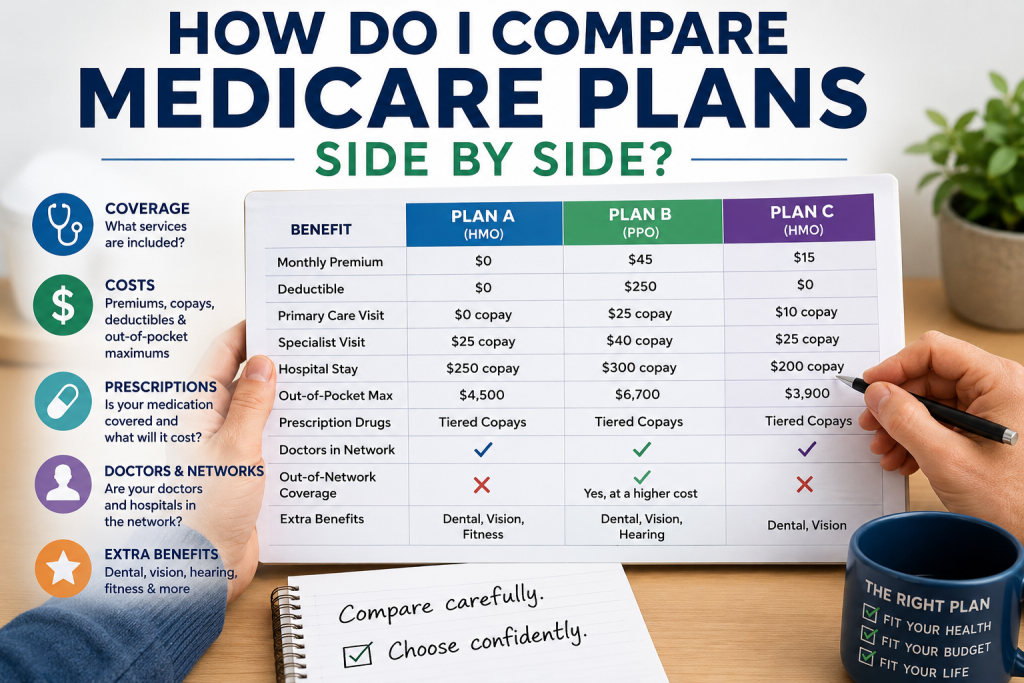
Comparing Medicare plans side by side sounds simple until you actually sit down to do it.
Then suddenly you are staring at premiums, copays, deductibles, drug tiers, doctor networks, dental benefits, star ratings, formularies, prior authorizations, referrals, out-of-pocket maximums, and about twelve other things that sound like they were invented by a committee that had too much coffee.
No wonder people get overwhelmed.
The good news is this: comparing Medicare plans does not have to be complicated if you know what to look for. The mistake many people make is comparing only the monthly premium. That is like buying a car by looking only at the color. It may look nice in the driveway, but you still need to know what is under the hood.
A Medicare plan should be compared based on how it works for your doctors, your prescriptions, your budget, your health needs, and your lifestyle.
That is the real side-by-side comparison.
At MedicareSelfEnroll.com, you can review Medicare plan options privately and at your own pace. No pressure. No one sitting at your kitchen table. No rushed decision. Just information, choices, and a way to compare what may fit your situation.
Start With the Big Question: Original Medicare or Medicare Advantage?
Before comparing individual plans, you need to understand what kind of coverage you are comparing.
Most people are choosing between two broad paths.
The first path is Original Medicare. This includes Medicare Part A for hospital coverage and Part B for medical coverage. Many people with Original Medicare also add a standalone Part D prescription drug plan and sometimes a Medicare Supplement plan, also called Medigap.
The second path is Medicare Advantage, also called Part C. These plans are offered by private insurance companies approved by Medicare. Medicare Advantage plans must cover the services Original Medicare covers, but they often include additional benefits such as dental, vision, hearing, fitness, transportation, and prescription drug coverage.
Medicare.gov has a helpful official page that lets you compare Original Medicare and Medicare Advantage. This is a good place to begin because the two choices work differently.
Original Medicare generally gives you broad access to doctors and hospitals that accept Medicare. Medicare Advantage usually works through a plan network, such as an HMO or PPO. That network difference is one of the most important things to understand.
A low premium means very little if your doctor is not in the plan.
Compare the Monthly Premium, But Do Not Stop There
The monthly premium is usually the first number people see. Some Medicare Advantage plans may have a low premium or even a zero-dollar premium. That can be attractive, especially for people on fixed incomes.
But the monthly premium is only one part of the total cost.
You also need to compare:
Monthly plan premium
Primary doctor copay
Specialist copay
Hospital copay
Emergency room copay
Prescription drug costs
Deductibles
Out-of-pocket maximum
Dental, vision, and hearing limits
Costs for out-of-network care, if available
This is where people can get fooled. A plan may have a very low monthly premium but higher costs when you actually use care. Another plan may cost more each month but provide better access or lower copays for the services you expect to use.
The goal is not to find the cheapest-looking plan. The goal is to find the plan that makes sense when you add up the whole picture.
For many people, the question is not, “What does this plan cost if I stay perfectly healthy?”
The better question is, “What could this plan cost me if I actually need medical care?”
That is a very different question.
Look at the Maximum Out-of-Pocket Cost
One of the most important side-by-side numbers in a Medicare Advantage plan is the maximum out-of-pocket cost.
This is the most you would pay in a year for covered medical services under that plan. Once you reach that limit, the plan pays covered medical costs for the rest of the year.
This number matters.
A plan with a low premium but a high maximum out-of-pocket cost may be fine for someone who rarely uses care. But if you develop a serious condition, need surgery, or have repeated specialist visits, that number becomes very real.
Original Medicare does not have the same built-in yearly out-of-pocket maximum unless you have supplemental coverage, such as a Medigap policy. Medicare Advantage plans do have maximum out-of-pocket limits for covered Part A and Part B services.
When comparing plans side by side, do not skip this number. It tells you how much financial exposure you may have during a difficult health year.
Check Your Doctors First
This may be the most practical step of all.
Before you get excited about dental benefits, gym memberships, or a low premium, check your doctors.
Ask:
Is my primary care doctor in the plan?
Are my specialists in the plan?
Is my preferred hospital in the plan?
Are nearby urgent care centers in the plan?
Do I need referrals to see specialists?
Can I go out of network?
What happens if I travel?
Medicare.gov provides a tool to compare care providers near you, but when it comes to Medicare Advantage networks, you should also confirm directly with the plan and the doctor’s office. Provider directories can change. Doctors may leave networks. A specialist who was in the plan last year may not be in the plan this year.
This is why an annual review is so important.
If your doctors matter to you, the network matters.
A zero-premium plan is not a bargain if it forces you to give up the doctor who knows your history.
Compare HMO and PPO Plans Carefully
Many Medicare Advantage plans are either HMOs or PPOs.
An HMO usually requires you to use in-network providers except in emergencies. Some HMO plans may require referrals to see specialists. These plans may have lower costs but less flexibility.
A PPO usually gives you more flexibility. You can often see out-of-network providers, but you may pay more when you do. PPO plans may be better for people who travel, split time between states, or want more provider flexibility.
Medicare.gov has an official page where you can compare types of Medicare Advantage plans, including HMO and PPO options.
Do not assume one is always better than the other. It depends on your doctors, your area, your health needs, and how much flexibility you want.
For someone who uses local doctors and does not mind staying in network, an HMO may work well. For someone who travels or wants more freedom, a PPO may be worth considering.
The right answer depends on your life.
Compare Prescription Drug Coverage
Prescription drug coverage is one of the biggest areas where plans can differ.
Two Medicare plans may look almost identical until you add your medications. Then one plan may cost hundreds or even thousands more over the year.
When comparing plans side by side, enter every prescription you take, including:
Drug name
Dosage
How often you take it
Preferred pharmacy
Mail-order preference, if any
Then compare each plan’s formulary. A formulary is the list of drugs the plan covers. Plans place medications into different tiers. Lower-tier drugs usually cost less. Higher-tier drugs can cost much more.
You should also check for restrictions such as prior authorization, step therapy, and quantity limits.
Medicare explains that Part D helps pay for brand-name and generic prescription drugs, but each plan can cover drugs differently. That is why your neighbor’s plan may not be right for you, even if your neighbor loves it.
Your prescriptions are personal. Your plan comparison should be personal too.
Use Medicare’s Plan Finder, But Read the Details
The official Medicare Plan Finder allows you to compare health and drug plans in your area. You can enter your ZIP code, medications, and pharmacy preferences. This can help you compare premiums, drug costs, star ratings, and plan benefits.
This tool is useful, but do not rush through it.
Look carefully at:
Estimated annual drug cost
Monthly premium
Deductible
Pharmacy pricing
Mail-order pricing
Prior authorization rules
In-network and out-of-network costs
Star rating
Plan type
Extra benefits
The Medicare Plan Finder is a starting point, not the whole conversation. After you narrow down your choices, you still need to verify doctors, hospitals, pharmacies, and plan details.
That is why MedicareSelfEnroll.com is helpful for people who want to compare Medicare plans privately without feeling pressured. You can look at options, review plan details, and move at your own pace.
Compare Dental, Vision, and Hearing Benefits the Right Way
Many Medicare Advantage plans advertise dental, vision, and hearing benefits. These benefits can be valuable, but you need to read the fine print.
For dental, ask:
How much is the annual dental allowance?
Does it cover cleanings only, or major services too?
Are crowns, dentures, root canals, or implants included?
Must I use a network dentist?
Is there a waiting period?
For vision, ask:
Is there an eyewear allowance?
How often can I get glasses?
Are routine eye exams covered?
Are specific optical stores required?
For hearing, ask:
Is there a hearing aid allowance?
Which hearing aid providers are in network?
How often can I use the benefit?
Are exams included?
Do not just see the word “dental” and assume everything is covered. A dental benefit with a small allowance may not go very far if you need major dental work.
The benefit headline gets your attention. The benefit details tell the truth.
Compare Star Ratings, But Do Not Worship Them
Medicare uses star ratings to help people compare the quality of Medicare Advantage and Part D plans. These ratings can include customer service, member complaints, drug safety, preventive care, and other quality measures.
CMS explains that the Star Ratings system helps people compare the quality of Medicare Advantage and Part D plans. A higher star rating may be a good sign, but it should not be the only reason you choose a plan.
A five-star plan that does not include your doctor may not be right for you. A highly rated plan that does not cover your medication well may not be right for you either.
Star ratings are useful, but they are not a substitute for checking your doctors, drugs, costs, and benefits.
Think of star ratings like restaurant reviews. They help, but you still need to know whether the restaurant serves food you actually eat.
Compare Travel Coverage and Flexibility
Travel matters more than many people realize.
If you spend part of the year in another state, visit family often, travel internationally, or live in one state but receive care in another, you need to compare plans carefully.
Original Medicare generally allows you to see any provider in the United States who accepts Medicare. Medicare Advantage plans may have network rules. PPOs may offer some out-of-network coverage, but costs can be higher. HMOs are usually more limited outside the network except for emergencies and urgent care.
Foreign travel is another issue. Original Medicare usually does not cover health care outside the United States except in limited situations. Some Medigap plans offer limited foreign travel emergency coverage. Some Medicare Advantage plans may also offer emergency or urgent care coverage while traveling.
Do not assume. Check.
If travel is part of your life, make it part of your side-by-side comparison.
Compare What Changed From Last Year
This is the part many people miss.
Medicare plans can change every year. Premiums can change. Copays can change. Drug formularies can change. Doctor networks can change. Dental benefits can change. Pharmacy pricing can change.
Every fall, your plan sends an Annual Notice of Change. Too many people toss it aside because it looks like another boring Medicare mailing. That document matters.
Medicare Open Enrollment generally runs from October 15 through December 7 each year. During this time, people can compare coverage options for the coming year. CMS notes that Medicare.gov and the Medicare Plan Finder allow people to compare coverage options that may change from year to year.
If your plan worked well this year, that is good. But that does not automatically mean it will work the same next year.
Medicare is not a “set it and forget it” decision. It is more like checking the oil in your car. Ignore it long enough and something expensive may happen.
Do Not Compare Plans Based on Someone Else’s Experience
This is one of the biggest mistakes.
Your friend may love a plan. Your neighbor may hate the same plan. Both may be telling the truth.
Why?
Because Medicare plans work differently depending on your doctors, medications, hospitals, county, health needs, and finances.
A plan that is excellent for someone who takes no medications may be terrible for someone who takes five brand-name drugs. A plan that works beautifully in one county may not even be available in another county. A plan with a great local hospital network may be useless if your specialist is not in it.
Medicare comparison has to be personal.
That is why “my neighbor said” is not a strategy. It is only a conversation starter.
A Simple Side-by-Side Medicare Plan Checklist
When comparing Medicare plans, look at each plan through the same set of questions.
Can I keep my doctor?
Can I use my hospital?
Are my prescriptions covered?
What are my drug costs for the full year?
What is the monthly premium?
What is the medical deductible?
What is the drug deductible?
What are specialist copays?
What are hospital copays?
What is the maximum out-of-pocket cost?
Is it an HMO or PPO?
Do I need referrals?
Can I use out-of-network care?
What dental benefits are included?
What vision benefits are included?
What hearing benefits are included?
What is the star rating?
What changed from last year?
Does it fit my lifestyle?
If you compare each plan using these questions, you are no longer guessing. You are making a decision based on facts.
Why MedicareSelfEnroll.com Makes This Easier
The old way of shopping for Medicare often made people uncomfortable. Too much pressure. Too many phone calls. Too many sales pitches. Too many people telling you what you “must” do.
That is not how a Medicare decision should feel.
At MedicareSelfEnroll.com, the goal is simple: compare Medicare plan options privately, easily, and without pressure. You can review choices from home, look at plan details, and take your time.
For people turning sixty-five, already on Medicare, moving, losing employer coverage, or reviewing annual plan changes, this kind of private comparison can make the process much less stressful.
Medicare decisions are important. But important does not have to mean intimidating.
Final Thoughts: The Best Plan Is the Plan That Fits You
So how do you compare Medicare plans side by side?
You compare them by looking at what actually matters.
Not just the premium.
Not just the dental benefit.
Not just the television commercial.
Not just what your neighbor picked.
You compare doctors, prescriptions, hospitals, pharmacies, copays, deductibles, maximum out-of-pocket costs, networks, star ratings, travel rules, and annual changes.
The best Medicare plan is not always the plan with the lowest premium. It is not always the plan with the biggest advertisement. It is the plan that fits your doctors, your medications, your budget, your health, and your life.
And remember, the wrong answer is usually doing nothing.
Medicare plans change. Your health can change. Your medications can change. Your doctors can change networks. That is why comparing plans side by side is not just smart. It is necessary.
Start with facts. Take your time. Ask questions. Review your options.
And when you are ready, you can compare Medicare plans privately at MedicareSelfEnroll.com.
No pressure. Just options.

William Vargas brings over 50 years of financial and insurance expertise to every Medicare conversation. He operates MedicareSelfEnroll.com, helping seniors in Florida, New York, and North Carolina — with no pressure, no phone calls required.