In This Article
- Exercise Wasn’t Just About Looking Better
- Meet Your Hippocampus
- The Brain Isn’t a Piece of Concrete
- You Don’t Have to Exercise Like Jane Fonda
- Aerobic Exercise and the Brain
- Don’t Forget Your Muscles
- Exercise May Help the Brain Indirectly Too
- Forty Years Later, I See Exercise Differently
- Did Jane Get You Exercising Back Then?
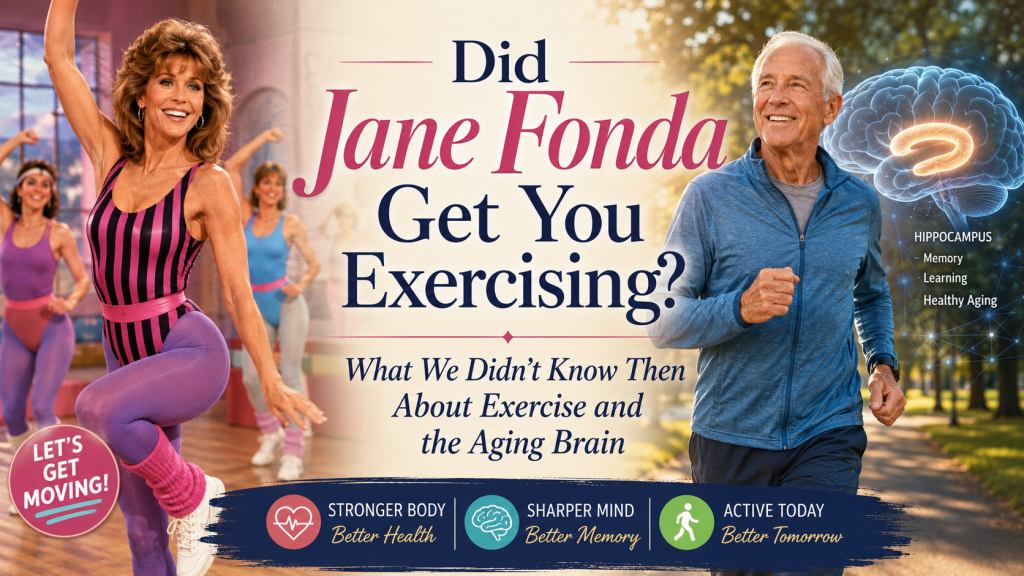
If you were around in the 1980s, you probably remember the leg warmers.
You may remember the brightly colored leotards, the VCR, the television set — and Jane Fonda telling millions of Americans to get off the couch and move.
And some of us actually listened.
I was one of them.
About 40 years ago, I began exercising in the morning before going to work. My reason was pretty straightforward: I wanted to be at my best when I went to work.
I wasn’t thinking about my hippocampus.
Frankly, I’m not sure I even knew where my hippocampus was.
I wasn’t exercising because I thought I might be protecting my brain four decades later. I was exercising because it made me feel better, gave me more energy and helped prepare me for the day.
Jane Fonda and the fitness revolution of that era helped make exercise part of everyday American life. Her first famous workout video appeared in 1982, helping turn home exercise into a cultural phenomenon. What seemed revolutionary at the time was the idea that ordinary people could exercise regularly without becoming athletes or joining expensive health clubs.
But here’s where the story gets much more interesting.
We now know something about exercise that most of us didn’t understand back then.
We weren’t just exercising our bodies.
We were exercising our brains.
Exercise Wasn’t Just About Looking Better
Think back to how exercise was marketed 40 years ago.
Lose weight.
Flatten your stomach.
Tone your legs.
Improve your waistline.
“Feel the burn.”
Exercise was largely presented as something you did to change the way your body looked.
Those benefits certainly mattered, but the science of exercise has moved far beyond appearances.
Today, researchers are studying physical activity as part of healthy aging, cardiovascular health, metabolic health and — perhaps most fascinating of all — brain health.
The National Institute on Aging says physical activity is an important component of healthy aging, while the CDC reports that regular activity can help preserve thinking, learning and judgment skills as we get older.
That changes the conversation considerably.
At 40, exercise may have been about looking better in a pair of pants.
At 70, 80 or 90, it may be about remembering where you left the pants.
That’s progress.
Meet Your Hippocampus
Deep inside your brain is a structure called the hippocampus.
No, it doesn’t have anything to do with hippopotamuses, although at our age we’re entitled to ask.
The hippocampus plays an important role in learning and memory. It’s particularly important in forming and organizing memories.
And here’s the important connection with aging:
The hippocampus is one of the areas of the brain that can undergo age-related changes.
That is one reason researchers have been so interested in whether exercise can help protect it.
The National Institute on Aging has highlighted research suggesting that physical activity may help reduce age-related changes involving the hippocampus, and studies of older adults have associated higher levels of physical activity with slower cognitive decline.
Even more intriguing, research cited by the NIA has found that exercise can increase the size of a brain structure important to memory and learning and improve spatial memory.
Think about what that means.
For years we thought exercise strengthened your legs, heart and lungs.
Now we’re learning that the brain may be responding too.
The Brain Isn’t a Piece of Concrete
Many of us grew up with an overly simple idea of aging.
You were born with a brain.
It developed.
You got older.
And eventually things simply began wearing out.
End of story.
Modern neuroscience presents a more interesting picture.
The aging brain changes, certainly. But it also remains responsive to how we live.
Exercise affects circulation. Physical activity is associated with changes in brain metabolism and with biological processes involved in learning, memory and brain-cell health. Researchers continue to investigate exactly how these mechanisms interact.
The lesson isn’t that exercise magically prevents dementia.
It doesn’t.
And we should be very suspicious whenever anyone promises that one food, pill, supplement or exercise routine will guarantee that you’ll never develop Alzheimer’s disease.
Human biology isn’t that cooperative.
The stronger and more defensible message is this:
Physical activity is one of the behaviors consistently associated with better overall health and better brain health as we age.
The CDC’s information on physical activity and brain health notes benefits involving memory, thinking, learning, problem-solving and emotional well-being.
That’s quite a return on investment for something that doesn’t require a prescription.
You Don’t Have to Exercise Like Jane Fonda
Here’s the good news for those of us who haven’t worn leg warmers since Ronald Reagan was president.
You don’t need to perform a 1982 aerobics routine in your living room.
And at 80, I certainly wouldn’t recommend trying to prove you can still exercise exactly the way you did at 40.
Even Jane Fonda herself has described her modern fitness routine as essentially doing what she used to do, only more slowly. She continues to combine activity such as walking and strength work as she has gotten older.
There’s a lesson in that.
Healthy aging isn’t about pretending you’re still 30. It’s about continuing to use the body you have.
Walk.
Ride a bicycle.
Use a treadmill.
Dance.
Work in the garden.
Lift weights appropriate for your abilities.
Do resistance exercises.
Get out of the chair regularly.
Find something you’ll actually continue doing.
The best exercise program in the world is worthless if you hate it so much that you quit after three weeks.
Consistency beats heroics.
Aerobic Exercise and the Brain
Aerobic activity has received particular attention in brain-health research.
Walking briskly, cycling, swimming and other activities that raise your heart rate increase the demand for blood and oxygen throughout the body.
Research summarized by Harvard Health has found associations between regular aerobic exercise and increases in the size of the hippocampus, the region involved in learning and memory.
That doesn’t mean you need to become a marathon runner.
It means movement matters.
And that is especially important because many people become progressively less active during their senior years.
The less they move, the harder movement becomes.
Then because movement becomes harder, they move even less.
That’s not a cycle we want to encourage.
Our broader philosophy of healthy aging is maintaining function for as long as possible — not chasing youth, but protecting independence.
If exercise helps you continue climbing stairs, carrying groceries, riding a bicycle, dancing, traveling and thinking clearly, those are not cosmetic benefits.
Those are quality-of-life benefits.
Don’t Forget Your Muscles
The brain story shouldn’t cause us to forget strength.
Muscle becomes increasingly important as we grow older because strength affects balance, mobility, independence and our ability to recover from illness or periods of inactivity.
Newer research is also examining resistance training and cognition. Harvard Health recently discussed a small 2025 study in which older adults who completed six months of weight training showed improvements in memory-related measures. It is one study, not a final verdict, but it illustrates how broadly scientists are now investigating the relationship between physical activity and the aging brain.
This is why a good healthy-aging program isn’t necessarily one type of exercise.
It can include:
Aerobic activity for cardiovascular fitness.
Resistance exercise for muscle.
Balance work to help prevent falls.
Flexibility and mobility to keep doing ordinary activities.
And perhaps the most overlooked ingredient of all:
Something you enjoy enough to keep doing.
Exercise May Help the Brain Indirectly Too
There’s another interesting part of this story.
Exercise doesn’t have to affect brain cells directly to benefit your brain.
Physical activity may also improve factors that themselves influence cognitive health.
For example, regular exercise can contribute to better cardiovascular health, glucose regulation and sleep.
It can also help with mood, stress and anxiety — factors that can affect how clearly we think and how well we function.
Harvard Health notes that some of exercise’s benefits for memory and thinking may occur indirectly through improvements in sleep and mood and reductions in stress and anxiety.
The body and brain aren’t two separate departments.
They’re sharing the same building.
What helps one often influences the other.
Forty Years Later, I See Exercise Differently
When I started exercising before work about four decades ago, I thought I was doing something for that particular day.
Get up.
Exercise.
Feel better.
Go to work.
Be at my best.
Simple.
What I couldn’t see was the possibility that maintaining that habit might have benefits extending decades into the future.
That’s one of the fascinating things about aging.
Sometimes you don’t understand the value of a decision until much later.
The walk you take today isn’t just a walk.
The bicycle ride isn’t merely burning calories.
The strength exercise isn’t just about having larger muscles.
You may be making deposits into something much more valuable:
your future independence.
That’s why we often talk about making better choices for healthier aging.
There is no guarantee that any of us will reach 90 or 100 in perfect health.
But there are choices that can improve the odds of remaining healthier and more capable along the way.
Movement appears to be one of them.
Did Jane Get You Exercising Back Then?
So I have to ask:
Did Jane Fonda get you exercising back then?
Maybe it was Jane.
Maybe it was Jack LaLanne.
Maybe it was jogging.
Maybe it was Jazzercise.
Maybe you bought one of those stationary bicycles that eventually became a very expensive clothes rack.
Whatever got you moving, perhaps we owe those early exercise pioneers more credit than we realized.
They were talking about cardiovascular fitness, strength, flexibility and weight control.
They couldn’t fully tell us what researchers are discovering today about the connection between physical activity and the aging brain.
Forty years later, science has given us another reason to keep moving.
Not because we’re trying to become young again.
We’re not.
Not because exercise guarantees we’ll never become ill.
It doesn’t.
But because our senior years don’t have to be a surrender to inactivity.
The objective is not to turn an 80-year-old into a 40-year-old.
The objective is to make that 80-year-old the strongest, healthiest, most capable 80-year-old he or she can reasonably be.
If that means walking instead of running, fine.
If it means lighter weights, fine.
If the bicycle goes a little slower than it once did, fine.
Even Jane Fonda slowed down.
The important part is that we’re still moving.
Because one of the things science has taught us since those VHS workout days is wonderfully simple:
When you exercise your body, your brain may be benefiting right along with it.
And if Jane Fonda helped get an entire generation off the couch 40 years ago?
Maybe she deserves another round of applause.
Preferably while we’re standing up.

William Vargas brings over 50 years of financial and insurance expertise to every Medicare conversation. He operates MedicareSelfEnroll.com, helping seniors in Florida, New York, and North Carolina — with no pressure, no phone calls required.