In This Article
- Start With the Parent, Not the Insurance Company
- Understand the Basic Choices First
- Make a Doctor and Hospital List
- Build an Accurate Prescription List
- Do Not Compare Plans by Premium Alone
- Look at the Maximum Out-of-Pocket Limit
- Check the Pharmacy Too
- Ask About Travel
- Pay Attention to Prior Authorization
- Do Not Let Extra Benefits Dominate the Decision
- Review the Annual Notice of Change
- Use Medicare.gov as an Independent Reference
- Help Without Taking Control
- Watch for Cognitive or Organizational Problems
- Be Very Careful With Medicare Marketing
- Compare Plans Privately and Without Pressure
- The Best Question Adult Children Can Ask
Medicare decisions can be difficult even for people who have spent their entire lives making responsible financial and healthcare choices.
Then adult children get involved.
Sometimes that is extremely helpful.
Sometimes it turns the kitchen table into a congressional hearing.
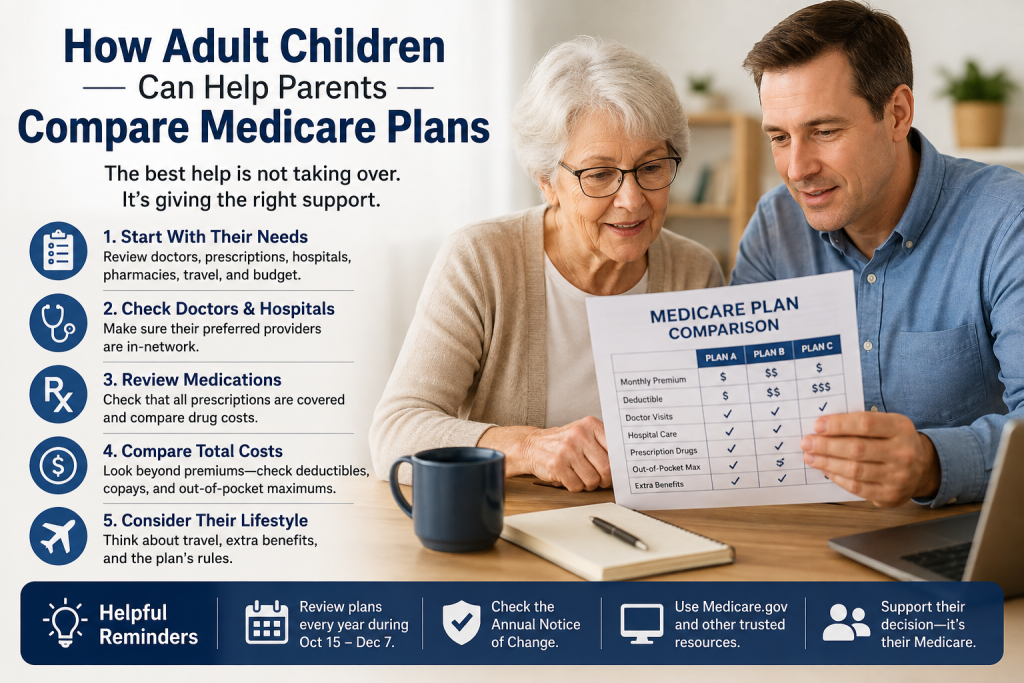
The best role for an adult child is not to take over the decision. It is to help a parent organize the information, ask better questions, and make sure important details do not get overlooked.
Medicare is not simply a matter of picking the plan with the lowest premium or the most extra benefits. Doctors, hospitals, prescriptions, pharmacies, travel, health conditions, finances, and tolerance for risk can all matter.
That is why helping a parent compare Medicare plans should begin with something much more basic:
What healthcare does Mom or Dad actually need?
Start With the Parent, Not the Insurance Company
Before comparing a single plan, sit down with your parent and make a simple healthcare inventory.
You want to know:
- Which doctors do they see?
- Which specialists matter most?
- Which hospitals do they prefer?
- What prescriptions do they take?
- Which pharmacy do they use?
- Do they travel frequently?
- Do they spend part of the year in another state?
- How important is predictable healthcare spending?
- Would a large unexpected medical bill create a financial problem?
This is the foundation.
Without it, comparing Medicare plans is like shopping for shoes without knowing the size.
The official Medicare website recommends considering factors including doctor and hospital choice, costs, coverage, and other healthcare needs when comparing Original Medicare with Medicare Advantage.
Adult children can be particularly helpful here because they are often better at gathering documents, making lists, using online comparison tools, and spotting details buried inside plan information.
But gathering information is different from making the decision.
Your parent is still the person who has to live with the coverage.
Understand the Basic Choices First
Before comparing individual insurance companies, make sure everyone understands the basic structure of Medicare.
One path is Original Medicare, consisting primarily of Medicare Part A and Part B.
Many people who choose Original Medicare also purchase a Medicare Supplement, commonly called Medigap, to help pay some of the costs Original Medicare does not cover. They may also purchase a separate Part D prescription drug plan.
Another path is Medicare Advantage, also known as Part C.
Medicare Advantage plans are offered by private insurance companies approved by Medicare. Depending on the plan, they may include medical coverage, prescription drug coverage, and additional benefits.
Neither route is automatically better for everyone.
That is one reason our article Medicare Advantage vs. Medigap: What Seniors Need to Know Before Choosing is worth reviewing before you begin comparing individual plans.
The important point is this:
Compare the healthcare system first. Compare insurance companies second.
Make a Doctor and Hospital List
One of the most valuable things an adult child can do is create a written list of the parent’s healthcare providers.
Do not just write:
“Dr. Smith.”
Write:
Dr. Robert Smith
Cardiologist
Practice name
City
Telephone number
Do the same for specialists, hospitals, outpatient facilities, and any other providers that are particularly important.
Why?
Because Medicare Advantage plans may use provider networks, and different types of Medicare Advantage plans have different network rules. Medicare itself distinguishes among HMO, PPO and other Medicare Advantage plan structures.
A parent’s longtime physician being listed as participating today does not necessarily mean every plan from that insurance company includes that physician.
And never rely solely on statements such as:
“My doctor takes UnitedHealthcare.”
Or:
“My doctor takes Aetna.”
The real question is:
Does this specific doctor participate in this specific Medicare plan?
Those are very different questions.
Whenever possible, verify participation through the insurance company’s provider directory and then confirm directly with the doctor’s office.
Build an Accurate Prescription List
Prescription coverage is another place where adult children can be enormously helpful.
Write down:
- Exact medication name
- Dosage
- Number of pills or units
- How often it is taken
- Preferred pharmacy
- Whether mail order is acceptable
Medicare drug plans maintain lists of covered medications called formularies, and each plan can have its own formulary.
A medication can also be assigned to different pricing tiers by different plans.
Some medications may require prior authorization, step therapy, or quantity limits.
That means simply asking whether a drug is “covered” does not tell the whole story.
A better question is:
How is this medication covered under this particular plan?
For a deeper explanation, see our guide to what Medicare Part D drug plans cover.
An adult child who is comfortable using a computer can often save a parent considerable frustration by entering the complete medication list into a Medicare comparison system rather than attempting to compare plans from advertisements.
Do Not Compare Plans by Premium Alone
This may be one of the biggest mistakes families make.
They see:
$0 monthly premium.
And the shopping stops.
A zero-dollar Medicare Advantage premium does not mean zero healthcare cost.
Depending on the plan, a beneficiary may still face deductibles, copayments, coinsurance, hospital costs, specialist charges, diagnostic imaging costs, prescription expenses, and other out-of-pocket costs.
At the other extreme, paying a higher premium does not automatically make a plan better.
The correct comparison is not simply:
Plan A costs $0.
Plan B costs $150.
The real comparison is:
What might each plan cost under the healthcare circumstances my parent is likely to encounter?
This is where an adult child with financial experience can be extremely helpful.
Create three columns:
Monthly predictable costs.
Routine healthcare costs.
Potential major healthcare costs.
Now the family is comparing risk, rather than advertising.
Look at the Maximum Out-of-Pocket Limit
For Medicare Advantage plans, pay special attention to the annual maximum out-of-pocket amount for covered Part A and Part B services.
This figure can become especially important during a bad health year.
A parent who rarely visits a doctor may focus on the premium.
An adult child may be better positioned to ask:
“What happens financially if Dad has a heart attack?”
That is not pessimism.
That is financial planning.
The cheapest plan during a healthy year may not necessarily be the plan someone prefers during a difficult health year.
Medicare decisions involve balancing premium against potential financial exposure.
Check the Pharmacy Too
Families sometimes carefully check the doctors and prescriptions but forget the pharmacy.
That can be expensive.
Prescription drug plans and Medicare Advantage plans with drug coverage may have pharmacy networks.
One pharmacy may be preferred while another is considered standard.
The same prescription can therefore have different costs depending upon where it is filled.
If your parent has used the same neighborhood pharmacy for 25 years, make sure that pharmacy works well with the plan being considered.
Or compare whether changing pharmacies would meaningfully reduce prescription costs.
The goal is not to change everything unnecessarily.
The goal is to know the consequences before making the decision.
Ask About Travel
This becomes particularly important for retirees.
Does your parent spend winters in Florida?
Visit children in another state?
Travel around the country in an RV?
Take cruises?
Spend months away from home?
Original Medicare and Medicare Advantage work differently when it comes to provider access.
Some Medicare Advantage PPO plans may provide certain out-of-network benefits, while HMOs generally have more restrictive network requirements except in situations such as emergencies.
The correct plan for someone who rarely leaves home may not be the correct plan for someone who spends four months every winter somewhere else.
Adult children often know Mom and Dad’s actual lifestyle better than an insurance advertisement does.
Use that knowledge.
Pay Attention to Prior Authorization
Another increasingly important consideration is how a Medicare Advantage plan manages medical services.
Some services may require prior authorization before the plan will cover them.
This does not automatically make a plan bad.
But families should understand how the plan operates.
If a parent has a complicated medical history, receives frequent treatments, or regularly sees specialists, administrative rules can become more important than they would be for someone who rarely uses healthcare.
Again, the question is not:
“Does this plan offer dental?”
The more important question may be:
How will this plan function when Mom actually needs significant medical care?
Do Not Let Extra Benefits Dominate the Decision
Dental.
Vision.
Hearing.
Gym memberships.
Over-the-counter allowances.
Transportation.
These benefits can certainly have value.
But they should be viewed after the major medical questions have been answered.
A $100 allowance for eyeglasses is pleasant.
Keeping access to your oncologist is considerably more important.
Families can easily get distracted by tangible extras because they are easy to understand.
Hospital networks and prior authorization are less exciting.
Unfortunately, they may matter much more.
Review the Annual Notice of Change
Helping a parent choose Medicare coverage should not be a one-time event.
Plans can change.
Each fall, people enrolled in Medicare Advantage or Part D plans receive an Annual Notice of Change, commonly called an ANOC.
Medicare says this notice explains changes to coverage, costs, and other plan provisions taking effect the following January.
This document deserves attention.
Do not assume:
“Mom loves her plan, so we’ll just leave everything alone.”
Instead ask:
Did the premium change?
Did copayments change?
Did the drug deductible change?
Are her prescriptions still covered the same way?
Are her doctors still participating?
Did the hospital network change?
Are any important benefits being reduced?
Medicare’s annual Open Enrollment Period generally runs from October 15 through December 7, with changes taking effect January 1.
That makes autumn an excellent time for adult children to schedule an annual Medicare review with their parents.
Think of it as an annual financial checkup.
Use Medicare.gov as an Independent Reference
Even if you work with an insurance agent or use an independent Medicare comparison service, Medicare.gov should remain one of your reference points.
The official Medicare website provides information about Medicare benefits and plan options and offers tools for comparing coverage.
For Medigap policies, Medicare also provides a comparison resource where consumers can review standardized benefits and obtain company information.
Using more than one source is simply good decision-making.
Insurance is too important to base on one television commercial, one piece of mail, or one phone call.
Help Without Taking Control
This may be the most important advice in this entire article.
Adult children sometimes become frustrated because a parent does not choose the plan the child thinks is best.
Remember:
It is their Medicare.
A parent may value keeping a physician more than saving $40 a month.
They may strongly prefer a certain hospital.
They may dislike changing pharmacies.
They may be more comfortable paying a higher predictable premium rather than accepting greater financial uncertainty.
Those are legitimate preferences.
Your job is to help make the consequences clear.
You can say:
“Here are the choices.”
“Here is what each one costs.”
“Here are the doctors.”
“Here are the prescriptions.”
“Here is the risk.”
Then let your parent participate fully in the decision.
That preserves something extremely important:
independence.
Watch for Cognitive or Organizational Problems
There is another side to this discussion.
Sometimes an adult child becomes involved because the parent is beginning to struggle with paperwork, memory, organization, or complicated decisions.
That requires sensitivity.
Missing bills, unopened Medicare correspondence, forgotten prescriptions, or confusion about insurance may be signs that additional help is needed.
The answer is still not necessarily to march in and seize control.
Start by simplifying.
Create one Medicare folder.
Keep the Medicare card, insurance cards, prescription list, provider information, and important plan documents together.
Keep usernames and important contact information securely organized where appropriate.
Attend appointments or conference calls if the parent wants help.
Small organizational improvements can prevent large mistakes.
Be Very Careful With Medicare Marketing
Medicare beneficiaries can receive an enormous amount of advertising.
Television commercials.
Mailers.
Phone calls.
Emails.
Social media advertisements.
Not all of it provides the full picture.
CMS maintains specific Medicare marketing rules intended to govern how Medicare Advantage and prescription drug plans are marketed.
An adult child can serve as a second set of eyes.
Whenever an advertisement says:
“Get all these benefits!”
Ask:
Under what plan?
In what county?
Who qualifies?
What are the limitations?
What does the medical coverage look like?
Are Mom’s doctors included?
Are Dad’s prescriptions included?
That little bit of skepticism can be extremely valuable.
Compare Plans Privately and Without Pressure
One advantage families have today is the ability to research before speaking with anyone.
You can begin at MedicareSelfEnroll.com and review Medicare options privately, or use the official Medicare.gov resources as another comparison point.
The objective should never be to rush someone into a Medicare plan.
It should be to understand the choices.
Education first. Enrollment second.
That is particularly important when an adult child is helping.
You are not looking for someone to tell your parent what to buy.
You are looking for enough information to help your parent make an informed decision.
The Best Question Adult Children Can Ask
After looking through premiums, deductibles, networks, formularies, extras, and copays, Medicare can begin to feel impossibly complicated.
So bring the discussion back to one question:
“How does Mom or Dad actually use healthcare?”
That question changes everything.
A plan is not good because thousands of other people like it.
It is good only if it fits the individual using it.
Doctors matter.
Prescriptions matter.
Hospitals matter.
Finances matter.
Travel matters.
Risk matters.
And personal preference matters.
Adult children can make the Medicare process dramatically easier by organizing those pieces and helping their parents compare them logically.
Just remember the goal.
You are not there to choose Medicare for your parents.
You are there to help them understand what they are choosing.
Because the best Medicare decision is not necessarily the plan with the lowest premium, the longest list of extras, or the most impressive television commercial.
It is the plan that makes sense for the person sitting across the kitchen table.
And sometimes the most valuable thing an adult child can bring to that table isn’t an answer.
It is a better set of questions.

William Vargas brings over 50 years of financial and insurance expertise to every Medicare conversation. He operates MedicareSelfEnroll.com, helping seniors in Florida, New York, and North Carolina — with no pressure, no phone calls required.