In This Article
- What Does a Personalized Medicare Recommendation Mean?
- Why Your ZIP Code and County Matter
- Your Doctors Matter More Than the Commercial
- Prescription Drugs Can Change the Answer
- Medicare Advantage vs. Medicare Supplement
- What About Dental, Vision, and Hearing?
- What If I Need Help Paying for Medicare?
- Can Medicare.gov Give Me a Personalized Recommendation?
- Beware of Fake “Personalized” Recommendations
- What Information Should I Have Ready?
- Can I Compare Plans Privately Online?
- The Best Recommendation Is the One You Understand
- Final Answer: Yes, But Do It the Right Way
Choosing a Medicare plan should not feel like guessing which wire to cut in an old movie bomb scene. Red wire? Blue wire? Prescription drug plan? HMO? PPO? Supplement? Dental? Vision? Hearing? By the time some people finish reading the brochures, they need a nap, a cup of coffee, and maybe a second pair of reading glasses.
So the question is a good one:
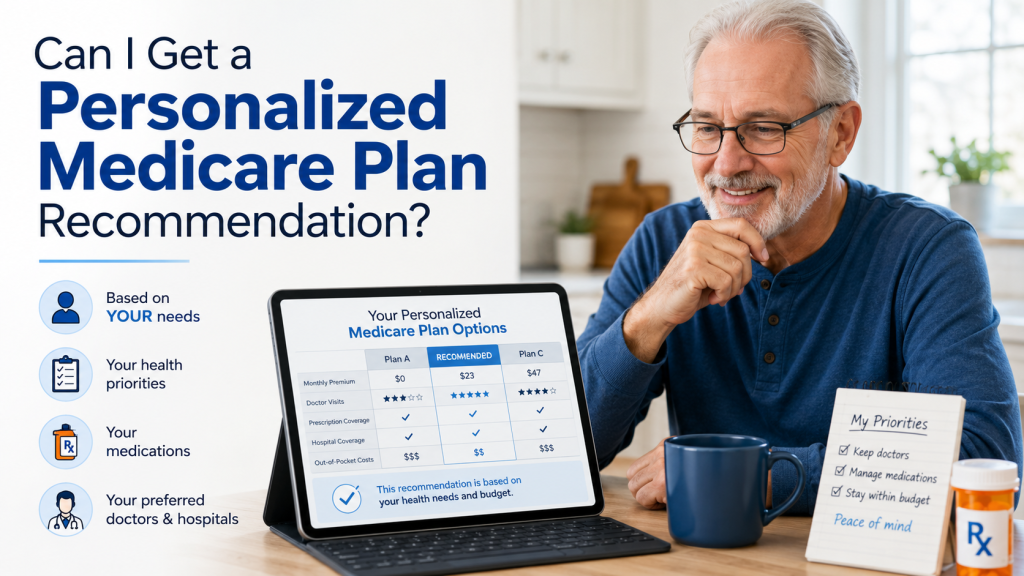
Can I get a personalized Medicare plan recommendation?
The answer is: yes, you can get personalized Medicare help — but you should understand what “personalized” really means.
A good Medicare plan recommendation is not based on which company has the loudest television commercial, the biggest postcard, or the friendliest celebrity spokesperson. It should be based on your doctors, your prescriptions, your county, your budget, your health needs, and how you actually use care.
That is exactly why Medicare plan shopping should never be treated like buying a toaster.
A toaster either burns the bread or it doesn’t. A Medicare plan can affect your doctors, hospitals, prescriptions, out-of-pocket costs, referrals, travel flexibility, dental benefits, and peace of mind.
What Does a Personalized Medicare Recommendation Mean?
A personalized Medicare recommendation means someone looks at your real situation before helping you compare your options.
That includes questions like:
Are you turning 65, or are you already on Medicare?
Do you have both Medicare Part A and Part B?
Do you take prescription drugs?
Do you want to keep certain doctors?
Do you travel often?
Do you prefer a lower monthly premium, or are you willing to pay more for broader access?
Do you qualify for help paying Medicare costs?
Are you comparing Medicare Advantage, Medicare Supplement, and Part D options?
That is the real work. Not guessing. Not pushing. Not saying, “This plan is popular, so take it.”
Popular does not mean appropriate. A plan can be great for your neighbor and completely wrong for you. Your neighbor may take no medications, see one doctor a year, and never leave the county. You may take five prescriptions, see three specialists, and spend winters in another state.
That is why Medicare is personal.
Why Your ZIP Code and County Matter
Medicare plans are local. This is especially true with Medicare Advantage and Part D prescription drug plans.
A plan available in one county may not be available in another. A premium in one area may be different from a premium somewhere else. Provider networks can also change by location.
That is why the first step in comparing plans is usually your ZIP code.
The official Medicare Plan Finder lets people search Medicare health and drug plans by area and compare estimated costs. Medicare.gov explains that you can enter your ZIP code or log in to compare plans using saved drugs and pharmacies.
That is helpful, but many people still find the process overwhelming. Medicare.gov gives information. It does not always make the decision feel simple.
That is where a guided comparison can help.
At MedicareSelfEnroll.com, the idea is to let you compare plans privately, at your own pace, without feeling chased, pressured, or cornered at the kitchen table.
Your Doctors Matter More Than the Commercial
One of the biggest mistakes people make is choosing a plan before checking their doctors.
This is especially important with Medicare Advantage plans. Many Medicare Advantage HMO plans require you to use doctors and hospitals in the plan’s network, except in emergencies. PPO plans may give more flexibility, but out-of-network care can cost more.
Medicare.gov explains that Medicare Advantage plan types can differ, including HMOs and PPOs, and that plan rules can affect how you receive care.
That means a personalized recommendation should ask:
Is your primary doctor in the network?
Are your specialists in the network?
Are your preferred hospitals included?
Do you need referrals?
Do you want out-of-network flexibility?
Do you spend part of the year in another state?
A zero-premium plan may look attractive. And sometimes it is. But if your doctor is not in the network, that “free” plan may not feel so free when you have to change doctors.
The right question is not only, “What is the premium?”
The better question is, “What happens when I actually need care?”
Prescription Drugs Can Change the Answer
Prescription drugs are another major reason personalized Medicare comparisons matter.
Two people can live on the same street, choose the same health plan, and still have very different total costs because their medications are different.
A plan that covers your neighbor’s medications well may not cover yours the same way. Formularies, tiers, deductibles, preferred pharmacies, and prior authorization rules can all matter.
Medicare Part D is optional, but Medicare.gov explains that Part D helps pay for brand-name and generic drugs and is offered through private companies approved by Medicare. Medicare also warns that even people who do not take medications now should consider drug coverage to avoid a possible late enrollment penalty later.
That is why a real recommendation should include your medication list.
Not “I take a little white pill.”
That will not do it.
You need the name, dosage, and how often you take it. Your pharmacy also matters because some plans have preferred pharmacies with lower costs.
A good plan comparison looks at the full picture: premium, deductible, copays, coinsurance, and drug costs.
Medicare Advantage vs. Medicare Supplement
One of the biggest Medicare decisions is whether to choose Medicare Advantage or Original Medicare with a Medicare Supplement, also called Medigap.
Medicare Advantage plans are offered by private companies that contract with Medicare. Medicare.gov explains that these plans provide Part A and Part B benefits and may include additional benefits depending on the plan.
Medicare Supplement plans work differently. They help pay some of the out-of-pocket costs left by Original Medicare. People with Medigap usually also need a separate Part D prescription drug plan.
Neither path is automatically “better” for everyone.
Medicare Advantage may appeal to people who want lower monthly premiums, built-in extras like dental or vision, and coordinated care. But they must understand networks, prior authorization, referrals, and out-of-pocket maximums.
Original Medicare with a Supplement may appeal to people who want broad access to providers who accept Medicare and fewer network concerns. But premiums are usually higher, and drug coverage is separate.
That is why a personalized recommendation should not begin with a product.
It should begin with you.
What About Dental, Vision, and Hearing?
Many people are surprised to learn that Original Medicare does not cover routine dental care, routine eye exams for glasses, or hearing aids in the way many people expect.
Some Medicare Advantage plans include dental, vision, and hearing benefits. But those benefits vary widely.
One plan may offer preventive dental only. Another may include more comprehensive dental coverage. One plan may have a hearing aid allowance. Another may have a limited network or specific vendor rules.
This is where people get tripped up.
They hear “dental included” and assume everything is covered.
Not so fast.
A personalized recommendation should look at the details. Cleanings? X-rays? Fillings? Crowns? Dentures? Hearing aid allowance? Eyewear allowance? Annual limits?
The small print matters because teeth, eyes, and ears have a way of becoming expensive at exactly the wrong time.
What If I Need Help Paying for Medicare?
A good recommendation should also consider whether you may qualify for financial help.
Medicare.gov says there are programs run by states that can help lower Medicare costs, including help with Part A and Part B premiums and other costs, as well as help with drug costs.
These programs can make a major difference.
Some people may qualify for a Medicare Savings Program. Some may qualify for Extra Help with prescription drug costs. Some may qualify for Medicaid in addition to Medicare.
The problem is many people never ask. They assume they will not qualify. Sometimes they are wrong.
And here is the honest truth: pride can be expensive.
If help is available and you qualify, you should know about it. You worked, paid taxes, raised families, served communities, and carried responsibilities for decades. There is no prize for overpaying because you did not ask.
Can Medicare.gov Give Me a Personalized Recommendation?
Medicare.gov is an important official resource. It lets you compare health and drug plans, review plan details, and estimate costs. You can also contact Medicare directly by phone or live chat. Medicare.gov says people can talk or live chat with a real person 24 hours a day, 7 days a week, except some federal holidays.
That is useful.
But there is a difference between information and guidance.
Medicare.gov can show options. A licensed agent or counselor can help you understand how those options may fit your situation.
You can also contact your local SHIP program. SHIP provides one-on-one Medicare counseling and assistance.
Some people prefer SHIP because it is counseling-based. Others prefer working with a licensed Medicare agent because the agent can help compare plans and assist with enrollment if the person chooses to enroll.
The key is simple: you should never feel rushed.
Beware of Fake “Personalized” Recommendations
Not every “recommendation” is truly personalized.
Some recommendations are really just sales pitches wearing a nice hat.
Be careful if someone pushes one plan before asking about your doctors, drugs, pharmacy, county, and health needs.
Be careful if someone says, “Everyone is choosing this.”
Be careful if someone says, “You must decide today,” unless there is a real enrollment deadline.
Be careful if someone calls out of the blue and asks for your Medicare number.
Medicare decisions are important. You do not need panic. You need clarity.
A real Medicare comparison should feel like someone is turning on the lights, not turning up the pressure.
What Information Should I Have Ready?
Before asking for a personalized Medicare plan recommendation, gather a few things:
Your ZIP code
Your Medicare card information
Your list of doctors
Your preferred hospitals
Your prescription medications, including dosage and frequency
Your pharmacy
Your travel habits
Your current insurance card, if you already have coverage
Your budget concerns
Whether dental, vision, hearing, transportation, fitness, or over-the-counter benefits matter to you
This information helps narrow the choices.
Without it, comparing Medicare plans is like trying to buy shoes without knowing your size. You may get something shiny, but you might limp all the way home.
Can I Compare Plans Privately Online?
Yes, and for many seniors, that is the best place to start.
Not everyone wants a salesperson at the kitchen table. Not everyone wants five phone calls. Not everyone wants to be rushed into a decision while still trying to understand what Part B even does.
That is why MedicareSelfEnroll.com was created around a simple idea: compare Medicare options privately and easily, without pressure.
You can start with the basics, review your choices, and move at your own pace.
You may also want to read:
How Do I Compare Medicare Plans Side by Side?
How Often Can I Change My Medicare Plan Each Year?
How Do I Get Help Paying for Medicare Premiums?
Can I Use My Current Doctor with Medicare Advantage?
Those topics all connect because Medicare is not one decision. It is a set of connected decisions.
The Best Recommendation Is the One You Understand
Here is something people do not say enough:
The “best” Medicare plan is not always the plan with the longest list of benefits.
It is the plan you understand.
It is the plan that fits your doctors, your prescriptions, your budget, your county, and your comfort level.
It is the plan where you know what happens if you need a specialist, go to the hospital, travel, fill prescriptions, or need dental work.
A plan is not truly good for you if you do not understand the rules.
That is where a personalized comparison can help. It slows the process down. It asks the right questions. It helps you see the trade-offs.
Final Answer: Yes, But Do It the Right Way
So, can you get a personalized Medicare plan recommendation?
Yes.
But do not settle for a generic answer.
A real personalized Medicare recommendation should be based on your doctors, prescriptions, pharmacy, county, health needs, travel habits, financial situation, and personal preferences.
It should compare your options clearly.
It should explain the trade-offs.
It should not pressure you.
It should not scare you.
And it should not make you feel foolish for asking questions.
Medicare can be confusing, but confusion is not a character flaw. It is the natural result of too many letters, too many plans, too many commercials, and too many people pretending the answer is simple.
The smart move is to compare carefully.
Start privately. Ask questions. Review your options. Get help when you need it.
You can begin at MedicareSelfEnroll.com, where you can compare Medicare plans at your own pace, with no pressure.
Because the wrong answer is not asking for help.
The wrong answer is doing nothing when your health coverage deserves a closer look.

William Vargas brings over 50 years of financial and insurance expertise to every Medicare conversation. He operates MedicareSelfEnroll.com, helping seniors in Florida, New York, and North Carolina — with no pressure, no phone calls required.