In This Article
- More Money Going Into Medicare Advantage — But Benefits Can Still Change
- Your $0 Premium Plan May Still Be $0 — But What Did You Lose?
- The Number More Seniors Should Be Looking At
- Your Doctor Is Part of the Benefit
- Prescription Drugs Deserve Their Own Review
- Don’t Let the Extra Benefits Distract You
- Don’t Automatically Abandon Medicare Advantage Either
- Medicare Is a Financial Decision — Not Just a Medical Decision
- The Most Dangerous Medicare Strategy for 2027
- You Don’t Have to Buy Medicare From a Salesperson
- Before October 15, Do Your Homework
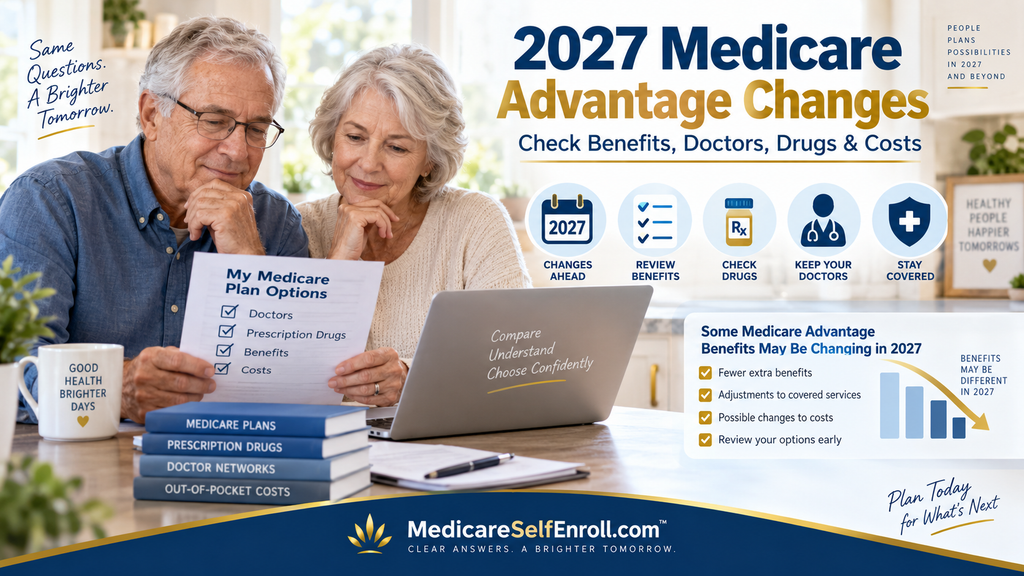
If you have a Medicare Advantage plan, 2027 may be the year when simply saying, “I’ll keep what I have,” becomes an expensive mistake.
We are getting closer to Medicare Open Enrollment, which runs from October 15 through December 7, and an important picture is beginning to emerge.
Some Medicare Advantage insurers are reducing plans, trimming benefits, changing networks and redesigning coverage for 2027.
That does not mean Medicare Advantage is suddenly bad.
It does mean that the Medicare Advantage plan you liked in 2026 may not be the same plan in 2027.
And that distinction matters.
More Money Going Into Medicare Advantage — But Benefits Can Still Change
The Centers for Medicare & Medicaid Services, better known as CMS, announced that Medicare Advantage payments are projected to increase by approximately 2.48% for 2027.
That represents more than $13 billion in additional payments to Medicare Advantage plans.
You might reasonably ask:
“If the plans are receiving more money, why would my benefits be reduced?”
Unfortunately, Medicare does not work quite that simply.
Insurance companies have to account for rising medical costs, prescription drug expenses, utilization, provider payments, risk-adjustment changes and the profitability of individual plans and markets.
As a result, an insurer can receive higher overall Medicare payments while still deciding that a particular plan, county or benefit is no longer financially attractive.
That is why you should never assume that an increase in government funding means your individual plan benefits will increase.
Your plan has to be examined individually.
Your $0 Premium Plan May Still Be $0 — But What Did You Lose?
One of the easiest numbers to advertise in Medicare Advantage is:
$0 monthly premium.
It is simple. Everyone understands it.
But premium is only one part of what your Medicare coverage can cost you.
A plan could remain at a $0 premium while increasing hospital copayments.
It could raise specialist copays.
It could change the amount you pay for diagnostic imaging.
It could change prescription drug tiers.
It could reduce dental, vision, hearing, transportation or over-the-counter benefits.
It could change the provider network.
Or it could increase the maximum out-of-pocket limit.
So a Medicare plan can technically remain “$0” while becoming substantially more expensive when you actually use healthcare.
That is why at MedicareSelfEnroll.com we believe:
PREMIUM ≠ COST.
The cheapest-looking Medicare plan can sometimes become the most expensive plan when you actually need medical care.
The Number More Seniors Should Be Looking At
One number that deserves far more attention is the plan’s maximum out-of-pocket limit, commonly called the MOOP.
This is the maximum amount you could generally be required to pay during the year for covered Medicare Part A and Part B services under your Medicare Advantage plan, subject to the plan’s rules.
It does not mean you will spend that amount.
Most people won’t.
But it tells you something extremely important:
How much financial risk are you accepting in exchange for the plan’s premium and benefits?
That is a much better Medicare question than simply asking:
“What is the cheapest plan?”
For someone who rarely uses healthcare, a low-premium Medicare Advantage plan can be an excellent financial arrangement.
But Medicare decisions should not be made solely around the healthcare you used last year.
You are buying coverage for the healthcare you may need next year.
Your Doctor Is Part of the Benefit
People sometimes think of Medicare Advantage benefits as dental allowances, eyeglasses, hearing aids, gym memberships or over-the-counter cards.
Those benefits can certainly have value.
But there is another benefit that doesn’t come printed on a plastic debit card:
access to your doctors and hospitals.
Provider networks can change.
A physician who accepted your Medicare Advantage plan in 2026 may not necessarily participate in exactly the same network in 2027.
Your hospital system may change its relationship with an insurer.
Specialists can enter or leave networks.
And PPO does not automatically mean every doctor accepts your plan.
Before keeping a Medicare Advantage plan for 2027, verify the providers who are important to you.
Do not rely solely on what was true last year.
And whenever possible, confirm participation with both the insurance company and the provider.
Prescription Drugs Deserve Their Own Review
Prescription coverage is another area where doing nothing can cost you money.
A drug that was covered favorably in 2026 could move to another tier in 2027.
A preferred pharmacy could change.
Prior authorization requirements can change.
Formularies can change.
And Medicare Part D itself is changing.
For 2027, the standard Part D deductible rises from $615 in 2026 to $700.
The annual Part D out-of-pocket threshold increases from $2,100 in 2026 to $2,400 in 2027.
Once again, that does not mean everyone will spend $2,400 on prescriptions. It is the annual out-of-pocket threshold for covered Part D drugs under the redesigned benefit.
There is also another change worth watching.
CMS announced that the temporary Part D Premium Stabilization Demonstration for standalone prescription drug plans will end after 2026.
That makes reviewing standalone Part D premiums particularly important for people using Original Medicare and a Medicare Supplement.
Your Medicare Supplement may stay exactly the same while your prescription drug coverage changes considerably.
Don’t Let the Extra Benefits Distract You
Dental.
Vision.
Hearing.
Grocery allowances.
Over-the-counter benefits.
Transportation.
Fitness memberships.
These benefits can be useful.
But they are supplemental benefits.
They should not distract you from the fundamental purpose of your Medicare coverage.
Ask yourself:
What happens if I get sick?
What would a hospital stay cost?
What would chemotherapy cost?
What would repeated specialist visits cost?
Is my preferred hospital in the network?
Are my important doctors participating?
What is my maximum financial exposure?
How are my prescriptions covered?
Those questions may not make an exciting television commercial.
But they are far more important than whether your plan gives you a few extra dollars for toothpaste.
Don’t Automatically Abandon Medicare Advantage Either
There is another mistake we need to avoid.
Hearing about Medicare Advantage benefit reductions does not mean everyone should run out and buy a Medicare Supplement.
Medicare Supplements have their own tradeoffs.
You usually pay a monthly Medicare Supplement premium whether you use medical care or not.
You generally need separate Part D prescription coverage.
Those premiums can increase as you age or as insurance rates change, depending on the rules in your state.
And in many states, switching from Medicare Advantage back to Original Medicare does not automatically guarantee that you can purchase the Medicare Supplement policy you want without medical underwriting.
That is why the Medicare decision should not be reduced to:
“Which one is better?”
The better question is:
Which financial risk are you more comfortable accepting?
Medicare Advantage generally shifts more costs toward the time when you actually use healthcare.
Medicare Supplement coverage generally asks you to pay more predictable premiums in exchange for reducing much of that medical cost-sharing.
Neither approach is automatically right for everyone.
Medicare Is a Financial Decision — Not Just a Medical Decision
This is one of the most important principles we teach at MedicareSelfEnroll.com.
Medicare is a financial decision, not just a medical decision.
You are deciding how you want to finance healthcare risk during retirement.
Suppose one plan saves you $250 a month in premiums.
That is $3,000 a year.
Over ten years, ignoring rate changes and investment returns, that is $30,000.
That is real money.
But suppose another person prefers paying higher monthly premiums because predictable expenses allow them to sleep better at night.
That has value too.
There isn’t one Medicare answer for every senior.
The objective should be to understand the tradeoff before making the decision.
The Most Dangerous Medicare Strategy for 2027
The strategy I worry about most is this:
Doing nothing because everything worked fine last year.
That is not really a Medicare strategy.
It is an assumption.
Your insurance company doesn’t promise that next year’s plan will be identical to this year’s plan.
That’s why your Annual Notice of Change exists.
Read it.
Compare it.
Look at the premium.
Look at hospital copays.
Look at specialist copays.
Look at the maximum out-of-pocket limit.
Check your prescriptions.
Check your pharmacies.
Check your doctors.
Check your hospitals.
Then compare those numbers against the alternatives available to you for 2027.
Only then can you make an informed decision.
You Don’t Have to Buy Medicare From a Salesperson
There is another change taking place that has nothing to do with insurance benefits.
More seniors are becoming comfortable researching Medicare themselves.
You can compare Medicare plans online.
You can study premiums, drug coverage and benefits.
You can verify doctors.
You can compare your choices before ever speaking with a salesperson.
And if you are uncomfortable doing it for the first time, MedicareSelfEnroll.com offers a practice Medicare selection experience so you can become familiar with the process before making an actual enrollment decision.
We believe seniors should understand their options before anyone asks them to buy anything.
Education First. Enrollment Second.
We don’t dumb Medicare down.
We break it down.
And we translate Medicare into plain English so you can make your own informed decision.
Before October 15, Do Your Homework
Medicare Open Enrollment begins October 15 and runs through December 7.
You do not need to panic.
You do not need to make a decision today.
And you certainly do not need to respond to the first Medicare advertisement that arrives in your mailbox.
But you should prepare.
The Medicare Advantage marketplace is changing.
Benefits are changing.
Drug coverage is changing.
Plans are changing.
Networks can change.
Your personal healthcare needs may have changed too.
The plan that worked perfectly for you in 2026 may still be the right plan for 2027.
But don’t assume it.
Verify it.
That one word could be the most important Medicare advice you receive this year.
At MedicareSelfEnroll.com, you can learn about Medicare, compare your options and enroll at your own pace.
No pressure.
No obligation.
And no one needs to call you.
We Don’t Sell You Plans. We Help You Find the Right Choice.
If you found this information useful, share it with another Medicare beneficiary. And subscribe to our Medicare updates so you can stay informed as the 2027 plans become available.
Because when it comes to Medicare, what you don’t check can cost you.

William Vargas brings over 50 years of financial and insurance expertise to every Medicare conversation. He operates MedicareSelfEnroll.com, helping seniors in Florida, New York, and North Carolina — with no pressure, no phone calls required.