In This Article
- What Is the Medicare Advantage Maximum Out-of-Pocket Limit?
- A $0 Premium Does Not Mean $0 Healthcare Costs
- What Counts Toward the Maximum?
- What Does NOT Count?
- Why the Maximum Matters Even If You Never Reach It
- Maximum Out-of-Pocket Is Not the Same as a Deductible
- PPO Plans Can Be More Complicated
- Compare Plans Using a Bad-Year Scenario
- Why Seniors Should Look Beyond Extra Benefits
- Original Medicare Has a Different Risk Structure
- Medicare Is About Risk Versus Premium
- Look at Your ANOC Every Year
- The Bottom Line
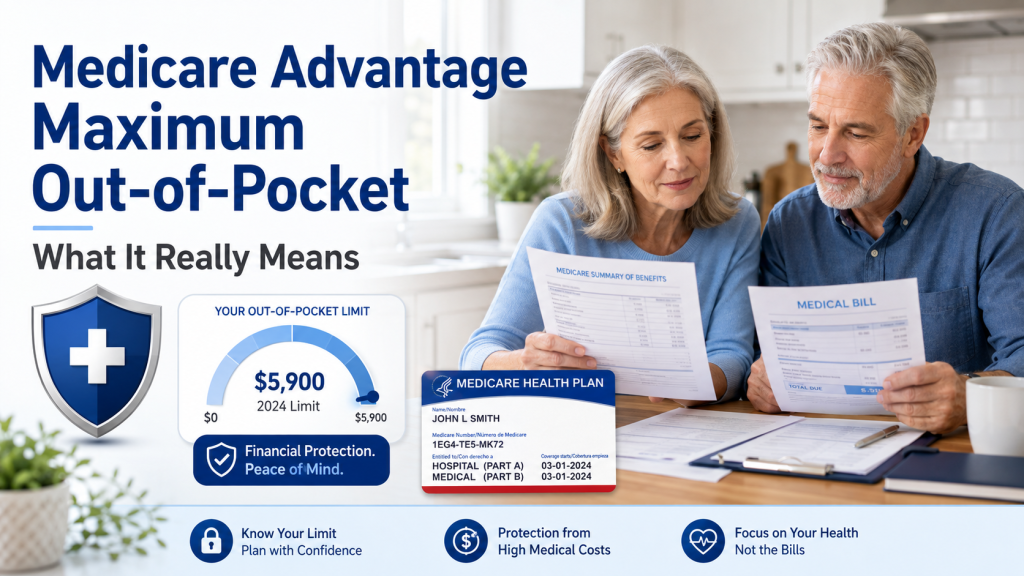
One of the most important numbers in a Medicare Advantage plan is also one of the most misunderstood:
The maximum out-of-pocket limit.
You may see a Medicare Advantage plan with a $0 monthly premium and think, “That sounds inexpensive.”
But the premium is only one part of the story.
The maximum out-of-pocket limit tells you something very different. It tells you how much financial exposure you could potentially face during a difficult healthcare year for covered Medicare Part A and Part B services.
And for seniors comparing Medicare plans, that number deserves just as much attention as the monthly premium.
What Is the Medicare Advantage Maximum Out-of-Pocket Limit?
Medicare Advantage plans are required to place an annual limit on what you pay out of pocket for covered Medicare Part A and Part B services.
Once you reach your plan’s maximum out-of-pocket limit, your Medicare Advantage plan generally pays 100% of the cost for covered Part A and Part B services for the remainder of that calendar year.
That protection is one of the important differences between Medicare Advantage and Original Medicare by itself.
Original Medicare does not have a yearly out-of-pocket maximum unless you have additional coverage, such as a Medicare Supplement policy, Medicaid, or certain employer or retiree coverage. Medicare explains this directly on its website.
But there is something very important to understand:
The maximum out-of-pocket number is not necessarily what you will spend.
It is the maximum amount of qualifying cost-sharing you could potentially be responsible for before the plan begins paying 100% for covered Part A and Part B services.
Think of it as a financial ceiling, not an expected bill.
A $0 Premium Does Not Mean $0 Healthcare Costs
This is where many people get confused.
Suppose you are considering a Medicare Advantage plan with a $0 monthly plan premium.
That sounds attractive.
And it may be a perfectly appropriate plan.
But $0 premium does not mean $0 medical expenses.
Depending on the plan, you may still have copayments or coinsurance for services such as:
- Hospital stays
- Specialist visits
- Outpatient surgery
- Diagnostic tests
- Physical therapy
- Ambulance transportation
- Emergency room visits
- Durable medical equipment
- Chemotherapy or other Part B medications
Each of those expenses may count toward your plan’s medical maximum out-of-pocket limit.
That is why we regularly explain at MedicareSelfEnroll.com that the monthly premium should never be the only number you compare.
A better question is:
“What could this plan cost me if I actually have to use it?”
That changes the entire Medicare conversation.
What Counts Toward the Maximum?
Generally, the medical cost-sharing you pay for covered Medicare Part A and Part B services under your Medicare Advantage plan counts toward its maximum out-of-pocket limit.
That can include deductibles, copayments, and coinsurance required by the plan.
For example, imagine you have a year involving:
A hospitalization.
Several specialist visits.
An MRI.
Physical therapy.
Outpatient surgery.
And ongoing medical treatment.
Each time you pay the plan-required copayment or coinsurance for covered Part A or Part B care, those amounts generally accumulate toward the plan’s annual maximum.
If you eventually reach that maximum, you pay nothing further for covered Part A and Part B services for the remainder of that calendar year.
Medicare describes the maximum out-of-pocket limit as the yearly limit on what you pay for services covered under Parts A and B.
What Does NOT Count?
This is where you need to read carefully.
The maximum out-of-pocket limit is not a universal cap on every dollar you spend on healthcare.
For example, your monthly Medicare Part B premium does not simply disappear because you reached your Medicare Advantage maximum.
You must generally continue paying your Part B premium to remain enrolled in Medicare Advantage.
Likewise, additional premiums charged by a Medicare Advantage plan generally should not be confused with medical cost-sharing that accumulates toward the plan’s MOOP.
Prescription drug spending is another major area of confusion.
Medicare Advantage plans that include Part D prescription coverage have separate rules governing prescription drug expenses.
For 2026, Medicare Part D has a $2,100 annual out-of-pocket threshold for covered Part D drugs.
That $2,100 prescription drug protection is separate from the Medicare Advantage medical maximum out-of-pocket limit.
So think of them as two different buckets:
One bucket for covered Part A and Part B medical services.
Another bucket for covered Part D prescription drugs.
Mixing those two numbers together can give you a very inaccurate picture of your potential costs.
Why the Maximum Matters Even If You Never Reach It
Some people look at a Medicare Advantage plan’s maximum out-of-pocket amount and say:
“I’ll never spend that much.”
Hopefully, they are right.
Most people probably do not plan to have a major hospitalization, cancer diagnosis, serious accident, or complicated medical year.
But insurance is not designed only around what we expect to happen.
It is also designed around what could happen.
That is why the maximum out-of-pocket number should be viewed as part of your personal financial risk.
Suppose Plan A has:
A very low premium.
Attractive dental benefits.
A gym membership.
And several other extras.
But it also exposes you to considerably greater medical cost-sharing in a serious year.
Plan B might have slightly higher monthly costs but potentially lower exposure when significant healthcare is needed.
Which is better?
There is no universal answer.
It depends on your health, finances, doctors, medications, risk tolerance, and priorities.
That is why Medicare should be looked at as a financial decision as much as an insurance decision.
Maximum Out-of-Pocket Is Not the Same as a Deductible
These two terms are sometimes confused.
A deductible is an amount you may have to pay before certain benefits begin paying according to the plan.
The maximum out-of-pocket limit is the annual ceiling on qualifying medical cost-sharing.
For example, your plan might have certain copayments from the beginning of the year.
You continue paying those copayments as you receive care.
Those qualifying expenses accumulate.
Only after you reach the maximum out-of-pocket limit does the plan begin paying 100% for covered Part A and Part B services for the rest of that calendar year.
The following January, the calculation starts over again.
That annual reset is worth remembering.
PPO Plans Can Be More Complicated
If you are enrolled in a Medicare Advantage PPO, pay especially close attention to how the maximum out-of-pocket protection works.
PPO plans may distinguish between in-network and out-of-network care.
The cost-sharing can be different depending on where you receive services.
Some PPO plans may have one maximum for in-network services and another combined maximum related to in-network and out-of-network spending.
This makes it especially important to read the plan’s Evidence of Coverage rather than relying only on a brochure or advertisement.
If you regularly see doctors outside a plan’s network, this issue can become financially significant.
Before enrolling, ask:
What is my in-network maximum?
What happens when I use out-of-network providers?
How much can I potentially spend in a worst-case year?
Those questions can reveal far more than simply asking what the premium costs.
Compare Plans Using a Bad-Year Scenario
Here is one of the simplest ways to evaluate Medicare Advantage plans.
Instead of comparing only what each plan costs during a healthy year, compare what each plan could cost during a difficult year.
Imagine you need:
A hospital admission.
Specialist care.
Several diagnostic tests.
Outpatient procedures.
Physical therapy.
And expensive Part B treatments.
Then look at the copayments and coinsurance.
You begin to see the plan differently.
A $0 premium plan might still be excellent.
But now you understand the financial structure behind it.
This is why our broader approach at MedicareSelfEnroll.com is:
Before You Compare Medicare Plans, Plan for Your Healthcare.
Start with the healthcare you expect to use.
Then examine how each plan pays for it.
You can also review our Medicare Advantage versus Original Medicare information at MedicareSelfEnroll.com to better understand how the two systems handle costs differently.
Why Seniors Should Look Beyond Extra Benefits
Medicare Advantage advertisements often emphasize benefits such as:
Dental.
Vision.
Hearing.
Fitness programs.
Over-the-counter allowances.
Transportation.
Those benefits can absolutely have value.
But they should not distract you from the underlying medical insurance.
If you are comparing two plans, dental benefits may matter.
But so does the hospital copayment.
So does specialist coinsurance.
So does the provider network.
And so does the maximum out-of-pocket exposure.
You are buying health insurance first.
The extras come second.
Original Medicare Has a Different Risk Structure
Original Medicare works differently.
There is no annual maximum out-of-pocket limit built directly into Original Medicare.
That is one reason many people who choose Original Medicare also purchase Medicare Supplement insurance.
A Medigap policy can help cover some of the deductibles and coinsurance that Original Medicare leaves behind.
This creates a different financial structure from Medicare Advantage.
Medicare Advantage often has lower monthly premiums but pay-as-you-use-it cost-sharing, subject to the plan’s annual maximum.
Original Medicare plus Medigap may involve higher predictable monthly premiums but substantially less medical cost-sharing, depending on the supplement plan.
Neither structure is automatically better for everyone.
The real question is:
Which financial arrangement fits you?
Medicare Is About Risk Versus Premium
Here is a simple way to think about Medicare.
You can often pay more upfront to transfer more financial risk to an insurance company.
Or you can pay less upfront and accept more financial responsibility when healthcare is used.
That is the same basic principle that exists throughout insurance.
The mistake is evaluating only one side of that equation.
Someone may proudly say:
“My Medicare Advantage plan costs me $0 per month.”
Fine.
Now ask:
“What is your maximum out-of-pocket?”
That second number tells you something the first number does not.
It tells you about risk.
Look at Your ANOC Every Year
Your Medicare Advantage plan can change from year to year.
Premiums can change.
Copayments can change.
Networks can change.
Drug formularies can change.
And your maximum out-of-pocket limit can change.
That is why you receive an Annual Notice of Change, often called the ANOC.
Do not throw it into a drawer.
Review it.
Compare the upcoming year with the current year.
And pay particular attention to the services you actually use.
You can also compare plans through the official Medicare Plan Finder at Medicare.gov. Medicare advises beneficiaries to consider premiums, deductibles, copayments, coinsurance, healthcare use, and the plan’s maximum out-of-pocket limit when evaluating costs.
The Bottom Line
The Medicare Advantage maximum out-of-pocket limit is one of the most valuable protections built into Medicare Advantage.
But it is also one of the most misunderstood.
It does not mean you automatically pay that amount every year.
It does not include every healthcare expense you have.
It is not the same as your drug plan’s prescription spending limit.
And it certainly does not mean a $0-premium Medicare Advantage plan is free healthcare.
The maximum out-of-pocket number is better understood as your potential financial exposure for covered Part A and Part B medical services under the plan.
So when comparing Medicare Advantage plans, don’t ask only:
“What is the premium?”
Ask:
“What will my healthcare cost if I stay healthy?”
“What will it cost if I need regular care?”
And perhaps most importantly:
“What could it cost me during a very bad year?”
Those are the questions that reveal what a Medicare plan really costs.
At MedicareSelfEnroll.com, we believe Medicare decisions should begin with education, not a sales pitch.
We Don’t Sell You Plans. We Help You Find the Right Choice.
Before enrolling or changing coverage, review the plan’s current Summary of Benefits and Evidence of Coverage, and compare your options using the official Medicare.gov Plan Finder.

William Vargas brings over 50 years of financial and insurance expertise to every Medicare conversation. He operates MedicareSelfEnroll.com, helping seniors in Florida, New York, and North Carolina — with no pressure, no phone calls required.