In This Article
- Your Prescriptions Are Part of the Medicare Decision
- Every Medicare Drug Plan Has Its Own Formulary
- Drug Tiers Can Make a Huge Difference
- Do Not Forget the Part D Deductible
- Your Pharmacy Can Change What You Pay
- Prior Authorization Can Be Just as Important as Price
- The 2026 Part D Out-of-Pocket Limit Helps—But Understand What It Means
- The $2,100 Limit Is Not a $2,100 Deductible
- Expensive Drugs Can Turn a Cheap Plan Into an Expensive Plan
- The Medicare Prescription Payment Plan Can Help With Cash Flow
- Extra Help Can Dramatically Reduce Prescription Costs
- Review Your Drug Coverage Every Year
- Before Choosing a Medicare Plan, Check These Five Things
- The Real Question Is Not “What Is the Premium?”
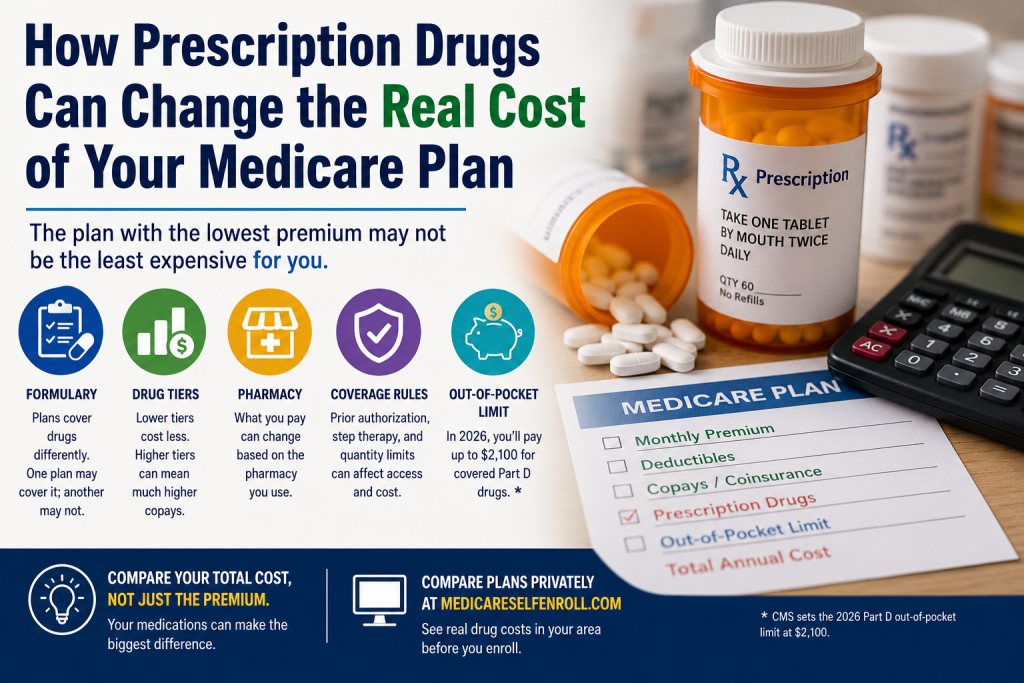
When people compare Medicare plans, one number often gets most of the attention: the monthly premium.
A Medicare Advantage plan may advertise a $0 monthly premium. A standalone Medicare Part D plan may have a relatively low monthly premium. At first glance, that can make one plan look much cheaper than another.
But the premium tells you only part of the story.
For many Medicare beneficiaries, prescription drugs can completely change the real cost of a Medicare plan.
A plan that looks inexpensive on paper may become costly if it does not cover your medications favorably. Another plan with a slightly higher premium could potentially save you hundreds—or even thousands—of dollars over the year because of the way it covers the drugs you actually take.
That is why comparing Medicare plans should never begin and end with the premium.
Your Prescriptions Are Part of the Medicare Decision
Imagine two Medicare plans.
Plan A has a $0 monthly premium.
Plan B costs $35 per month.
It would be easy to conclude that Plan A is the better bargain.
But suppose one of your medications costs $10 per month under Plan B and $80 per month under Plan A.
That single medication creates an $840 annual difference.
Suddenly that extra $420 per year in premiums for Plan B does not look so expensive.
This is why we often say at Medicare Self Enroll that the price printed on the front of the plan brochure may not be the price you ultimately experience.
Your doctors matter.
Your hospitals matter.
Your expected healthcare use matters.
And your prescription medications matter enormously.
Every Medicare Drug Plan Has Its Own Formulary
Medicare drug plans maintain a list of covered medications called a formulary.
Two Medicare plans available in the same ZIP code may treat the exact same medication very differently.
One plan might place your drug on a lower-cost tier.
Another might put it on a higher tier.
Another could require prior authorization.
And another might not include the medication on its formulary at all.
Medicare itself explains that prescription costs can vary depending on whether a drug is on the plan’s formulary, the drug’s tier, the pharmacy you use and the benefit phase you are in.
That is why saying, “This plan includes drug coverage,” does not tell you nearly enough.
The better question is:
How does this particular plan cover my particular medications?
Drug Tiers Can Make a Huge Difference
Most Medicare prescription drug plans organize medications into different pricing tiers.
Although the precise structure varies by plan, you might see categories such as:
- Preferred generic
- Generic
- Preferred brand
- Non-preferred drug
- Specialty drug
As you move into higher tiers, your share of the cost may increase substantially.
Some drugs have a simple fixed copayment.
For example, you might pay $5 or $15.
Other medications use coinsurance, meaning you pay a percentage of the drug’s cost rather than a fixed dollar amount.
That difference can become very important with expensive medications.
Twenty-five percent of a $20 prescription is one thing.
Twenty-five percent of a $1,000 prescription is something else entirely.
Do Not Forget the Part D Deductible
Drug coverage may also include a deductible.
For 2026, the maximum deductible under the standard Medicare Part D benefit is $615, although individual plans may charge less or structure their coverage differently. CMS confirms the $615 figure for 2026.
Some plans may also exclude certain lower-tier drugs from the deductible.
This creates another reason why comparing premiums alone can be misleading.
You need to look at:
Premium + deductible + copays + coinsurance + pharmacy pricing
That combination comes much closer to showing the real cost of the plan.
You can read more about how Medicare costs fit together in our guide, How Do I Know What My Out-of-Pocket Costs Will Be in Medicare?.
Your Pharmacy Can Change What You Pay
Here is another Medicare surprise.
The same prescription under the same plan can sometimes cost you different amounts depending on where you fill it.
Many Medicare drug plans have:
Preferred pharmacies and standard pharmacies.
A pharmacy may participate in the plan’s network but not receive the plan’s preferred pricing.
Medicare specifically notes that beneficiaries may pay less at a preferred pharmacy because that pharmacy has agreed to charge plan members less.
That means when comparing Medicare plans, checking your medications is only half the job.
Check your pharmacy too.
If you regularly use a particular local pharmacy, make sure you know how that pharmacy is treated by the plan.
Also compare mail-order pricing when appropriate.
A little inconvenience in pharmacy choice could sometimes produce considerable savings—but you should know about the tradeoff before enrolling.
Prior Authorization Can Be Just as Important as Price
Sometimes the problem is not simply how much a medication costs.
The question becomes whether the plan will approve it.
A plan may require prior authorization, which means certain conditions must be satisfied before coverage is approved.
Other plans may use step therapy, requiring you to try another medication before the plan covers the drug your doctor originally prescribed.
Plans may also impose quantity limits.
These requirements do not necessarily mean the plan is bad. Cost-control rules are a normal part of prescription coverage.
But they matter tremendously when the medication involved is important to your health.
At Medicare Self Enroll, we recently discussed this issue in more detail in What the Latest Medicare Drug Changes Mean for Beneficiaries.
The 2026 Part D Out-of-Pocket Limit Helps—But Understand What It Means
One major improvement in Medicare prescription coverage is the annual Part D out-of-pocket limit.
For 2026, out-of-pocket spending for covered Part D prescription drugs is capped at $2,100.
Once qualifying spending reaches that limit, beneficiaries generally pay nothing for covered Part D drugs for the remainder of the calendar year. Medicare confirms the $2,100 limit for 2026.
That is an important financial protection.
But there is a critical word in that sentence:
Covered.
The $2,100 cap does not magically make every prescription you want covered by your plan.
If a medication is outside the formulary, or the plan does not approve coverage, you can face an entirely different situation.
That is another reason you should not choose a drug plan simply because someone tells you, “Don’t worry—there’s a $2,100 cap.”
The cap is important.
The formulary is still important.
The $2,100 Limit Is Not a $2,100 Deductible
This point causes a lot of confusion.
You do not automatically have to spend $2,100 before your plan begins helping with prescription costs.
The $2,100 amount is an annual out-of-pocket ceiling for covered Part D drugs, not a universal deductible.
Your actual spending might be $100.
It might be $600.
It might reach $2,100.
That depends on the medications you take, your plan’s pricing structure, deductible, tiers and other factors.
We explain this distinction in greater detail in our article on the latest Medicare prescription drug changes.
Expensive Drugs Can Turn a Cheap Plan Into an Expensive Plan
Suppose you are taking nothing more than a couple of inexpensive generic prescriptions.
Drug coverage may represent a relatively small portion of your annual Medicare spending.
Now suppose your doctor prescribes a specialty medication costing thousands of dollars.
The economics of your Medicare plan can change almost overnight.
This is becoming increasingly important as more expensive medications enter the market for conditions involving cancer, autoimmune diseases, diabetes, cardiovascular disease and other chronic illnesses.
So when comparing plans, ask yourself not only:
“What am I paying today?”
Also ask:
“What happens if my medication needs change?”
Nobody can predict every future prescription.
But understanding how your plan handles expensive medications, prior authorization and specialty tiers gives you a better picture of the risk you are accepting.
The Medicare Prescription Payment Plan Can Help With Cash Flow
Medicare also offers the Medicare Prescription Payment Plan, which allows eligible Medicare drug plan members to spread their out-of-pocket prescription expenses across the calendar year rather than paying large amounts all at once at the pharmacy.
There is an important distinction:
It spreads the expense. It does not reduce the expense.
Medicare makes that very clear.
Someone with high prescription expenses early in the year may find the program valuable because it can make monthly budgeting easier.
However, the total amount owed does not disappear.
Think of it as a cash-flow tool rather than a discount program.
Extra Help Can Dramatically Reduce Prescription Costs
Beneficiaries with limited income and resources may qualify for Medicare’s Extra Help program.
For qualifying beneficiaries, Extra Help can substantially reduce premiums, deductibles and prescription costs.
For 2026, Medicare says beneficiaries receiving Extra Help can pay no premium or deductible for their drug plan under qualifying circumstances, with reduced copayments for covered medications.
If prescription costs are becoming difficult to manage, it is worth checking eligibility rather than simply assuming assistance is unavailable.
Review Your Drug Coverage Every Year
One of the biggest Medicare mistakes is assuming that because a plan worked well this year, it will work equally well next year.
Drug formularies can change.
Tiers can change.
Copays can change.
Pharmacy relationships can change.
Prior authorization requirements can change.
Your own prescriptions can change.
Medicare recommends reviewing both the Evidence of Coverage and the Annual Notice of Change that your plan sends each year because these documents explain changes in costs and coverage for the coming year.
That makes the Annual Enrollment Period more than an opportunity to shop.
It is an opportunity to check whether the plan you already have still fits you.
Before Choosing a Medicare Plan, Check These Five Things
Before enrolling, have your complete prescription information available.
For each medication, know:
- The exact drug name.
- The dosage.
- How often you take it.
- The pharmacy you prefer.
- Whether you would consider generic, alternative or mail-order options if appropriate.
Then compare plans using that actual information.
Do not rely on your neighbor’s plan.
Do not rely on a television commercial.
And do not assume that the lowest premium means the lowest cost.
Medicare’s own Medicare Plan Compare tool can help beneficiaries evaluate prescription coverage and estimated costs based on their medications.
You can also begin researching your options through MedicareSelfEnroll.com.
The Real Question Is Not “What Is the Premium?”
The better question is:
“What is this Medicare plan likely to cost me based on the healthcare and prescriptions I actually use?”
That is a very different calculation.
A $0-premium Medicare Advantage plan could still be an excellent choice for someone.
A higher-premium plan might be better for someone else.
There is no single answer for everyone because everyone does not take the same prescriptions, use the same doctors or face the same medical risks.
Prescription drugs are therefore not a small detail to check after choosing a Medicare plan.
They are part of choosing the Medicare plan.
At Medicare Self Enroll, our philosophy is simple:
We Don’t Sell You Plans. We Help You Find the Right Choice.
Before you enroll, compare the whole picture—not just the number printed beside the word “premium.”
Your prescription list may tell you more about the real cost of your Medicare coverage than the premium ever will.
And when it comes to Medicare, the goal is not simply finding the cheapest-looking plan.
It is understanding what you are buying before you need to use it.

William Vargas brings over 50 years of financial and insurance expertise to every Medicare conversation. He operates MedicareSelfEnroll.com, helping seniors in Florida, New York, and North Carolina — with no pressure, no phone calls required.