In This Article
- What Does a $0 Medicare Advantage Premium Actually Mean?
- Premium Is Only One Piece of the Medicare Cost Puzzle
- The Copayment Problem
- Hospital Costs Can Change the Equation Quickly
- Then There Is Coinsurance
- The Maximum Out-of-Pocket Limit Matters
- Prescription Drugs Are Another Cost Category
- Networks Can Have a Financial Cost Too
- The Extra Benefits Are Real — But Look Closely
- Why Can Insurance Companies Offer $0 Premium Plans?
- A $0 Premium Plan Can Still Be a Very Good Choice
- Compare Risk Versus Premium
- Five Questions to Ask Before Choosing a $0 Premium Plan
- Compare the Whole Plan — Not the Headline
If you have watched television for more than ten minutes during Medicare enrollment season, you have probably heard the magic words:
“You may be able to get a Medicare Advantage plan with a $0 monthly premium.”
That certainly gets your attention.
After all, who does not like zero?
But there is an important distinction every Medicare beneficiary should understand:
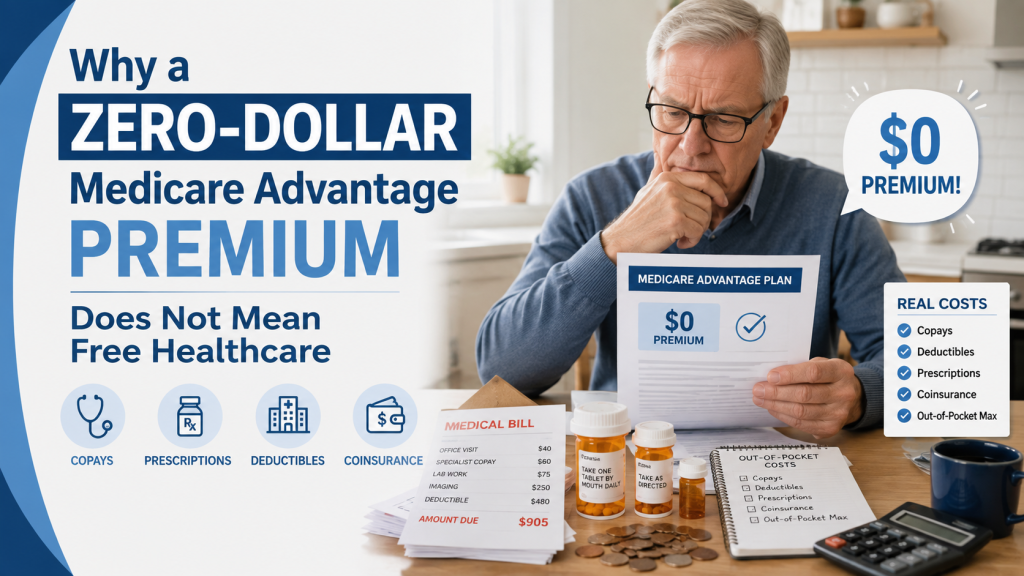
A $0 Medicare Advantage premium does not mean $0 healthcare.
It simply means that the Medicare Advantage plan itself does not charge you an additional monthly premium. You can still have substantial healthcare expenses during the year through your Medicare Part B premium, copayments, coinsurance, deductibles, prescription drug costs, and other out-of-pocket expenses.
That does not make a zero-premium Medicare Advantage plan bad. For many people, these plans can provide good coverage at a reasonable cost.
The problem comes when people confuse low premium with low total cost.
Those are two very different things.
What Does a $0 Medicare Advantage Premium Actually Mean?
Medicare Advantage, also called Medicare Part C, is offered by private insurance companies approved by Medicare.
Instead of receiving your Medicare-covered services directly through Original Medicare, the private Medicare Advantage plan administers your Medicare benefits.
Some Medicare Advantage plans charge an additional monthly premium.
Others charge $0.
When a plan advertises a $0 premium, it generally means you do not pay an additional monthly premium to that insurance company for the Medicare Advantage plan.
But Medicare explains that you normally must continue paying your Medicare Part B premium even when you enroll in a Medicare Advantage plan.
In 2026, the standard Medicare Part B premium is $202.90 per month, although higher-income beneficiaries may pay more.
That comes to more than $2,400 a year before you have visited a doctor, entered a hospital, filled a prescription, or received any other healthcare.
So right from the beginning, the phrase “zero-dollar plan” needs a little translation.
It means:
$0 additional plan premium.
It does not mean:
$0 healthcare expenses.
For more on how Medicare expenses fit together, read How Do I Know What My Out-of-Pocket Costs Will Be in Medicare?.
Premium Is Only One Piece of the Medicare Cost Puzzle
One of the biggest mistakes people make when comparing Medicare plans is asking:
“What is the monthly premium?”
That is certainly an important question.
But it should never be the only question.
A better question is:
“What could this healthcare plan actually cost me over an entire year?”
Your total costs can include:
- Medicare Part B premiums
- Medicare Advantage plan premiums, if any
- Medical deductibles
- Doctor copayments
- Specialist copayments
- Hospital copayments
- Outpatient surgery costs
- Diagnostic imaging
- Physical therapy
- Ambulance services
- Durable medical equipment
- Coinsurance
- Prescription drug expenses
The premium is simply the price of getting through the front door.
What happens after you walk through that door can matter much more.
The Copayment Problem
Many Medicare Advantage plans use copayments.
You might see something such as:
Primary care visit: $0 or a small copayment.
Specialist visit: perhaps $30, $40, $50 or more.
Urgent care: another copayment.
Emergency room: another copayment.
Physical therapy: a copayment for each visit.
Diagnostic imaging: perhaps a larger copayment or coinsurance.
The exact amounts vary significantly from one plan to another.
If you are relatively healthy and rarely use healthcare, those expenses might remain modest.
But healthcare usage can change very quickly.
Nobody wakes up January 1 and says:
“This is the year I plan on needing an MRI, three specialists, outpatient surgery and six weeks of physical therapy.”
Healthcare has an annoying habit of ignoring our financial plans.
That is why comparing Medicare plans based only on the premium can be misleading.
Hospital Costs Can Change the Equation Quickly
Hospitalization is where many beneficiaries discover just how different $0 premium and $0 cost really are.
Medicare Advantage plans can have their own cost-sharing structures for inpatient hospitalization.
Depending on the plan, you might pay a set amount per day for the first several days of hospitalization, a flat hospital copayment, or another form of cost sharing.
A serious hospitalization can therefore produce hundreds or even thousands of dollars in expenses.
Before selecting a Medicare Advantage plan, look carefully at the plan’s Summary of Benefits and Evidence of Coverage.
Do not simply ask:
“What does hospitalization cost?”
Ask:
“Exactly what would I owe if I were admitted to the hospital for three days? Five days? Seven days?”
That turns an abstract insurance number into something you can understand.
Then There Is Coinsurance
Copayments are usually fixed dollar amounts.
Coinsurance is different.
With coinsurance, you pay a percentage of the cost.
For example, certain Medicare Advantage services may require you to pay 10%, 20%, or another percentage of the plan-approved amount.
That percentage can become significant when the medical service itself is expensive.
Twenty percent of a $100 service is not particularly frightening.
Twenty percent of a $5,000 service gets your attention.
This is why we frequently say at MedicareSelfEnroll:
Do not evaluate Medicare based solely on premium. Evaluate the financial risk you are accepting in exchange for that premium.
The Maximum Out-of-Pocket Limit Matters
One important protection Medicare Advantage plans provide is an annual maximum out-of-pocket limit for covered Medicare Part A and Part B services.
Medicare says every Medicare Advantage plan has a yearly limit on what you pay for covered medical services. Once you reach your plan’s applicable limit, the plan generally pays 100% of covered services for the rest of the calendar year.
But here is where people sometimes misunderstand the number.
The maximum out-of-pocket amount is not what you automatically pay every year.
It represents the financial ceiling you could potentially approach if you need significant covered healthcare.
Think of it as your risk exposure.
Suppose two plans both have a $0 monthly premium.
Plan A might have relatively low copayments and a lower maximum out-of-pocket limit.
Plan B might have higher specialist, hospital and treatment costs and a substantially higher maximum out-of-pocket limit.
They both advertise:
$0 PREMIUM.
Yet financially, they are not remotely identical.
If you want to explore this subject further, see Medicare Advantage vs Supplement Plans: What Most Seniors Get Wrong.
Prescription Drugs Are Another Cost Category
Many Medicare Advantage plans include Part D prescription drug coverage.
Again, having drug coverage does not mean every prescription costs nothing.
Your costs can depend on:
- Whether your medication is on the formulary
- What drug tier it occupies
- Whether the plan has a drug deductible
- Which pharmacy you use
- Whether the pharmacy is preferred
- Whether prior authorization is required
- Whether step therapy applies
- Whether quantity limits apply
For 2026, Medicare Part D limits out-of-pocket spending on covered Part D prescriptions to $2,100 for the calendar year.
That is an important protection.
But again, the word covered matters.
If your prescription is not covered by your plan, or if you fail to meet a coverage requirement, the situation can become more complicated.
That is why prescriptions should always be checked individually before choosing a Medicare Advantage plan.
Do not simply ask whether the plan “includes drugs.”
Ask:
“Does this plan cover my drugs, at my pharmacy, and what will I actually pay?”
Networks Can Have a Financial Cost Too
Medicare Advantage plans commonly use provider networks.
Depending on whether you have an HMO, PPO or another type of plan, your costs and access to doctors can vary significantly.
You should verify:
- Your primary care physician
- Specialists
- Hospitals
- Medical groups
- Outpatient facilities
- Rehabilitation providers
- Preferred pharmacies
A plan may look inexpensive until you discover that the specialist or hospital you want is outside the network.
With some PPO plans, you may still receive out-of-network care, but your costs can be higher.
With many HMO plans, non-emergency out-of-network services may not be covered at all.
So network access is not simply a convenience issue.
It can also become a financial issue.
For help understanding what is actually available where you live, see What Medicare Plans Are Available in My Area?.
The Extra Benefits Are Real — But Look Closely
Many Medicare Advantage plans include additional benefits that Original Medicare normally does not provide.
These can include:
- Dental
- Vision
- Hearing
- Fitness memberships
- Transportation
- Over-the-counter allowances
- Meal programs
- Other supplemental benefits
These benefits can have real value.
But do not let a dental allowance or free gym membership distract you from the bigger financial picture.
You are buying health insurance first.
Dental benefits are valuable.
But if your hospital exposure is several thousand dollars, the free toothbrush is not the part of the contract you should be studying most closely.
Ask yourself:
What happens financially when I am sick?
That question often tells you far more about a Medicare plan than the list of extras advertised on television.
Why Can Insurance Companies Offer $0 Premium Plans?
A reasonable question is:
If I am not paying a monthly premium, how does the insurance company make money?
The answer is that Medicare pays private Medicare Advantage companies to provide Medicare-covered benefits to enrolled beneficiaries.
The companies then structure their plans using those government payments along with their own benefit design, networks, copayments, coinsurance and other cost-sharing arrangements.
That makes it possible for some companies in some counties to offer plans with no additional monthly premium.
There is nothing mysterious about it.
And there is nothing inherently wrong with it.
The danger is simply assuming that because the premium is zero, everything else must also be free.
It isn’t.
A $0 Premium Plan Can Still Be a Very Good Choice
None of this means seniors should avoid Medicare Advantage.
Quite the opposite.
For the right person, a $0-premium Medicare Advantage plan can make excellent financial sense.
Someone might prefer:
- Lower monthly fixed expenses
- One plan covering medical and prescription benefits
- Additional dental, vision or hearing coverage
- An annual medical out-of-pocket limit
- A local network that includes their doctors and hospitals
That can be an excellent tradeoff.
Another person may prefer paying higher monthly premiums for a Medicare Supplement because they want broader provider access and more predictable medical expenses.
Neither approach is automatically right.
That is why comparing Medicare Advantage and Medicare Supplement coverage should involve much more than looking at premiums.
Compare Risk Versus Premium
Here is a simple way to think about Medicare.
Imagine two buckets.
The first bucket is:
Money you know you will spend.
That includes monthly premiums.
The second bucket is:
Money you might have to spend.
That includes deductibles, copayments, coinsurance and other healthcare expenses.
A Medicare Supplement generally puts more money into the first bucket because you pay a higher monthly premium.
Medicare Advantage often puts less money into the first bucket but potentially more into the second.
Neither system magically eliminates healthcare costs.
They simply distribute the financial risk differently.
That is why Medicare is not just an insurance decision.
It is a financial decision.
Five Questions to Ask Before Choosing a $0 Premium Plan
Before enrolling simply because you see “$0 premium,” ask these questions:
- What is my maximum out-of-pocket exposure?
- What would I pay for hospitalization, specialists, diagnostic imaging and outpatient surgery?
- Are my doctors and hospitals in the network?
- Are all my prescriptions covered, and what will they cost?
- Could I comfortably afford this plan if I had a bad healthcare year instead of a good one?
That fifth question may be the most important.
Medicare should not be designed around the assumption that you will remain perfectly healthy.
Insurance exists because sometimes life refuses to cooperate.
Compare the Whole Plan — Not the Headline
A $0 Medicare Advantage premium can be attractive.
It can even be the right choice.
But it is only one number.
The real question is not:
“Can I get a zero-premium Medicare Advantage plan?”
The better question is:
“What will this plan cost me when I actually use healthcare?”
Look at the premium.
Then look beyond it.
Examine your doctors, hospitals, prescriptions, copayments, coinsurance, deductibles, network rules and maximum out-of-pocket exposure.
Medicare itself recommends comparing plan costs because Medicare Advantage premiums, deductibles, copayments and coinsurance can vary by plan.
At MedicareSelfEnroll.com, you can compare Medicare options and look beyond the advertising headline to the benefits and costs that actually matter to you.
Because when it comes to Medicare:
Zero premium does not mean zero cost.
And the cheapest-looking Medicare plan is not necessarily the plan that will cost you the least.
Education first. Enrollment second.

William Vargas brings over 50 years of financial and insurance expertise to every Medicare conversation. He operates MedicareSelfEnroll.com, helping seniors in Florida, New York, and North Carolina — with no pressure, no phone calls required.