In This Article
- What Is Medicare Part D?
- The 2026 Medicare Part D Out-of-Pocket Limit
- The Maximum Part D Deductible Is $615 in 2026
- Where Did the Medicare Donut Hole Go?
- The Cost of Prescription Drugs Did Not Disappear
- Your Part D Formulary Can Change
- Your Pharmacy Can Affect Your Costs
- Do Not Select a Part D Plan by Premium Alone
- The Medicare Prescription Payment Plan
- Medicare Drug Price Negotiation Has Begun
- Review Your Annual Notice of Change
- How to Prepare for the Next Medicare Enrollment Period
- The Bottom Line
Changes to Medicare prescription drug coverage have created plenty of confusion. Premiums are moving, deductibles are changing, drug formularies are being revised, and some insurance companies are reducing or restructuring their plan offerings.
That has led some Medicare beneficiaries to ask a frightening question:
Is Medicare Part D going away?
The answer is no.
Medicare Part D is not being eliminated. Medicare beneficiaries will continue to have access to prescription drug coverage through standalone Part D plans and Medicare Advantage plans that include prescription drug benefits.
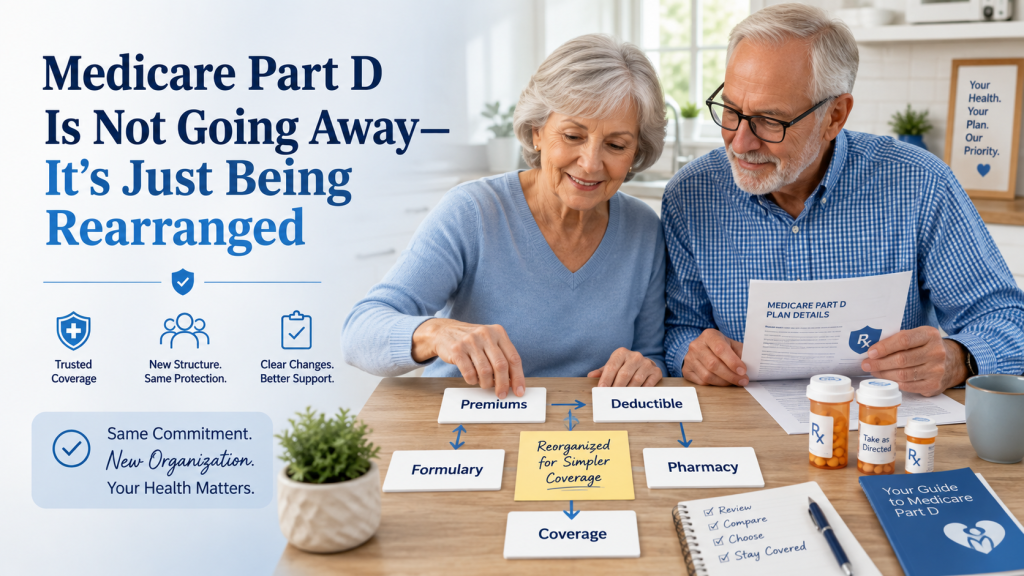
However, Medicare Part D is being rearranged.
The program now provides greater protection against extremely high prescription drug expenses, but the financial responsibilities of Medicare, insurance companies, drug manufacturers, and beneficiaries have changed.
As insurance companies adjust to the new rules, beneficiaries may see changes to premiums, deductibles, copayments, drug formularies, pharmacy networks, and available plans.
The program is not disappearing. But the Part D plan that worked well for you last year may not work exactly the same way next year.
What Is Medicare Part D?
Medicare Part D is the part of Medicare that helps pay for outpatient prescription medications.
Private insurance companies approved by Medicare offer Part D coverage. You can receive this coverage in one of two primary ways:
- A standalone Medicare Part D prescription drug plan used alongside Original Medicare.
- A Medicare Advantage plan that includes prescription drug coverage, commonly called an MAPD plan.
People enrolled in Original Medicare often purchase a separate Part D plan, especially when they also have a Medicare Supplement policy.
Most Medicare Advantage plans include prescription drug coverage as part of the plan.
Medicare Part D remains a central part of the Medicare program. What is changing is how costs are divided and how plans are designed.
The 2026 Medicare Part D Out-of-Pocket Limit
One of the most important improvements is the annual limit on what beneficiaries pay out of pocket for medications covered by their Part D plan.
For 2026, the annual Part D out-of-pocket threshold is $2,100. Once a beneficiary reaches that amount in qualifying out-of-pocket spending, the beneficiary generally pays nothing more for covered Part D prescriptions for the remainder of that calendar year.
This provides important financial protection for people who take expensive brand-name or specialty medications.
Before the Part D redesign, beneficiaries could continue paying a portion of their prescription expenses during the catastrophic coverage stage. Someone using a costly cancer, autoimmune disease, or diabetes medication could face thousands of dollars in annual drug expenses.
The out-of-pocket limit creates a clearer ceiling.
However, it is important to understand what the limit does—and what it does not do.
The $2,100 limit applies to covered Part D medications. Monthly plan premiums do not count toward the limit. Money spent on medications that are not covered by the plan may not count either.
The limit also does not eliminate formulary restrictions, prior authorization, quantity limits, or step therapy requirements.
It is valuable protection, but it operates within the rules of your particular Medicare drug plan.
The Maximum Part D Deductible Is $615 in 2026
The maximum allowable Medicare Part D deductible for 2026 is $615. Some plans may charge the full deductible, while others may offer a lower deductible or no deductible at all.
A plan may also apply the deductible differently depending on the drug tier.
For example, some plans may cover lower-cost generic medications before the deductible is met while requiring beneficiaries to satisfy the deductible before receiving coverage for brand-name and specialty drugs.
This is why beneficiaries should not assume that every Part D plan works the same way.
Two plans may have similar premiums but provide dramatically different coverage for the same group of prescriptions.
Where Did the Medicare Donut Hole Go?
For many years, Medicare beneficiaries worried about falling into the Part D coverage gap, commonly known as the Medicare donut hole.
The traditional donut hole has been eliminated under the redesigned Part D benefit.
Instead of moving through the old deductible, initial coverage, coverage-gap, and catastrophic stages, beneficiaries now receive stronger protection from high annual prescription expenses.
Eliminating the traditional coverage gap does not mean prescriptions have become free. Beneficiaries may still pay deductibles, copayments, or coinsurance until they reach the annual out-of-pocket threshold.
The difference is that there is now a more meaningful limit on how much a beneficiary may have to spend for covered Part D medications during the year.
The Cost of Prescription Drugs Did Not Disappear
Here is the part that often gets left out of the cheerful announcements:
The cost of prescription drugs did not simply vanish.
It was redistributed.
Under the redesigned Part D program, insurance companies are responsible for a larger portion of certain drug costs. Drug manufacturers also contribute discounts, while Medicare continues to pay part of the expense.
Beneficiaries receive greater protection from catastrophic costs, but insurance companies must still find a way to pay their share.
That may influence how plans are designed.
Some insurers may adjust premiums. Others may change copayments, deductibles, drug tiers, pharmacy networks, or formulary rules.
Some companies may reduce the number of standalone Part D plans they offer in a particular state or service area.
That is why the best way to describe what is happening is this:
Medicare Part D is not going away. It is being rearranged.
The house is still standing, but someone is moving the furniture.
Your Part D Formulary Can Change
A formulary is the list of medications covered by a Medicare prescription drug plan.
It also identifies the tier assigned to each medication and any special coverage rules that may apply.
A formulary may include:
- Tier 1 preferred generic drugs
- Tier 2 generic medications
- Tier 3 preferred brand-name drugs
- Tier 4 nonpreferred drugs
- Tier 5 specialty medications
The exact structure varies by plan.
A medication that was covered at a low copayment this year could move to a higher tier next year. A drug that previously required only a fixed copayment could become subject to percentage-based coinsurance.
A plan may also add prior authorization, step therapy, or quantity limits.
This means you cannot assume your coverage will remain unchanged just because you are taking the same medications.
Your pills may be the same. The plan’s treatment of those pills may be different.
Your Pharmacy Can Affect Your Costs
Many Medicare Part D plans have preferred pharmacy networks.
A preferred pharmacy generally offers lower plan-negotiated prices than a standard in-network pharmacy.
Your local pharmacy may continue accepting your plan but lose its preferred status. If that happens, you may pay more even though the pharmacy remains in the plan’s network.
Beneficiaries should compare prescription costs at the pharmacies they actually use.
Someone living in New York can begin by reviewing Medicare options through our New York Medicare plan page.
Beneficiaries living in North Carolina can review available coverage information through our North Carolina Medicare plan page.
Florida residents can begin their comparison through our Florida Medicare plan page.
Plan availability, costs, formularies, and pharmacy networks can vary by state, county, and ZIP code. A plan offered in Florida may not be available in New York or North Carolina, and plans offered by the same insurance company may work differently in different service areas.
Do Not Select a Part D Plan by Premium Alone
One of the most common Medicare mistakes is choosing the plan with the lowest monthly premium.
A low premium is attractive, but it does not reveal the plan’s total cost.
Imagine two prescription drug plans.
The first plan has a premium of $5 per month but places one of your medications on a high-cost nonpreferred tier.
The second plan has a premium of $25 per month but covers that same medication with a small copayment.
The plan with the higher premium could save you hundreds or even thousands of dollars over the course of the year.
When comparing plans, look at the estimated total annual cost, including:
- Monthly premiums
- The annual deductible
- Drug copayments
- Percentage-based coinsurance
- Pharmacy pricing
- Formulary coverage
- Prior authorization requirements
- Step therapy
- Quantity limits
The premium is only the admission ticket. It is not the final cost of the show.
The Medicare Prescription Payment Plan
The Medicare Prescription Payment Plan allows beneficiaries to spread their out-of-pocket prescription costs across the remaining months of the calendar year instead of paying the entire amount at the pharmacy counter.
All Medicare drug plans must offer this option, and participation is voluntary.
This may help someone who faces a large prescription expense early in the year.
For example, a beneficiary who fills an expensive prescription in January might prefer to spread that cost over several monthly payments instead of paying the full amount at once.
However, the Medicare Prescription Payment Plan does not lower the total price of the medication.
It is not an additional insurance policy.
It is not a discount card.
It simply changes when the beneficiary pays the amount owed.
Think of it as cutting a large bill into smaller monthly pieces. The pieces may be easier to manage, but they still belong to the same bill.
Medicare Drug Price Negotiation Has Begun
Another important Part D change is the Medicare Drug Price Negotiation Program.
Negotiated prices for the first 10 selected Medicare Part D medications took effect on January 1, 2026. These medications are used to treat conditions including diabetes, heart disease, autoimmune disorders, blood clots, and cancer.
More medications are being added during future negotiation cycles.
This may reduce spending for Medicare and lower out-of-pocket costs for some beneficiaries who use the selected medications.
However, it does not mean every Medicare prescription will suddenly become inexpensive.
A beneficiary’s actual savings will depend on the medication, the plan, the pharmacy, and the way the negotiated price affects the person’s cost-sharing.
Medicare rarely works in slogans. It works in details.
Review Your Annual Notice of Change
Every fall, your Medicare drug plan sends an Annual Notice of Change.
Do not throw it away.
Do not place it in a drawer with expired coupons, old instruction manuals, and batteries that may or may not still work.
Read it carefully.
The Annual Notice of Change explains what will be different in the coming year.
Pay particular attention to changes involving:
- Monthly premiums
- Deductibles
- Copayments and coinsurance
- Covered medications
- Drug tiers
- Preferred pharmacies
- Prior authorization
- Step therapy
- Quantity limits
You may be perfectly satisfied with your current plan, and it may continue to be your best option.
The purpose of reviewing your coverage is not to change plans merely for the sake of changing.
The purpose is to verify that your current plan still meets your needs.
Staying in a plan should be a decision—not an accident.
How to Prepare for the Next Medicare Enrollment Period
Before comparing Medicare drug plans, create an accurate prescription list.
Include:
- The exact name of each medication
- The dosage
- How often you take it
- The quantity received with each refill
- Whether you use a retail or mail-order pharmacy
- The pharmacy locations you prefer
Even a small difference in dosage or refill quantity can change a plan comparison.
You should also review whether each medication requires prior authorization, step therapy, or quantity limits.
Do not compare plans based on what your spouse, neighbor, brother, friend, or bowling partner takes.
Prescription drug coverage is personal because prescription needs are personal.
The Bottom Line
Medicare Part D is not going away.
Beneficiaries will continue to receive prescription coverage through standalone Medicare Part D plans and Medicare Advantage plans that include drug benefits.
The program now provides stronger protection against extremely high prescription expenses. The annual out-of-pocket cap can provide meaningful relief for people who take costly medications, while the Medicare Prescription Payment Plan may make large bills easier to manage.
But the cost of prescription drugs has not vanished.
It has been divided differently among beneficiaries, insurance companies, Medicare, and drug manufacturers.
As a result, insurers may change premiums, deductibles, drug formularies, copayments, pharmacy networks, and plan availability.
Do not panic—but do not ignore the changes.
Preparation reduces fear and brings peace of mind.
Review your medications, read your Annual Notice of Change, check your pharmacy, and compare the total annual cost of your coverage.
Whether you live in New York, North Carolina, or Florida, your Medicare choices depend on your location, prescriptions, healthcare needs, and budget.
At MedicareSelfEnroll.com, you can compare available Medicare plans privately, from home, and at your own pace.
There is no pressure, and no one needs to call you while you are eating dinner.
We do not represent every plan available in your area. We currently represent most major organizations. You can always contact Medicare directly or visit Medicare.gov to review all available choices.
Medicare Part D may be changing.
But understanding those changes can help you remain in control of your healthcare decisions.

William Vargas brings over 50 years of financial and insurance expertise to every Medicare conversation. He operates MedicareSelfEnroll.com, helping seniors in Florida, New York, and North Carolina — with no pressure, no phone calls required.