In This Article
- Medicare Eligibility Does Not Always Mean Automatic Enrollment
- Your Initial Enrollment Period
- What Happens If Your Birthday Is on the First Day of the Month?
- When Does Medicare Coverage Begin?
- Do You Have to Enroll at 65 If You Are Still Working?
- The Part B Special Enrollment Period
- The General Enrollment Period
- The Medicare Part B Late Enrollment Penalty
- When Can You Enroll in Medicare Advantage?
- Medicare Advantage Open Enrollment Period
- When Can You Join Medicare Part D?
- The Part D Late Enrollment Penalty
- Special Enrollment Periods for Medicare Plans
- Your Medigap Open Enrollment Period
- Important Medicare Dates at a Glance
- Five Steps to Avoid Missing a Medicare Deadline
- Compare Your Medicare Choices Privately
- The Bottom Line
Medicare enrollment would be much easier if everyone simply received a card on their 65th birthday and everything started automatically.
Unfortunately, Medicare has enrollment periods, deadlines, exceptions, penalties, and enough fine print to make a birthday cake look like government paperwork.
The good news is that the basic rules become much easier once you understand which enrollment period applies to your situation.
Some people are enrolled automatically. Others must actively apply. Some can delay Medicare because they are still working, while others may face lifelong penalties if they wait.
Here are the most important Medicare enrollment dates and deadlines you need to know.
Medicare Eligibility Does Not Always Mean Automatic Enrollment
Most people become eligible for Medicare when they turn 65. Some people qualify earlier because of a disability, End-Stage Renal Disease, or ALS.
However, becoming eligible does not always mean you will be enrolled automatically.
You will generally be enrolled automatically in Medicare Parts A and B if you are already receiving Social Security or Railroad Retirement Board benefits before turning 65. Your Medicare card is usually mailed before your coverage begins.
People who are not yet receiving Social Security benefits generally need to apply for Medicare themselves.
That distinction is important because many Americans now work beyond 65 and delay claiming Social Security. They may assume Medicare will contact them and handle everything automatically.
That assumption can lead to missed deadlines.
You can learn more in our guide, Turning 65? Here’s What You Need to Know About Medicare.
Your Initial Enrollment Period
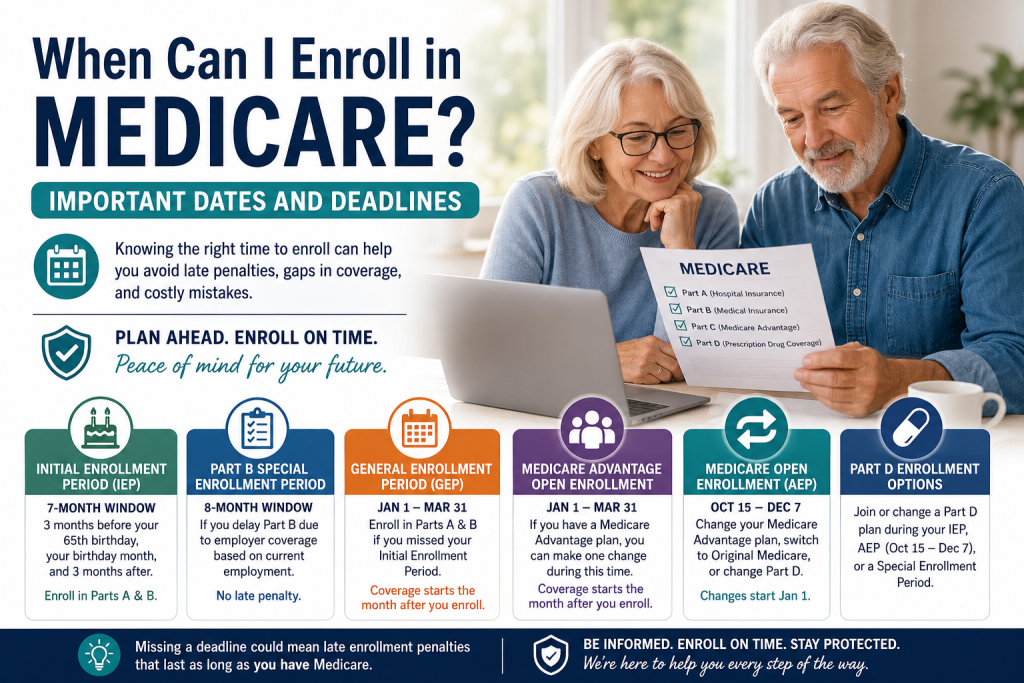
For most people, the first opportunity to enroll in Medicare is the Initial Enrollment Period, often called the IEP.
This is a seven-month period surrounding the month you turn 65. It includes:
- The three full months before your birthday month
- The month you turn 65
- The three full months after your birthday month
For example, suppose your 65th birthday is September 18.
Your Initial Enrollment Period would begin June 1 and end December 31.
The safest approach is usually to begin the process during the three months before your birthday month. This gives you time to receive your Medicare number, review your coverage choices, compare prescription drug plans, and avoid unnecessary gaps.
Medicare confirms that the Initial Enrollment Period is generally the first opportunity to sign up for Parts A and B. Coverage start dates depend on when you apply. (Medicare.gov)
What Happens If Your Birthday Is on the First Day of the Month?
Medicare has a special timing rule for people born on the first day of a month.
If your birthday is October 1, Medicare generally treats you as though your birthday occurred in September. Your eligibility and enrollment timeline may begin one month earlier than expected.
That may sound like a small technical detail, but it can affect when you should submit your application and when your coverage begins.
Do not rely only on a general birthday calculator. Confirm your effective date through Social Security or Medicare.
When Does Medicare Coverage Begin?
If you enroll before the month you turn 65, your Medicare coverage will generally begin on the first day of your birthday month.
If your birthday is on the first day of the month, coverage usually begins on the first day of the previous month.
If you enroll during your birthday month or during one of the three months afterward, your coverage generally begins the month after you sign up. (Medicare.gov)
This is one reason waiting until the last moment can be risky. You could create a gap between your old insurance and the beginning of Medicare.
Before retiring or ending employer coverage, confirm your exact Medicare effective date in writing.
Do You Have to Enroll at 65 If You Are Still Working?
Not necessarily.
You may be able to delay Medicare Part B without a penalty if you have health insurance based on your own current employment or your spouse’s current employment.
The important phrase is current employment.
Retiree coverage, COBRA, Veterans Affairs benefits, and individual marketplace insurance do not necessarily provide the same protection against Medicare late enrollment penalties.
The size of the employer can also matter. Medicare may be the primary payer for workers at smaller companies, while the employer plan may pay first at larger companies.
Do not assume your employer coverage allows you to delay Medicare safely. Ask the employer’s benefits administrator:
- Is this coverage based on current employment?
- Is the employer plan primary or secondary after age 65?
- Is the prescription coverage considered creditable?
- Do I need to enroll in Medicare Part A or Part B?
- Will my spouse’s coverage change when I turn 65?
- Can the employer provide its answers in writing?
Our article Do I Have to Take Medicare Part B? explains why this decision deserves careful attention.
The Part B Special Enrollment Period
If you delayed Part B because you had qualifying employer coverage based on current employment, you may be entitled to a Special Enrollment Period.
This Special Enrollment Period generally lasts for eight months after either:
- The employment ends, or
- The group health coverage based on that employment ends,
whichever occurs first.
Medicare states that people who qualify can generally sign up for Part B during this eight-month window without facing the standard late enrollment penalty. (Medicare.gov)
However, there is a trap.
COBRA does not extend the eight-month Medicare Special Enrollment Period.
Suppose you retire, keep your employer coverage temporarily through COBRA, and wait until COBRA ends before enrolling in Part B. By then, your Medicare Special Enrollment Period may already have expired.
You could face delayed coverage and a late enrollment penalty.
The same caution may apply to retiree insurance. Retiree coverage is generally not considered coverage based on current employment.
The safe move is to contact Social Security before your employment or employer health coverage ends.
The General Enrollment Period
People who miss their Initial Enrollment Period and do not qualify for a Special Enrollment Period may have to wait for the General Enrollment Period.
The General Enrollment Period runs every year from:
January 1 through March 31
If you enroll in Part A or Part B during this period, coverage generally begins the first day of the month after you sign up. (Medicare.gov)
The General Enrollment Period can help someone correct a missed enrollment, but it does not automatically erase late enrollment penalties.
That is why it is much better to understand your deadline before you miss it.
Read Missing Your Medicare Initial Enrollment Period Can Cost You for Life for a more detailed explanation.
The Medicare Part B Late Enrollment Penalty
The Part B penalty can be expensive because it may continue for as long as you have Part B.
In general, your monthly Part B premium may increase by 10% for every complete 12-month period you were eligible for Part B but did not enroll.
For example, waiting two full years without qualifying employer coverage could create a 20% penalty.
Medicare explains that this additional amount is generally added to your monthly Part B premium and may last for as long as you have Medicare.
The penalty is not a one-time late fee.
It can become a permanent addition to your Medicare expenses.
When Can You Enroll in Medicare Advantage?
You generally need both Medicare Part A and Part B before joining a Medicare Advantage plan.
When you first become eligible for Medicare, you may have an opportunity to choose a Medicare Advantage plan during your initial enrollment window.
After that, the major annual opportunity is the Medicare Open Enrollment Period, which runs from:
October 15 through December 7
During this period, people with Medicare can generally:
- Change from Original Medicare to Medicare Advantage
- Change from Medicare Advantage back to Original Medicare
- Switch from one Medicare Advantage plan to another
- Join, change, or drop a Medicare Part D plan
Changes made by December 7 generally take effect January 1 of the following year. (Medicare.gov)
This period is sometimes called the Annual Election Period.
Even when you are satisfied with your present coverage, it is wise to review your plan every fall. Premiums, copayments, provider networks, drug formularies, and supplemental benefits can change.
A plan that worked well this year may not be the best choice next year.
Medicare Advantage Open Enrollment Period
There is a separate enrollment period for people who are already enrolled in Medicare Advantage.
The Medicare Advantage Open Enrollment Period runs from:
January 1 through March 31
During this period, a person already in Medicare Advantage may generally:
- Switch to another Medicare Advantage plan, or
- Leave Medicare Advantage and return to Original Medicare
A person returning to Original Medicare may also be able to join a separate Part D prescription drug plan.
However, you cannot use this period to move from Original Medicare into Medicare Advantage. You also cannot generally use it to switch from one standalone Part D plan to another.
Only one Medicare Advantage change is generally permitted during this period. The new coverage normally begins the first day of the month after the plan receives the enrollment request.
When Can You Join Medicare Part D?
Medicare Part D provides outpatient prescription drug coverage.
You can usually join a Part D plan when you first become eligible for Medicare. You may also join, drop, or change Part D coverage during Medicare Open Enrollment from October 15 through December 7.
Special Enrollment Periods may be available after certain life events, such as losing employer or union drug coverage.
Even if you do not take many prescriptions, delaying Part D without other creditable drug coverage can create a late enrollment penalty.
Medicare recommends considering drug coverage when you first become eligible, even if you currently take few or no medications. (Medicare.gov)
The Part D Late Enrollment Penalty
You may owe a Part D penalty if you go 63 consecutive days or more without either Medicare drug coverage or other creditable prescription coverage after becoming eligible.
The penalty is generally calculated as 1% of the national base beneficiary premium for each uncovered month.
The amount can change from year to year, and you may continue paying it for as long as you have Part D coverage.
Keep all letters showing that your employer, union, retiree, VA, or other drug coverage was considered creditable.
You may need that documentation later.
Special Enrollment Periods for Medicare Plans
You may be allowed to join or change a Medicare Advantage or Part D plan outside the regular annual enrollment periods after certain life events.
These Special Enrollment Periods may apply if you:
- Move outside your plan’s service area
- Return to the United States after living abroad
- Lose employer or union coverage
- Lose Medicaid eligibility
- Move into or out of a nursing home or qualifying institution
- Qualify for Medicaid or Extra Help
- Leave a Program of All-Inclusive Care for the Elderly
- Enroll in or leave certain Special Needs Plans
- Experience an official plan termination
- Receive incorrect or misleading enrollment information
The length of the Special Enrollment Period depends on the event.
For example, after losing employer or union health coverage, the opportunity to join a Medicare Advantage or drug plan generally lasts for two full months after the month the coverage ends. Moving outside a plan’s service area may also provide a limited period to change coverage.
Do not assume that every change in your life qualifies. Confirm the rules before canceling existing coverage.
Your Medigap Open Enrollment Period
Medigap has its own enrollment rules.
Your federal Medigap Open Enrollment Period lasts for six months. It begins the first month that you are both:
- Age 65 or older, and
- Enrolled in Medicare Part B
During this six-month period, you generally have the right to purchase any Medigap policy sold in your state without medical underwriting.
After this window ends, an insurance company may be allowed to ask health questions, charge more, or decline an application unless you have a guaranteed-issue right or live in a state with stronger protections.
This Medigap window does not repeat every year.
That is a major difference between Medigap Open Enrollment and the annual Medicare Open Enrollment Period.
Also remember that switching from Medicare Advantage to Original Medicare does not automatically guarantee that you can purchase a Medigap policy.
Important Medicare Dates at a Glance
Here are the major dates most beneficiaries should remember:
Three months before your 65th birthday month:
Your Initial Enrollment Period usually begins.
Your birthday month:
You are generally first eligible for Medicare at age 65.
Three months after your birthday month:
Your Initial Enrollment Period usually ends.
January 1 through March 31:
General Enrollment Period for Parts A and B.
January 1 through March 31:
Medicare Advantage Open Enrollment for people already enrolled in Medicare Advantage.
October 15 through December 7:
Medicare Open Enrollment for Medicare Advantage and Part D changes.
January 1:
Most coverage changes selected during fall Open Enrollment take effect.
Eight months after qualifying employer coverage or employment ends:
The usual Special Enrollment Period for Part B.
Two months after many qualifying plan or coverage changes:
A common timeframe for Medicare Advantage or Part D Special Enrollment Periods, although the exact rule varies.
Five Steps to Avoid Missing a Medicare Deadline
First, begin researching Medicare at least three months before your 65th birthday.
Second, do not assume enrollment will happen automatically.
Third, if you are working after 65, get written information from your employer about whether your coverage allows you to delay Part B and Part D.
Fourth, keep proof of creditable prescription drug coverage.
Finally, review your coverage every fall—even when you like your current plan.
Medicare enrollment is not something to put off until the last week.
Procrastination may be harmless when you are cleaning the garage. With Medicare, it can lead to coverage gaps and penalties that follow you for years.
Compare Your Medicare Choices Privately
Once you have Medicare Parts A and B, your next decision may involve choosing between Original Medicare with separate coverage or a Medicare Advantage plan.
The right choice depends on your doctors, prescriptions, hospitals, travel habits, budget, and personal preferences.
At MedicareSelfEnroll.com, you can compare available Medicare plans privately and enroll online at your own pace.
There is no pressure and no requirement to schedule an appointment.
For location-specific guidance, visit our Medicare plan pages for New York, Florida, or North Carolina.
We do not represent every plan available in every area, but we represent most of the major Medicare companies in the areas where we are licensed.
The Bottom Line
The most important Medicare deadline is the one that applies to you.
For many people, that will be the seven-month Initial Enrollment Period surrounding their 65th birthday.
For someone continuing to work, it may be the eight-month Part B Special Enrollment Period after employer coverage ends.
For existing Medicare beneficiaries, the most important annual dates are October 15 through December 7.
Do not assume that your employer, Social Security, Medicare, or an insurance company will warn you before every deadline.
Ask questions early. Keep written records. Verify your coverage dates before canceling another policy.
Preparation removes uncertainty and brings peace of mind.
Medicare gives you choices—but those choices work best when you act before the clock runs out.
This article is for general educational purposes and is not legal, tax, financial, or individualized insurance advice. Medicare rules and plan availability may change. Contact Social Security, Medicare, your employer benefits administrator, or a licensed Medicare professional for guidance based on your circumstances.

William Vargas brings over 50 years of financial and insurance expertise to every Medicare conversation. He operates MedicareSelfEnroll.com, helping seniors in Florida, New York, and North Carolina — with no pressure, no phone calls required.