In This Article
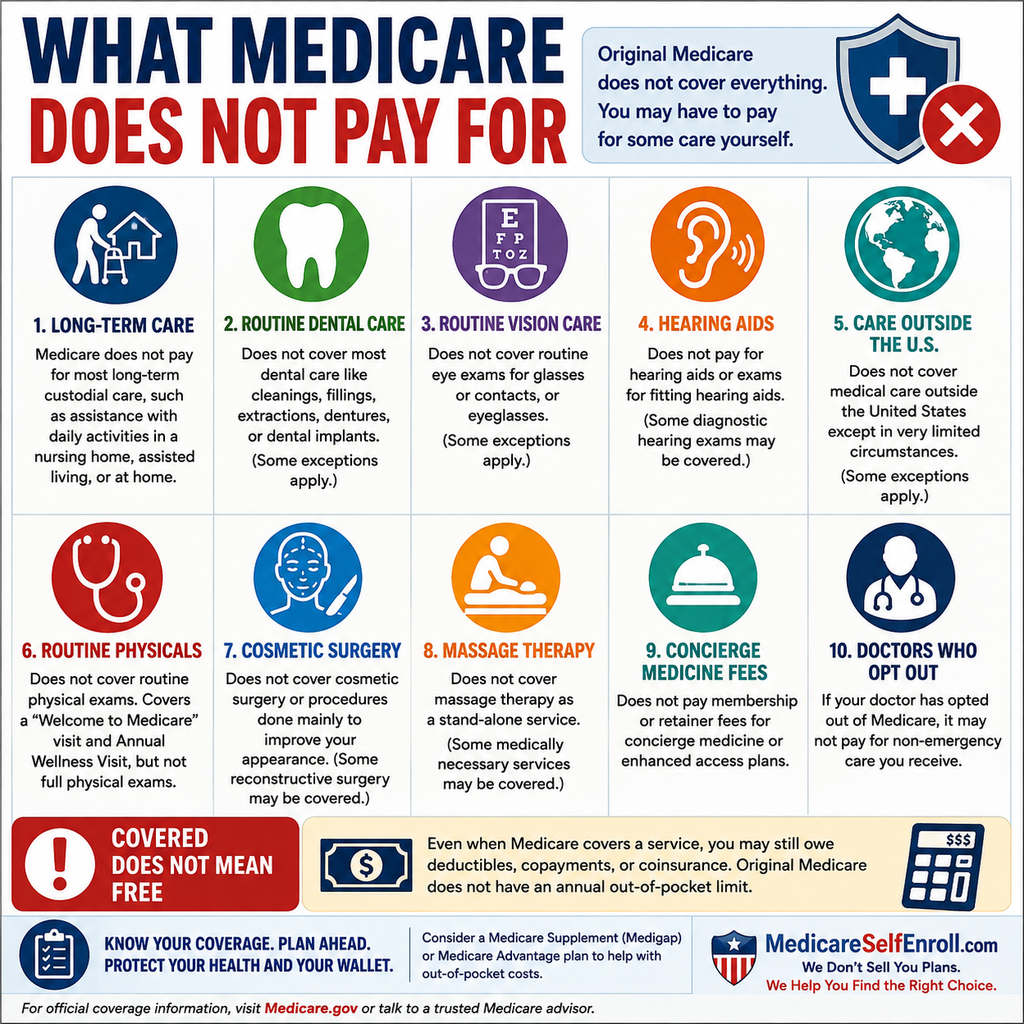
- 1. Long-Term Care — The Big One
- 2. Most Routine Dental Care
- 3. Routine Eye Exams and Eyeglasses
- 4. Hearing Aids
- 5. Most Healthcare Outside the United States
- 6. Routine Physical Examinations
- 7. Cosmetic Surgery
- 8. Massage Therapy
- 9. Concierge Medicine Fees
- 10. Doctors Who Opt Out of Medicare
- But Here’s the Bigger Misunderstanding: “Covered” Does Not Mean “Free”
- Medicare Advantage May Cover Some of These Gaps
- Medigap Doesn’t Fill Every Gap Either
- The Question to Ask Before You Need the Care
- The Bottom Line
When you turn 65 and finally get your Medicare card, it is easy to feel as though one of life’s biggest financial worries has been taken care of.
You have Medicare.
You’re covered.
Right?
Well… mostly.
And that little word “mostly” can become very expensive.
Medicare provides remarkably broad healthcare coverage for millions of older Americans. But Medicare was never designed to pay for every healthcare expense you might encounter during retirement.
Some of the things it does not routinely cover are exactly the things older people are increasingly likely to need.
Dental work.
Hearing aids.
Eyeglasses.
Long-term custodial care.
Healthcare outside the United States.
And even when Medicare does cover a medical service, that doesn’t necessarily mean you pay nothing.
That distinction is enormously important.
So before assuming Medicare has you covered from head to toe for the rest of your life, let’s look at what Medicare doesn’t pay for.
1. Long-Term Care — The Big One
This may be the most important Medicare misunderstanding of all.
Medicare does not pay for most long-term custodial care.
We’re talking about the kind of care someone may eventually need because they can no longer perform everyday activities independently.
Things like:
- Bathing
- Dressing
- Eating
- Using the bathroom
- Getting in and out of bed
- General personal assistance
Medicare describes this as long-term care or custodial care and says that it does not pay for it when that is the primary type of care you need.
That includes care that may be provided in a nursing home, assisted-living setting, community program, or sometimes at home.
And here’s where the confusion begins.
Medicare can cover limited skilled nursing facility care when certain medical requirements are met.
But skilled nursing care and long-term custodial care are not the same thing.
A skilled nursing facility might provide temporary rehabilitation after a hospitalization, surgery, stroke, or serious illness.
Medicare Part A may cover that care for a limited period when you meet the rules.
That does not mean Medicare will pay indefinitely because you can no longer live independently.
This is why long-term care deserves a place in retirement planning alongside Social Security, housing, investments, and Medicare.
If you want more information, Medicare has an excellent explanation of long-term care coverage.
Because when someone needs years rather than weeks of assistance, the financial consequences can be enormous.
2. Most Routine Dental Care
Your teeth apparently didn’t get the memo that you became eligible for Medicare.
They continue needing attention.
Original Medicare generally does not cover routine dental services such as:
- Cleanings
- Fillings
- Most extractions
- Dentures
- Dental implants
There are limited circumstances when Medicare may pay for dental services that are directly connected with certain covered medical treatments.
For example, Medicare may cover certain dental work required before an organ transplant, heart valve procedure, dialysis-related treatment, or some cancer therapies.
But needing a crown because your tooth cracked?
That is a different matter.
You may be paying for it yourself unless you have separate dental coverage or another plan that provides dental benefits.
Some Medicare Advantage plans include dental benefits, but those benefits vary considerably from plan to plan.
Don’t simply ask:
“Does the plan have dental?”
Ask:
“How much dental does it actually cover?”
Those are two very different questions.
A $1,000 dental allowance sounds wonderful until the dentist presents you with a $5,000 treatment plan.
3. Routine Eye Exams and Eyeglasses
Original Medicare generally does not cover routine eye examinations simply to determine whether you need a new prescription for glasses. It also generally does not pay for ordinary eyeglasses or contact lenses.
There are exceptions.
Medicare covers certain eye-related medical services, including testing and treatment connected with conditions such as glaucoma, diabetes, and macular degeneration when eligibility requirements are met.
Medicare may also provide limited coverage for corrective lenses following cataract surgery involving an intraocular lens.
But routine vision care is one of the areas Original Medicare generally leaves out. Medicare specifically lists eye exams for prescription eyeglasses among services it doesn’t routinely cover.
Again, some Medicare Advantage plans offer additional vision benefits.
The important word is additional.
Those benefits come from the private Medicare Advantage plan, not from Original Medicare itself.
4. Hearing Aids
Now we arrive at something that becomes particularly relevant as we grow older.
Hearing.
Original Medicare generally does not pay for hearing aids or examinations performed solely for fitting hearing aids.
Medicare Part B can cover certain diagnostic hearing and balance examinations when medically necessary and ordered to determine whether medical treatment is needed.
But that expensive pair of hearing aids?
Usually not through Original Medicare.
And hearing aids can easily cost thousands of dollars.
Some Medicare Advantage plans include hearing benefits, but once again, you have to look beneath the headline.
What brands are covered?
What level of technology?
Is there a copayment?
Is the stated benefit per ear or per pair?
Must you use a particular hearing provider?
How often can you replace them?
“HEARING BENEFIT INCLUDED” looks terrific in 24-point type.
The details usually live farther down the page.
5. Most Healthcare Outside the United States
This one surprises travelers and retirees considering living abroad.
Medicare generally does not cover healthcare you receive outside the United States.
There are a few narrow exceptions, including certain situations involving foreign hospitals closer than an appropriate U.S. hospital and limited circumstances while traveling between Alaska and another state through Canada.
But these are exceptions, not normal international medical coverage.
Medicare also says its drug plans generally do not cover prescription drugs purchased outside the United States.
So if your retirement dream involves six months in Italy, Portugal, Costa Rica, Mexico, Thailand, or anywhere else overseas, your Medicare card does not suddenly become an international health insurance card when your passport gets stamped.
Some Medigap policies provide limited foreign-travel emergency benefits, and travelers may also purchase separate travel medical insurance.
You can review the government’s explanation at Medicare’s travel outside the United States page.
This is also one reason retiring abroad deserves more planning than simply comparing housing costs.
6. Routine Physical Examinations
Here’s another Medicare language trap.
Medicare covers a “Welcome to Medicare” preventive visit and an Annual Wellness Visit when eligibility requirements are met.
But an Annual Wellness Visit is not necessarily the traditional head-to-toe physical examination many people imagine.
Original Medicare lists routine physical exams among services it does not generally cover.
That doesn’t mean Medicare doesn’t cover preventive medicine.
It covers many screenings, vaccines, tests, counseling services, and preventive services.
But terminology matters.
Ask your doctor’s office exactly what type of appointment is being scheduled and whether Medicare covers it.
Otherwise, the first indication that something wasn’t covered may arrive in your mailbox.
7. Cosmetic Surgery
Want Medicare to pay because something is medically necessary?
Possibly.
Want Medicare to pay because you’d like to look twenty years younger?
Good luck with that.
Medicare generally does not cover cosmetic surgery performed solely to improve appearance.
There can be exceptions when reconstructive surgery is medically necessary—for example, following an injury or certain medical treatments.
But elective cosmetic procedures are generally your responsibility.
Apparently Medicare believes wrinkles are a feature, not a diagnosis.
8. Massage Therapy
Massage can feel wonderful.
Your back may love it.
Medicare, however, generally doesn’t cover massage therapy as a standalone service. It is specifically included on Medicare’s list of commonly non-covered services.
That does not mean Medicare never covers rehabilitative treatment.
Physical therapy, occupational therapy, chiropractic treatment under limited circumstances, and other medically necessary services may be covered when Medicare’s requirements are met.
But don’t assume that every treatment someone calls “therapeutic” automatically becomes a Medicare benefit.
9. Concierge Medicine Fees
Concierge medicine has become increasingly popular.
You pay a physician an annual or monthly membership fee in exchange for things such as easier appointments, additional access, longer visits, or enhanced services.
Medicare generally doesn’t pay those membership or retainer fees.
Medicare may continue to cover eligible Medicare-covered medical services provided by a participating doctor, depending on the arrangement.
But the concierge membership itself?
That can be your expense.
10. Doctors Who Opt Out of Medicare
Another area people don’t always realize exists:
Some doctors choose to opt out of Medicare.
If you voluntarily receive non-emergency care from a physician who has formally opted out of Medicare, Medicare generally will not pay for that care, and you may enter into a private contract with the doctor agreeing to pay the bill yourself. Medicare specifically identifies services from opted-out providers as potentially non-covered except in certain emergency or urgent situations.
This is particularly worth checking before seeing specialists.
Never assume that because you’re 72 and the doctor treats older patients, the doctor accepts Medicare.
Ask.
But Here’s the Bigger Misunderstanding: “Covered” Does Not Mean “Free”
This is where Medicare gets financially interesting.
A service can be completely legitimate.
Medically necessary.
Approved by Medicare.
And covered by Medicare.
And you can still owe money.
Under Original Medicare, beneficiaries can face deductibles and coinsurance.
For example, after meeting the Part B deductible, you commonly pay 20% of the Medicare-approved amount for many Part B services.
And unlike Medicare Advantage plans, Original Medicare by itself does not have a general annual maximum out-of-pocket ceiling for Part A and Part B expenses.
That is one reason many people add a Medicare Supplement—or choose Medicare Advantage instead.
But those approaches create different financial tradeoffs.
A Medicare Supplement generally involves paying a higher predictable premium to reduce certain out-of-pocket exposure.
Medicare Advantage may have a lower monthly premium but can require copayments and coinsurance as services are used, up to the plan’s medical maximum out-of-pocket limit.
That brings us back to one of the most important principles in Medicare:
Premium is not the same thing as cost.
And neither is “covered.”
Medicare Advantage May Cover Some of These Gaps
Medicare Advantage plans must cover almost all medically necessary services covered by Original Medicare, and many plans provide additional benefits that Original Medicare doesn’t routinely offer, such as some dental, vision, and hearing coverage.
That can be valuable.
But don’t make the opposite mistake and assume Medicare Advantage automatically covers everything either.
Benefits vary by:
- Plan
- County
- Insurance company
- Provider network
- Benefit limits
- Copayments
- Prior authorization requirements
One plan may offer a generous dental allowance.
Another may provide very little.
One might provide hearing-aid coverage every few years.
Another might require substantial cost sharing.
You have to read the actual plan benefits.
Medigap Doesn’t Fill Every Gap Either
People sometimes hear “Medicare Supplement” and assume it supplements everything Medicare doesn’t cover.
That’s not how it works.
Medigap primarily helps pay certain deductibles, coinsurance, and copayments associated with Medicare-covered services.
Medigap plans generally do not pay for long-term custodial care, routine dental care, routine vision care, hearing aids, or private-duty nursing.
Some plans do provide limited foreign-travel emergency coverage.
But a Medicare Supplement is not an all-purpose healthcare policy.
That distinction is essential.
The Question to Ask Before You Need the Care
Most people learn what Medicare doesn’t cover at exactly the wrong moment:
When they need it.
A better approach is to ask beforehand:
“If Medicare doesn’t pay for this, what is my plan?”
Maybe you will self-pay for dental care.
Maybe your Medicare Advantage plan includes hearing benefits.
Maybe you’ll buy travel medical insurance when going overseas.
Maybe you’ll earmark savings for future long-term care.
Maybe Medicaid could eventually play a role if you meet financial and eligibility requirements.
The answer will be different for everyone.
But there should be an answer.
Because the most dangerous Medicare expense is often not the one with the biggest number.
It’s the one you never knew you were responsible for.
The Bottom Line
Medicare is excellent health insurance.
But Medicare is not everything insurance.
It was never designed to pay every healthcare bill you encounter from 65 until the end of your life.
That is why choosing Medicare coverage should involve more than asking:
“What is my premium?”
Ask instead:
What does this cover?
What doesn’t it cover?
What could I have to pay myself?
What happens in a bad health year?
What happens if I need long-term care?
What happens if I need expensive dental or hearing care?
What happens if I travel overseas?
Those aren’t pessimistic questions.
They’re retirement-planning questions.
And when you understand the gaps before they become emergencies, Medicare becomes considerably easier to manage.
Know what Medicare pays for.
But just as importantly:
Know what it doesn’t.
For official coverage information, you can always use Medicare.gov to check whether a particular test, service, or item is covered.
And at MedicareSelfEnroll.com, our philosophy is simple:
We Don’t Sell You Plans. We Help You Find the Right Choice.

William Vargas brings over 50 years of financial and insurance expertise to every Medicare conversation. He operates MedicareSelfEnroll.com, helping seniors in Florida, New York, and North Carolina — with no pressure, no phone calls required.