In This Article
- What Is Medicare IRMAA?
- How Medicare Determines Whether You Pay IRMAA
- The 2026 IRMAA Income Brackets
- IRMAA Can Also Increase Your Part D Costs
- What Counts as Income for IRMAA?
- IRMAA Has a “Cliff” Effect
- What If Your Income Has Gone Down?
- IRMAA Is Recalculated Every Year
- Does Choosing Medicare Advantage Avoid IRMAA?
- Can Your Medicare Agent Get IRMAA Removed?
- The Bigger Medicare Lesson
- Final Thought
Most people entering Medicare expect to pay the standard Medicare Part B premium.
Then a letter from Social Security arrives with an unpleasant surprise:
Your Medicare premium is higher than everyone told you it would be.
Welcome to IRMAA.
It sounds like a tropical storm, but for higher-income Medicare beneficiaries, it can feel almost as damaging to the monthly budget.
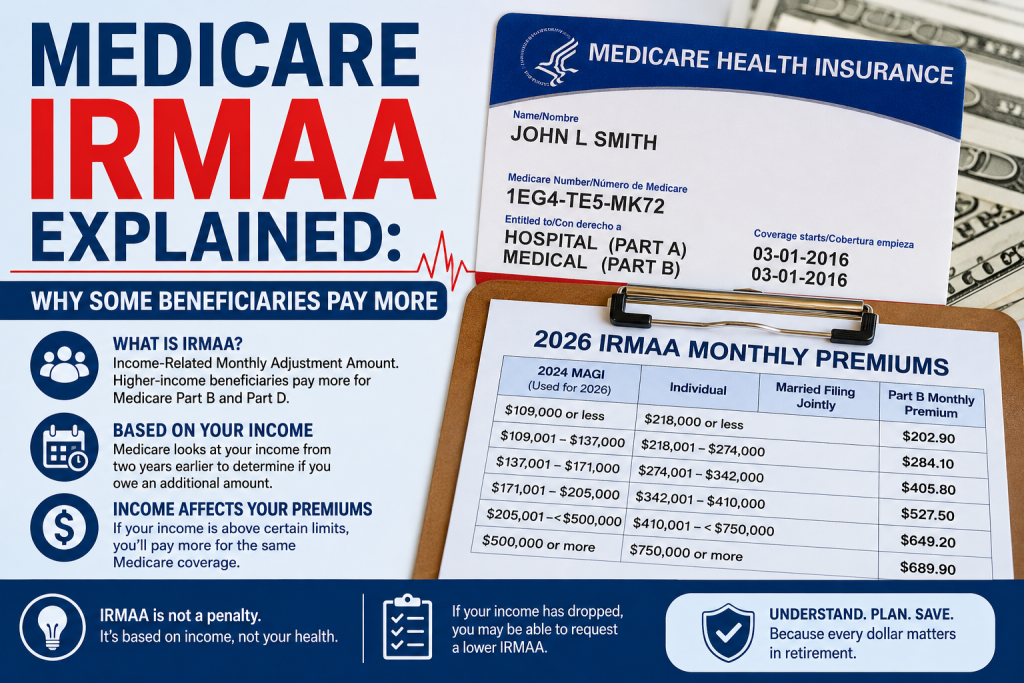
IRMAA stands for Income-Related Monthly Adjustment Amount. It is an additional amount some Medicare beneficiaries must pay for Medicare Part B and Medicare Part D because their income exceeds certain limits.
And here’s the part that catches many retirees off guard:
Medicare generally looks at your income from two years earlier.
So the income that determines what you pay for Medicare today may not resemble the income you’re living on today.
Understanding IRMAA before retirement, before selling investments, or before making a large Roth conversion can potentially prevent some expensive surprises.
What Is Medicare IRMAA?
Most Medicare beneficiaries pay the standard Part B premium.
For 2026, that standard Medicare Part B premium is $202.90 per month. CMS estimates that roughly 8% of people with Medicare Part B pay an additional income-related amount.
IRMAA is not a separate insurance plan.
It doesn’t give you additional benefits.
You don’t receive better doctors, a private room, or a complimentary fruit basket.
You simply pay more for the same Medicare coverage because your income is above the government’s designated thresholds.
IRMAA can affect both:
Medicare Part B, which generally covers doctors and outpatient medical services.
Medicare Part D, which covers outpatient prescription drugs.
You can learn more about current Medicare costs directly from Medicare.gov’s Medicare cost information.
How Medicare Determines Whether You Pay IRMAA
Social Security generally uses the modified adjusted gross income, or MAGI, reported on your federal income tax return from two years earlier.
For 2026 Medicare premiums, Social Security generally looks at your 2024 income.
That two-year lookback is one of the most important things for retirees to understand.
Suppose you earned $180,000 in 2024.
Then you retired in 2025, and your income dropped dramatically.
When 2026 arrives, Medicare may initially calculate your IRMAA using that much higher 2024 income.
You might look at the letter and think:
“But I don’t make that anymore!”
And you may be absolutely correct.
Fortunately, there is a process for requesting that Social Security reconsider your IRMAA when your income has fallen because of certain qualifying life-changing events.
We’ll get to that shortly.
The 2026 IRMAA Income Brackets
For 2026, individuals with modified adjusted gross income of $109,000 or less and married couples filing jointly with MAGI of $218,000 or less pay the standard $202.90 monthly Part B premium.
Above those thresholds, the Part B premium rises in steps.
| 2024 MAGI Used for 2026 | Single | Married Filing Jointly | 2026 Part B Monthly Premium |
|---|---|---|---|
| Standard bracket | $109,000 or less | $218,000 or less | $202.90 |
| First IRMAA bracket | Over $109,000–$137,000 | Over $218,000–$274,000 | $284.10 |
| Second bracket | Over $137,000–$171,000 | Over $274,000–$342,000 | $405.80 |
| Third bracket | Over $171,000–$205,000 | Over $342,000–$410,000 | $527.50 |
| Fourth bracket | Over $205,000–under $500,000 | Over $410,000–under $750,000 | $649.20 |
| Highest bracket | $500,000 or more | $750,000 or more | $689.90 |
These are not small differences.
Someone in the highest bracket pays $689.90 per month for Part B rather than $202.90.
That’s an additional $487 every month — $5,844 over a full year.
And if both spouses are on Medicare and subject to IRMAA, each spouse pays his or her own higher Medicare premium.
That is why IRMAA can become a meaningful retirement-planning issue.
IRMAA Can Also Increase Your Part D Costs
Part B isn’t the only place IRMAA appears.
Higher-income beneficiaries can also pay an additional amount for Medicare Part D prescription drug coverage.
For 2026, the monthly Part D IRMAA amounts range from $14.50 to $91, depending on income. This is added to whatever premium your Part D plan normally charges.
Here’s an important distinction:
Your Part D plan doesn’t collect the IRMAA simply because it is your drug plan.
The income-related adjustment is generally paid to Medicare, often through deductions from your Social Security benefit or through a Medicare bill.
So if your prescription plan costs $40 per month and your Part D IRMAA is $60.40, you’re effectively dealing with $100.40 per month between the plan premium and the income-related adjustment.
What Counts as Income for IRMAA?
IRMAA is based on modified adjusted gross income.
For Medicare IRMAA purposes, that generally means your adjusted gross income plus certain tax-exempt interest.
That means income sources retirees sometimes don’t think of as “income” can affect Medicare premiums.
Examples can include:
Wages.
Pension income.
Taxable Social Security benefits.
Traditional IRA withdrawals.
401(k) distributions.
Capital gains.
Investment income.
Roth conversions.
Certain business income.
Tax-exempt interest.
This is where Medicare suddenly becomes part of financial planning.
Imagine selling a highly appreciated investment.
You may have needed the money for a perfectly legitimate reason.
But the capital gain could push your income into another IRMAA bracket.
Or perhaps you perform a large Roth IRA conversion.
That conversion might make excellent long-term tax sense.
But it can also temporarily increase MAGI and potentially trigger higher Medicare premiums two years later.
That doesn’t mean you shouldn’t sell investments or perform Roth conversions.
It means the Medicare consequences should be part of the calculation.
At Medicare Self Enroll, we encourage seniors to look beyond the monthly plan premium and understand the broader financial consequences of Medicare decisions.
IRMAA Has a “Cliff” Effect
One of the frustrating features of IRMAA is that the brackets can behave like cliffs.
If your income crosses into the next bracket, even by a relatively small amount, your Medicare premium can increase.
Suppose a married couple is close to an IRMAA threshold and realizes an additional capital gain late in the year.
That additional income could potentially move them into the next IRMAA bracket.
The financial impact may therefore be larger than simply the additional income tax.
This is why someone approaching Medicare age may want to discuss income planning with a qualified tax professional or financial adviser.
You’re no longer simply asking:
“How much tax will this transaction create?”
You may also need to ask:
“Could this affect my Medicare premiums two years from now?”
That’s a question many people don’t think about until the Social Security letter arrives.
What If Your Income Has Gone Down?
This may be the most important section for recently retired seniors.
Suppose Social Security uses income from two years ago, when you were earning a substantial salary.
But now you’ve retired.
Your current income is dramatically lower.
Are you simply stuck paying IRMAA?
Not necessarily.
Social Security allows beneficiaries to ask for a new IRMAA determination when income has decreased because of certain life-changing events.
According to Social Security, these can include situations such as work stoppage or reduction, marriage, divorce, death of a spouse, loss of certain income-producing property, loss of pension income, or an employer settlement payment.
The form commonly used is Form SSA-44.
You can review Social Security’s official information about lowering IRMAA through Social Security’s Medicare premium guidance.
Retirement is especially important.
If you stopped working and your income dropped substantially, don’t simply assume the IRMAA determination is permanent.
Contact Social Security and find out whether you qualify to request a reconsideration based on your changed circumstances.
IRMAA Is Recalculated Every Year
Another misconception is that once you’re subject to IRMAA, you’ll always pay it.
That’s not necessarily true.
IRMAA is reassessed annually.
If your income declines, your adjustment may decline or disappear in a later year.
If your income rises, IRMAA may increase.
The income limits themselves can also change from year to year.
That’s why you shouldn’t assume the IRMAA thresholds you heard about several years ago still apply today.
For current figures, check Medicare.gov or Social Security.
Does Choosing Medicare Advantage Avoid IRMAA?
No.
This is another important misunderstanding.
Joining a Medicare Advantage plan generally does not eliminate your obligation to pay the Medicare Part B premium or any applicable Part B IRMAA.
Likewise, if your Medicare Advantage plan includes Part D prescription coverage and your income makes you subject to Part D IRMAA, you may still owe the Part D income-related adjustment.
IRMAA is tied to your Medicare coverage and income, not simply to whether you chose Original Medicare or Medicare Advantage.
Can Your Medicare Agent Get IRMAA Removed?
No.
Your insurance agent doesn’t determine IRMAA.
Your Medicare Advantage company doesn’t determine IRMAA.
Your Medigap company doesn’t determine IRMAA.
Social Security generally makes the determination using tax information supplied by the IRS.
If you believe your IRMAA is incorrect or your income has fallen because of a qualifying life event, the issue generally needs to be addressed with Social Security.
The Bigger Medicare Lesson
IRMAA illustrates something we talk about frequently at Medicare Self Enroll:
Medicare is not simply a medical insurance decision.
It can also be a financial decision.
A person could choose an excellent Medicare plan and still be surprised by several thousand dollars in additional annual premiums because of IRMAA.
That’s why seniors approaching Medicare should think beyond:
“What’s the premium on this plan?”
Instead, look at the whole picture.
Your Part B premium.
Your Part D premium.
Possible IRMAA.
Your prescriptions.
Your doctors.
Your deductibles.
Your copayments and coinsurance.
And your potential maximum out-of-pocket exposure.
If you want to research Medicare choices without immediately sitting across from someone trying to sell you a plan, visit MedicareSelfEnroll.com.
We Don’t Sell You Plans. We Help You Find the Right Choice.
Final Thought
IRMAA isn’t a penalty for doing something wrong.
It is simply the law’s way of requiring higher-income Medicare beneficiaries to pay a larger portion of their Medicare Part B and Part D costs.
But because Medicare generally looks back two years, IRMAA can produce some very confusing situations for retirees.
Remember these three things:
Your 2026 IRMAA is generally based on your 2024 income.
Both Part B and Part D can be affected.
And if your income has fallen because of a qualifying life-changing event, you may be able to ask Social Security to reconsider the amount.
So if you open that Social Security envelope and discover your Medicare premium is much higher than $202.90, don’t panic.
And don’t throw the letter in the junk drawer.
Find out why.
Because sometimes understanding one Medicare rule can save you from wondering where several thousand dollars went at the end of the year.

William Vargas brings over 50 years of financial and insurance expertise to every Medicare conversation. He operates MedicareSelfEnroll.com, helping seniors in Florida, New York, and North Carolina — with no pressure, no phone calls required.