In This Article
- Start With the Cost Almost Everyone Has: Medicare Part B
- Then Decide Which Medicare Road You Are Taking
- Estimating the Cost of Original Medicare Plus Medigap
- What About Original Medicare Without a Supplement?
- Estimating Medicare Advantage Costs
- Find the Maximum Out-of-Pocket Number
- Build Three Medicare Cost Scenarios
- Prescription Drugs Need Their Own Calculation
- Don’t Forget IRMAA
- Include the Costs Medicare Doesn’t Cover
- Use This Simple Annual Medicare Formula
- Don’t Compare Medicare Plans by Premium Alone
- Medicare Is Really About Risk Versus Premium
- Before You Enroll, Know These Five Numbers
- The Bottom Line
One of the biggest mistakes people make when choosing Medicare coverage is looking at only one number:
The monthly premium.
A plan may advertise a $0 premium.
A Medicare Supplement may have a predictable monthly premium.
A prescription drug plan may look inexpensive.
But none of those numbers, by themselves, tell you what Medicare is likely to cost you.
The better question is:
What could my total healthcare cost be for the entire year?
That means looking at premiums, deductibles, copayments, coinsurance, prescriptions, doctor visits, hospital costs, and your potential financial exposure if you have a bad health year.
Medicare is not just an insurance decision.
It is also a financial planning decision.
Here is a practical way to estimate your Medicare costs before you enroll.
Start With the Cost Almost Everyone Has: Medicare Part B
For most Medicare beneficiaries, Medicare Part B is the starting point.
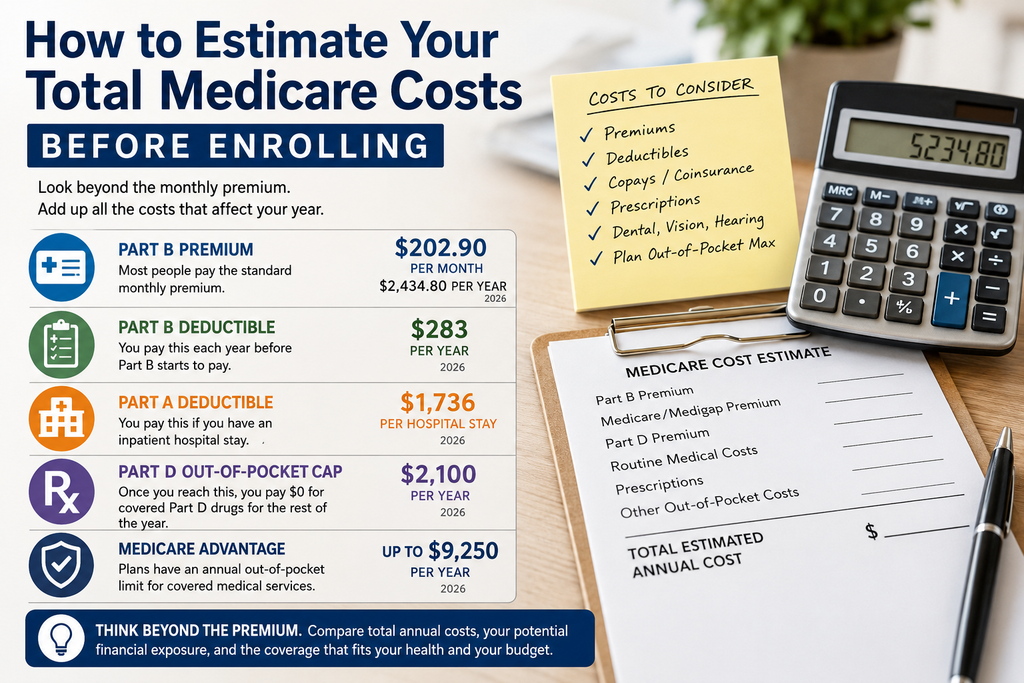
In 2026, the standard Medicare Part B premium is $202.90 per month.
That works out to:
$202.90 × 12 = $2,434.80 per year
There is also a $283 annual Part B deductible in 2026.
Higher-income beneficiaries may pay more because of the Income-Related Monthly Adjustment Amount, commonly called IRMAA.
So before comparing any Medicare Advantage or Medicare Supplement plan, put your Part B premium into your annual Medicare budget.
Remember something particularly important:
If you enroll in a Medicare Advantage plan, you generally continue paying your Medicare Part B premium.
The Medicare Advantage premium does not replace Part B.
According to Medicare.gov, Medicare Advantage members must continue paying the Part B premium unless their particular plan provides some form of Part B premium reduction.
Then Decide Which Medicare Road You Are Taking
Most people eventually find themselves comparing two broad approaches.
Original Medicare plus supplemental coverage
This may include:
- Medicare Part A
- Medicare Part B
- A Medicare Supplement, or Medigap plan
- A separate Part D prescription drug plan
Medicare Advantage
A Medicare Advantage plan generally combines Part A and Part B coverage through a private insurance company and often includes Part D prescription coverage.
Neither approach is automatically cheaper.
They simply distribute costs differently.
That distinction matters.
With a Medicare Supplement, you may pay more in predictable monthly premiums in exchange for reducing much of your medical cost-sharing.
With Medicare Advantage, you may pay a low or even $0 additional plan premium but pay copayments and coinsurance as you use healthcare services.
A simple way to think about it is:
One approach may ask you to pay more now for predictability. The other may ask you to pay more later if you actually need significant healthcare.
Estimating the Cost of Original Medicare Plus Medigap
Suppose you are considering Original Medicare with a Medicare Supplement.
Start adding the costs.
1. Medicare Part B premium
For someone paying the standard 2026 rate:
$2,434.80 per year
2. Medicare Supplement premium
Suppose your Medigap policy costs $225 per month.
That would be:
$225 × 12 = $2,700 per year
Your actual premium could be considerably higher or lower depending on where you live, your age, the company, the Medigap plan you choose, and the rating method used in your state.
3. Part D premium
Now add your prescription drug coverage.
Suppose your Part D plan costs $55 per month:
$55 × 12 = $660 per year
We are already at:
$2,434.80 Part B
- $2,700 Medigap
- $660 Part D
Estimated fixed annual cost: $5,794.80
And we have not yet counted prescription copayments, deductibles, dental care, vision care, hearing care, or services Medicare does not cover.
That is why simply saying, “My supplement pays almost everything,” does not tell you what Medicare actually costs you.
The premiums count.
They are healthcare expenses too.
What About Original Medicare Without a Supplement?
This deserves special attention.
Original Medicare by itself does not have a general annual out-of-pocket maximum.
Medicare.gov specifically notes that traditional Medicare has no yearly limit on what you may spend out of pocket unless you have supplemental coverage or another form of protection.
That creates potentially significant financial exposure.
For example, Original Medicare Part B generally leaves the beneficiary responsible for 20% coinsurance for many covered services after the deductible.
Twenty percent of a $100 office service may not sound frightening.
Twenty percent of repeated expensive outpatient treatments can be another matter entirely.
That is one reason many people with Original Medicare purchase Medigap coverage.
Estimating Medicare Advantage Costs
Medicare Advantage requires a different calculation.
Suppose you find a Medicare Advantage plan with a $0 monthly plan premium.
It is easy to look at that number and think:
“My health insurance costs nothing.”
It does not.
You will normally still pay your Medicare Part B premium.
So your starting annual cost at the standard 2026 Part B rate is already:
$2,434.80
Then look at the plan’s actual cost-sharing.
You need to investigate items such as:
- Primary care copayments
- Specialist copayments
- Diagnostic testing
- X-rays
- CT scans
- MRIs
- Outpatient surgery
- Emergency room visits
- Ambulance services
- Hospital admissions
- Physical therapy
- Durable medical equipment
- Skilled nursing care
- Prescription drugs
Do not assume these costs are insignificant just because the premium is $0.
A low premium tells you what it costs to own the plan.
It does not necessarily tell you what it costs to use the plan.
Find the Maximum Out-of-Pocket Number
This is one of the most important numbers on a Medicare Advantage plan.
Medicare Advantage plans have an annual out-of-pocket limit for covered Part A and Part B medical services.
Once you reach the plan’s applicable limit, the plan generally pays 100% of covered medical services subject to that limit for the remainder of the calendar year.
The actual maximum varies by plan.
For 2026, Medicare Advantage plans may have an in-network out-of-pocket limit as high as $9,250, although many plans have substantially lower limits. PPO plans can also have higher combined in-network and out-of-network limits.
This number is not what you will necessarily spend.
Think of it as your potential medical risk ceiling under the plan.
If one plan has a $4,500 maximum and another has an $8,500 maximum, that difference deserves attention even if both plans advertise a $0 premium.
Build Three Medicare Cost Scenarios
Instead of trying to predict exactly what will happen next year—which none of us can do—create three scenarios.
Scenario 1: A Healthy Year
Estimate:
- Annual premiums
- Routine doctor visits
- Specialist visits
- Regular prescriptions
- Preventive care
- Minor testing
This gives you your likely cost in a relatively uneventful year.
Scenario 2: A Moderate Healthcare Year
Now add things such as:
- Several specialist appointments
- Physical therapy
- MRI or CT scan
- Emergency room visit
- Outpatient surgery
- More expensive medications
This may be a more realistic estimate for many older adults.
Scenario 3: A Bad Year
Now ask the uncomfortable but important question:
What happens financially if I get seriously sick?
Perhaps you have:
- A hospitalization
- Rehabilitation
- Repeated imaging
- Specialists
- Outpatient treatments
- Home healthcare
- Expensive prescription drugs
With Medicare Advantage, compare your potential spending against the plan’s maximum out-of-pocket limit.
With a Medicare Supplement, compare the additional premiums you pay every year against the amount of medical exposure the policy eliminates.
You are not predicting illness.
You are evaluating risk.
Prescription Drugs Need Their Own Calculation
Prescription costs deserve a separate worksheet because the cheapest medical plan is not necessarily the cheapest Medicare package once medications are included.
For 2026, Medicare Part D plans may have a deductible of up to $615.
Once a beneficiary’s eligible out-of-pocket spending on covered Part D drugs reaches $2,100 in 2026, the beneficiary enters catastrophic coverage and has no additional cost-sharing for covered Part D medications for the remainder of the year.
But there is an important distinction:
The $2,100 is not a cap on everything you spend related to Part D.
Your monthly Part D premium does not simply disappear into that cap.
You still need to consider:
- Monthly plan premiums
- Whether each medication is on the formulary
- The medication’s tier
- Deductibles
- Copayments or coinsurance
- Prior authorization
- Quantity limits
- Step therapy
- Pharmacy choice
Even the pharmacy you use can materially affect the price of a prescription.
That is why Medicare drug plans should be compared using your actual medications rather than by premium alone.
Don’t Forget IRMAA
Higher-income beneficiaries may pay additional Medicare Part B and Part D charges known as IRMAA.
For 2026, IRMAA begins above certain income thresholds.
For example, the standard Part B premium applies to individuals with modified adjusted gross income of $109,000 or less and married couples filing jointly with income of $218,000 or less, based on the applicable tax-year income information Medicare uses.
Above those levels, Part B premiums can increase significantly.
If you are estimating Medicare costs after retirement, this becomes especially important because your current income may be very different from the income reported on the tax return Medicare is initially using.
Include the Costs Medicare Doesn’t Cover
Your Medicare budget should also contain a category called:
Things Medicare may not fully pay for.
Depending on your coverage, those expenses may include:
- Routine dental care
- Dentures
- Routine eye exams
- Eyeglasses
- Hearing aids
- Long-term custodial care
- Certain services received outside the United States
Some Medicare Advantage plans offer additional benefits for dental, vision, hearing, transportation, fitness, and other services.
Those benefits can have real value.
But examine the details.
A “$2,000 dental benefit” does not necessarily mean the plan will hand you $2,000 for any dental treatment you choose.
Networks, annual allowances, coverage rules, exclusions, and cost-sharing may apply.
Use This Simple Annual Medicare Formula
Before enrolling, write down:
Annual Part B premium
plus
Annual Medicare Advantage or Medigap premium
plus
Annual Part D premium
plus
Expected medical copayments and coinsurance
plus
Expected prescription costs
plus
Expected dental, vision, and hearing costs
equals
Estimated annual healthcare cost
Then calculate one additional number:
Your Financial Risk Number
Ask:
What might I have to spend in a very bad healthcare year?
That number may be far more useful than comparing whether Plan A costs $0 and Plan B costs $30 per month.
Don’t Compare Medicare Plans by Premium Alone
Imagine two Medicare Advantage plans.
Plan A:
$0 monthly premium
$8,500 medical maximum out of pocket
Plan B:
$45 monthly premium
$4,500 medical maximum out of pocket
Plan B costs an additional:
$45 × 12 = $540 per year
Does that automatically make Plan A better?
Of course not.
You need to compare doctors, hospitals, prescriptions, copayments, networks, benefits, and financial exposure.
The same principle applies when comparing Medicare Advantage with Medigap.
A Medicare Supplement might cost several thousand dollars more in premiums over the year.
That does not automatically make it a bad choice.
You may be purchasing predictability, provider flexibility, and reduced medical cost-sharing.
The question is whether that trade-off makes sense for your finances and your healthcare needs.
Medicare Is Really About Risk Versus Premium
This is the part of Medicare discussions that often gets lost.
People ask:
“What is the cheapest plan?”
But perhaps the better question is:
How much financial risk am I willing and able to accept?
One person may happily pay higher monthly premiums because they want predictable healthcare expenses.
Another may prefer lower monthly premiums and accept the possibility of higher expenses if substantial medical care becomes necessary.
Neither philosophy is automatically right or wrong.
What matters is understanding what you are buying.
Before You Enroll, Know These Five Numbers
At a minimum, know:
- Your total annual premiums.
- Your expected prescription costs.
- Your likely routine medical costs.
- Your plan’s maximum medical financial exposure.
- Your approximate cost in a bad health year.
Then compare plans.
That is a much better approach than choosing Medicare coverage because somebody said:
“This one has a $0 premium.”
The Bottom Line
There probably is no way to know exactly what your healthcare will cost next year.
Nobody knows whether they will remain perfectly healthy, need surgery, start a new medication, or suddenly require several specialists.
But you can estimate.
And that estimate can dramatically improve your Medicare decision.
Think beyond the monthly premium.
Calculate the whole package.
Look at what you pay every month.
Look at what you pay when you use healthcare.
Look at your prescription costs.
Look at what happens if you become seriously ill.
And look at the maximum amount of financial risk you are accepting.
Because the most important Medicare number may not be the premium printed in large type on the brochure.
It may be the number buried several pages later that tells you what happens when you actually need the plan.
Before you compare Medicare plans, plan for your healthcare.
Education first. Enrollment second.

William Vargas brings over 50 years of financial and insurance expertise to every Medicare conversation. He operates MedicareSelfEnroll.com, helping seniors in Florida, New York, and North Carolina — with no pressure, no phone calls required.