In This Article
- Your Medicare Plan Can Change Every Year
- Don’t Look Only at the Premium
- Check Your Maximum Out-of-Pocket Limit
- Check Your Prescription Drugs Again
- Check Your Doctors — And Your Hospital
- Look Carefully at Supplemental Benefits
- Compare 2027 With 2026 Side by Side
- Your Plan Is Renewing — But Should You?
- October 15 to December 7 Is Your Opportunity to Make Changes
- Compare — Don’t Automatically Replace
- The Envelope You Should Not Throw Away
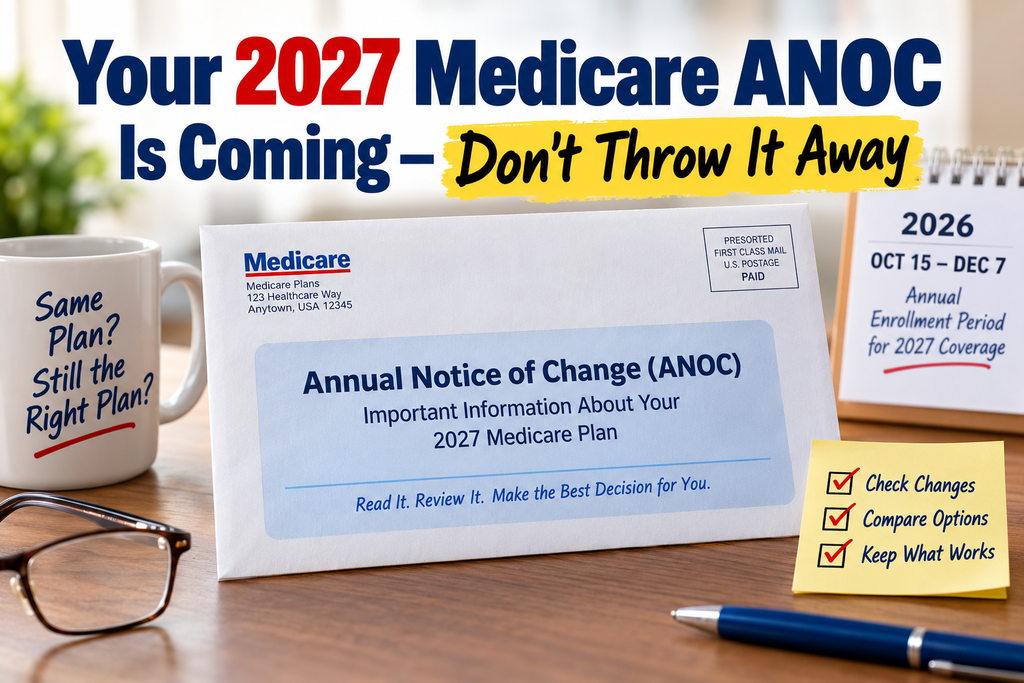
Every fall, millions of Medicare beneficiaries receive a thick envelope from their Medicare Advantage or Part D plan.
And every fall, a remarkable number of those envelopes probably go straight from the mailbox to the kitchen counter, where they sit under a pile of catalogs until somebody eventually throws them away.
That can be an expensive mistake.
The document inside is called your Annual Notice of Change, usually shortened to ANOC.
It may not look exciting.
There are no balloons.
There is no television celebrity telling you to call before midnight.
But this document may contain some of the most important Medicare information you receive all year.
Your ANOC explains what is changing in your current Medicare Advantage or prescription drug plan for the coming year.
Medicare says plans send the Annual Notice of Change each fall, generally in September, and that it explains changes in coverage, costs, and other plan details that take effect in January.
For 2027, that means the ANOC arriving this fall tells you what your current plan is going to look like beginning January 1, 2027.
And that is why you should never assume that because you liked your Medicare plan in 2026, it will still be the right plan for you in 2027.
Your Medicare Plan Can Change Every Year
This is one of the most important things Medicare beneficiaries need to understand.
Medicare Advantage and Part D plans are annual contracts.
The insurance company can make changes from one year to the next.
Your plan might keep the same name.
Your insurance card may look almost identical.
The television commercial might still feature the same smiling couple riding bicycles down a beach.
But underneath the surface, important details may have changed.
Your monthly premium could change.
Your medical copayments could increase.
Your hospital costs could change.
Your maximum out-of-pocket limit could increase.
Your prescription drug formulary could change.
Your medications could move to different tiers.
Your preferred pharmacy arrangement could change.
Benefits such as dental, vision, hearing, transportation, over-the-counter allowances, or fitness programs could change.
And depending on the plan, provider networks can change as well.
That is why Medicare specifically tells beneficiaries to review the ANOC and decide whether their current plan will continue to meet their needs.
You can read Medicare’s official explanation of the Annual Notice of Change at Medicare.gov.
Don’t Look Only at the Premium
One of the biggest Medicare mistakes is comparing plans based almost entirely on the monthly premium.
A plan that remains at a $0 monthly premium may still become considerably more expensive to use.
Suppose your specialist copayment was $35 in 2026 and becomes $50 in 2027.
That may not sound dramatic.
But if you see several specialists throughout the year, the difference starts adding up.
Now suppose outpatient surgery costs change.
Hospital copayments change.
Diagnostic imaging changes.
Physical therapy changes.
Your maximum out-of-pocket limit increases.
Suddenly, the plan that still says “$0 premium” could expose you to considerably more financial risk.
That is why we repeatedly emphasize at MedicareSelfEnroll.com that the premium is only one piece of the Medicare puzzle.
Our guide on understanding Medicare out-of-pocket costs explains why you should look at the entire cost structure rather than just the monthly premium.
Think of the premium as the price of admission.
It does not necessarily tell you what the ride is going to cost once you get inside.
Check Your Maximum Out-of-Pocket Limit
If you have Medicare Advantage, one number deserves special attention in your ANOC:
Your maximum out-of-pocket limit.
This represents the maximum you could generally be responsible for during the year for covered Part A and Part B medical services under the plan.
It does not mean you will spend that amount.
Most people will not.
But it tells you something extremely important:
Your potential financial exposure during a really bad healthcare year.
Imagine having a hospital stay, followed by rehabilitation, several specialists, outpatient testing, physical therapy, and additional treatment.
That is when copayments and coinsurance can begin accumulating quickly.
This is why the maximum out-of-pocket figure should never be ignored.
And remember: your Medicare Advantage medical maximum out-of-pocket limit is not necessarily the same thing as your total annual healthcare cost.
Premiums, prescription drug costs, and noncovered services may involve separate expenses.
If you want a deeper explanation of this distinction, MedicareSelfEnroll also has a guide to comparing Medicare plans available in your area, including the importance of maximum out-of-pocket exposure.
Check Your Prescription Drugs Again
Do not assume that because your prescription was covered well in 2026, it will be covered exactly the same way in 2027.
Part D formularies can change.
A medication might move from one tier to another.
Your copayment or coinsurance might change.
A medication might have new utilization requirements such as prior authorization, step therapy, or quantity limits.
Your pharmacy can matter too.
One pharmacy may be considered preferred while another is simply a standard network pharmacy.
The same medication can sometimes cost substantially different amounts depending on where you fill it.
For 2027, the standard Part D annual out-of-pocket threshold is scheduled to be $2,400 for covered Part D drugs, according to CMS.
That limit is important, but it still does not mean every prescription expense disappears or that every drug you might want is automatically covered.
The safest approach is simple:
Enter your actual medications when comparing plans.
Not the medications you think you might take.
Not your neighbor’s medications.
Your medications.
Include the exact drug name, dosage, quantity, and frequency whenever possible.
You can learn more in our MedicareSelfEnroll guide explaining what Medicare Part D drug plans cover.
Check Your Doctors — And Your Hospital
This is especially important for Medicare Advantage members.
Do not simply ask:
“Does my doctor take Medicare?”
That question is too broad.
Instead ask:
“Does my doctor participate in this exact Medicare Advantage plan for 2027?”
There is a big difference.
A physician may accept Medicare patients but not participate in your particular Medicare Advantage network.
If you have specialists you rely on, check every one.
And do not forget your hospital.
People sometimes spend enormous amounts of time checking whether their primary doctor participates in a plan and almost no time checking whether their preferred hospital system participates.
Then a serious health problem occurs.
That is a bad time to discover that the hospital you expected to use is outside your plan’s network.
Our article Can I Use My Current Doctor With Medicare Advantage? explains why verifying both physicians and hospitals before enrolling is so important.
Whenever possible, verify coverage with both the insurance company and the provider’s billing office.
And make sure everybody is talking about the exact plan and the exact year.
Look Carefully at Supplemental Benefits
Dental.
Vision.
Hearing.
Over-the-counter allowances.
Transportation.
Fitness memberships.
Meal benefits.
These extra benefits receive enormous attention in Medicare Advantage advertising.
And they can certainly have value.
But benefits can change from year to year.
Maybe the dental allowance decreases.
Maybe the participating dental network changes.
Maybe the hearing aid benefit changes.
Maybe the over-the-counter allowance is smaller.
Maybe transportation coverage becomes more limited.
Do not simply look at whether the benefit still exists.
Look at how the benefit works.
A “$2,000 dental benefit” can mean very different things depending on which procedures are included, which dentists participate, whether there are frequency limitations, and what percentage of a procedure the plan actually pays.
The headline number is only the beginning.
Compare 2027 With 2026 Side by Side
One of the easiest ways to review your ANOC is to take out your current 2026 plan information and compare it directly with what is being proposed for 2027.
Create two columns.
Then compare:
Monthly premium.
Primary care copayment.
Specialist copayment.
Hospital costs.
Emergency room costs.
Ambulance costs.
Outpatient surgery.
Diagnostic imaging.
Physical therapy.
Maximum out-of-pocket limit.
Prescription deductible.
Drug copayments.
Dental.
Vision.
Hearing.
Over-the-counter benefits.
Doctors.
Hospitals.
Pharmacies.
You do not need to be an insurance expert.
You simply need to identify what changed.
Circle anything that becomes more expensive.
Highlight anything that disappears.
Put a question mark next to anything you do not understand.
That alone will put you ahead of many people who simply let their plan renew automatically.
Your Plan Is Renewing — But Should You?
This distinction is critical.
A plan being renewed by the insurance company does not mean you should automatically renew your membership in it.
Those are two completely different decisions.
The company is saying:
“We are offering this plan again.”
You still need to ask:
“Does this plan still make sense for me?”
Your health may have changed.
Your medications may have changed.
Your doctors may have changed.
Your financial situation may have changed.
And the plan itself may have changed.
The plan you chose three years ago may have been an excellent choice at the time.
That does not mean it remains the best fit today.
Medicare is not a “set it and forget it” decision.
October 15 to December 7 Is Your Opportunity to Make Changes
Medicare’s Annual Open Enrollment Period runs from October 15 through December 7 each year.
Changes made during this period generally take effect January 1.
During Open Enrollment, Medicare beneficiaries may be able to switch Medicare Advantage plans, move between Medicare Advantage and Original Medicare, or change standalone Part D plans depending on their situation.
Medicare provides the official enrollment rules and plan comparison tools at Medicare.gov.
One caution is important if you are thinking about leaving Medicare Advantage and purchasing Medigap.
Medigap enrollment rights are not identical everywhere, and depending on your circumstances and state, medical underwriting may apply.
Do not assume that you can always leave Medicare Advantage and obtain any Medigap plan you want without answering health questions.
Check your rights before making the change.
Compare — Don’t Automatically Replace
Reviewing your plan does not mean you need to switch.
Sometimes the smartest decision is to stay exactly where you are.
If your doctors remain in network, your prescriptions remain well covered, your costs remain reasonable, and the benefits fit your needs, keeping your existing plan may be completely appropriate.
The purpose of reviewing your ANOC is not to find a reason to leave.
It is to make sure you still have a reason to stay.
That is a very different philosophy.
We believe seniors should compare Medicare based on their actual healthcare situation, not advertising.
You can use the resources at MedicareSelfEnroll.com to research and compare your Medicare choices at your own pace.
No rush.
No pressure.
The purpose is to understand the plan before you enroll in it.
The Envelope You Should Not Throw Away
When your 2027 Annual Notice of Change arrives, do yourself a favor.
Open it.
Even if reading insurance documents ranks somewhere between cleaning the garage and getting a root canal on your list of favorite activities.
You do not have to read every page from beginning to end.
Start with the summary of changes.
Look for the things that affect your life.
Your premium.
Your medical copayments.
Your maximum out-of-pocket limit.
Your prescriptions.
Your doctors.
Your hospital.
Your pharmacy.
And the benefits you actually use.
Then compare your current plan with the other choices available for 2027.
Because the biggest Medicare mistake this fall may not be choosing the wrong plan.
It may be never checking whether the plan you already have has changed.
Your 2027 ANOC is coming.
When it arrives, don’t throw it away.
Read it.
Compare it.
And make your 2027 Medicare decision based on what the plan will be next year — not what it was last year.
Education First. Enrollment Second.
At MedicareSelfEnroll.com, we don’t sell you plans. We help you find the right choice.

William Vargas brings over 50 years of financial and insurance expertise to every Medicare conversation. He operates MedicareSelfEnroll.com, helping seniors in Florida, New York, and North Carolina — with no pressure, no phone calls required.