In This Article
- Medicare Drug Coverage Is Not Just Yes or No
- Start With the Prescriptions You Actually Take
- Watch the Drug Tier
- Prior Authorization Can Matter Just as Much as Price
- What Is Step Therapy?
- Do Not Forget Quantity Limits
- Your Pharmacy Can Affect What You Pay
- The 2027 Part D Out of Pocket Limit Is Changing
- Lower Premium Does Not Always Mean Lower Cost
- Check Your Annual Notice of Change
- Seven Questions to Ask About Every Prescription
- What If Your Drug Is Not Covered the Way You Need?
- Medicare Shopping Is Changing
- The Bottom Line
When people review their Medicare coverage for a new year, one of the first questions they often ask is:
“Are my prescriptions covered?”
That is an important question.
But for 2027, it may not be enough.
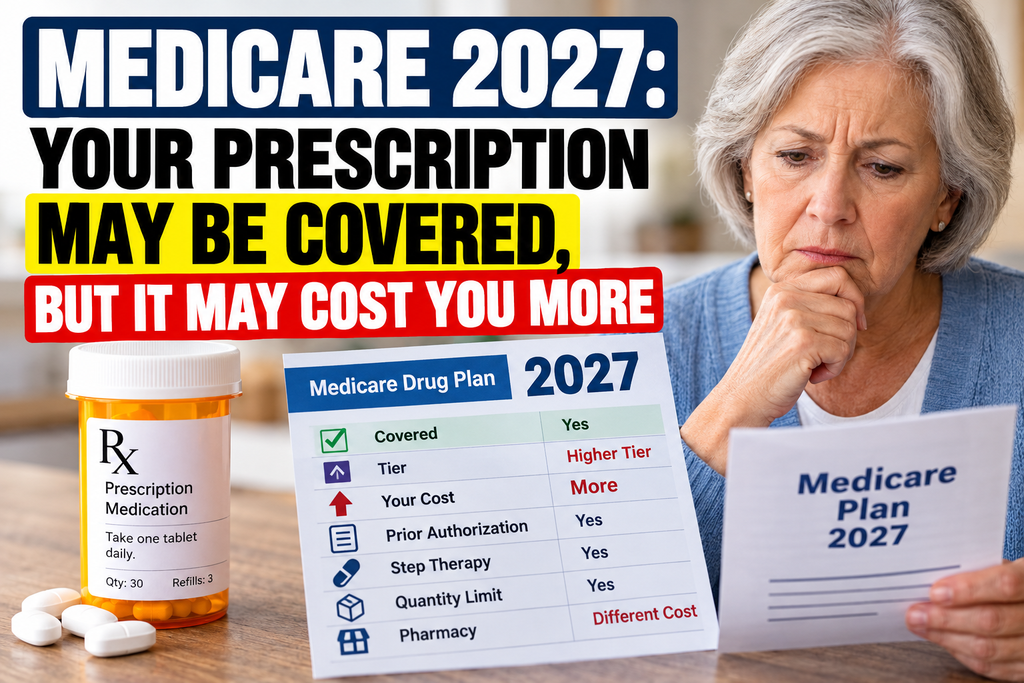
A prescription can still be covered by your Medicare drug plan and yet cost you more than it did last year.
The drug could move to a different tier.
Your copayment or coinsurance could change.
The plan could add prior authorization.
Step therapy could apply.
A quantity limit could change.
Or the pharmacy you have used for years might no longer give you the lowest price under that plan.
That is why Medicare beneficiaries should look beyond one simple word:
Covered.
The better question is:
How is my prescription covered in 2027?
Medicare Drug Coverage Is Not Just Yes or No
Every Medicare Part D plan, including Medicare Advantage plans that include prescription coverage, has a list of medications it covers.
This list is called a formulary.
But drugs on that formulary are usually organized into different pricing tiers.
According to Medicare, many plans use lower tiers for lower cost drugs and higher tiers for more expensive or nonpreferred medications.
That means a medication can remain on the formulary while moving to a tier that costs you more.
For example, suppose you paid a modest copayment for a medication throughout 2026.
You review the 2027 plan and see that the medication is still covered.
Good news?
Maybe.
But if the drug moved to a higher tier, your actual cost could still increase.
That is why simply checking whether the drug appears on the formulary does not tell you the whole story.
Medicare itself advises beneficiaries to review the drug list before joining a plan because formularies and tier structures vary from one plan to another.
Start With the Prescriptions You Actually Take
Before comparing Medicare plans for 2027, make a complete medication list.
Include:
Your exact medication name.
The dosage.
How often you take it.
Whether you normally receive a 30 day or 90 day supply.
And the pharmacy you normally use.
If you take five prescriptions, check all five.
If you take ten prescriptions, check all ten.
Do not assume that because your plan handled your medications well in 2026, it will work exactly the same way in 2027.
That assumption could become expensive.
This is one reason we continually encourage visitors to MedicareSelfEnroll.com to educate themselves first, compare carefully, and then decide.
Watch the Drug Tier
Drug tiers are one of the easiest places for a Medicare beneficiary to miss a meaningful change.
A typical formulary might place generic drugs on a lower tier, preferred brand name drugs on another tier, nonpreferred drugs on a higher tier, and expensive medications on a specialty tier.
The exact structure depends on the plan.
Generally, lower tiers cost less and higher tiers cost more.
So when reviewing your prescriptions, do not stop after locating the drug.
Look at the tier.
Then look at the cost attached to that tier.
That may tell you much more than the word “covered.”
Prior Authorization Can Matter Just as Much as Price
Another thing to check is whether your prescription requires prior authorization.
Prior authorization means you or your healthcare provider may need approval from the plan before the medication will be covered.
Medicare explains that a plan may require your prescriber to demonstrate that a drug is medically necessary or that you meet particular requirements before coverage is approved.
Think about the practical difference.
A drug can be listed on the formulary.
Your doctor can prescribe it.
But you may still have another administrative step before the plan pays for it.
If you depend on a particular medication, that is something you want to know before January, not after you are standing at the pharmacy counter.
What Is Step Therapy?
Step therapy is another coverage rule Medicare beneficiaries should understand.
Under step therapy, a plan may require you to try another medication first before it covers a more expensive medication.
Medicare describes this as requiring a beneficiary to begin with another drug that has been shown to work for many people with the condition before moving to another medication.
There may be situations where you or your prescriber can request an exception.
But once again, the important point is this:
A medication being listed on the plan does not necessarily mean you can simply fill it without additional requirements.
Do Not Forget Quantity Limits
Some plans also place limits on the quantity of a medication they will cover during a certain time period.
For example, a plan might cover only a certain number of tablets every 30 days.
Medicare identifies quantity limits as one of the common rules that drug plans can apply.
That may not matter for every medication.
But if you take a higher dosage or your doctor prescribes an amount outside the plan’s normal limit, it could matter a great deal.
Your Pharmacy Can Affect What You Pay
Here is another detail people sometimes overlook.
Two people taking the same medication under the same Medicare plan may not necessarily pay the same amount if they use different pharmacies.
Many plans have preferred pharmacy arrangements.
That means one pharmacy may provide a lower cost than another.
So when comparing your Medicare prescription coverage, ask:
Is my current pharmacy in the plan network?
Is it considered preferred?
What would my medication cost there?
Would another nearby pharmacy cost less?
And what about mail order?
This is where Medicare plan comparison becomes personal.
There is no meaningful answer to the question:
“Which plan has the cheapest prescriptions?”
without knowing which prescriptions you actually take.
The 2027 Part D Out of Pocket Limit Is Changing
There is an important 2027 number Medicare beneficiaries should know.
For 2027, the annual Medicare Part D out of pocket threshold for covered prescription drugs is $2,400, up from $2,100 in 2026.
That limit is an important protection for people with high prescription drug expenses.
But it does not mean every medication is covered.
It does not mean every medication costs the same.
And it does not mean your monthly premium is included in that $2,400 threshold.
This distinction is important.
The out of pocket threshold concerns qualifying spending on covered Part D drugs.
You still need to look separately at the plan premium, formulary, pharmacy network, and coverage requirements.
CMS has also codified major changes to the redesigned Part D program for 2027 and beyond, including the elimination of the old coverage gap phase and continued limits on enrollee cost sharing after reaching the annual out of pocket threshold.
Lower Premium Does Not Always Mean Lower Cost
This is one of the most important lessons in Medicare.
Premium does not equal cost.
Imagine Plan A costs $10 less per month than Plan B.
That saves you $120 per year in premiums.
Sounds good.
But suppose your medications cost $40 more per month under Plan A.
You saved $120 in premium and spent $480 more on prescriptions.
The cheaper premium was not actually the cheaper plan.
This is why Medicare decisions should not be made by looking at one number.
You need to look at the entire picture.
Premium.
Drug costs.
Medical copays.
Hospital costs.
Provider network.
Maximum out of pocket exposure.
And the benefits that actually matter to you.
Check Your Annual Notice of Change
If you already have a Medicare Advantage or Part D plan, your Annual Notice of Change is one of the most important documents you receive before the new plan year.
Do not toss it into a drawer.
Do not assume nothing important changed.
And do not automatically renew simply because you were satisfied last year.
Your experience tells you how the plan worked in 2026.
You are choosing coverage for 2027.
Those are not the same question.
CMS has encouraged Medicare beneficiaries to review their coverage and compare their options for 2027. The agency says Medicare Advantage and Part D remain broadly available, but individual plan costs and benefits can still differ.
Seven Questions to Ask About Every Prescription
Before keeping or changing your Medicare drug coverage for 2027, ask these seven questions:
- Is my medication covered?
- What tier is it on?
- What will I actually pay?
- Does it require prior authorization?
- Does it have step therapy requirements?
- Are there quantity limits?
- Is my pharmacy still one of the most cost effective pharmacies for this plan?
Those questions tell you much more than simply asking whether the drug is on the formulary.
What If Your Drug Is Not Covered the Way You Need?
There are situations where a beneficiary or prescriber can ask a Medicare drug plan for an exception.
For example, Medicare says an exception may sometimes be requested if a drug is not on the formulary, if a coverage rule creates a problem, or if a beneficiary needs a drug on a higher cost tier because alternatives would not work appropriately.
These requests generally require medical justification from the prescriber.
That does not guarantee approval.
But it is important to understand that there may be an appeals or exception process rather than simply assuming you have no options.
Medicare Shopping Is Changing
For years, many Medicare advertisements have focused heavily on premiums and extra benefits.
Those numbers certainly matter.
But Medicare in 2027 requires a more complete way of thinking.
Start with your healthcare.
Start with your doctors.
Start with your prescriptions.
Then look at the plan built around them.
That is the philosophy behind MedicareSelfEnroll.com.
Educate Yourself → Compare → Decide → Enroll
Take your time.
Ask questions.
Compare your options.
And make your own decision based on the healthcare you actually use.
You can also use Medicare’s official resources at Medicare.gov when comparing Medicare coverage and verifying Medicare rules.
The Bottom Line
Your prescription can remain covered in 2027 and still become more expensive or more complicated to obtain.
That is why one word is not enough.
Do not ask only:
“Is my medication covered?”
Ask:
“How is my medication covered, what will it cost me, and what rules apply?”
That is the information that can help you make a better Medicare decision.
The plan you had last year may not be the plan you have next year.
Educate yourself first.
Compare.
Decide.
And when you are ready, enroll with confidence at MedicareSelfEnroll.com.
Medicare information simplified.

William Vargas brings over 50 years of financial and insurance expertise to every Medicare conversation. He operates MedicareSelfEnroll.com, helping seniors in Florida, New York, and North Carolina — with no pressure, no phone calls required.