In This Article
- Medicare Prescription Drug Coverage Is Changing in 2027
- The Same Prescription Can Cost Differently Next Year
- Do Not Look Only at the Premium
- Check Every Prescription You Take
- Check the Drug Tier
- Look for Prior Authorization
- Check for Step Therapy
- Check Quantity Limits
- Your Pharmacy Matters Too
- What About Mail Order?
- Medicare Advantage Plans With Drug Coverage
- What Should You Review for 2027?
- Do Not Automatically Renew
- Medicare Is Changing
- Educate Yourself First
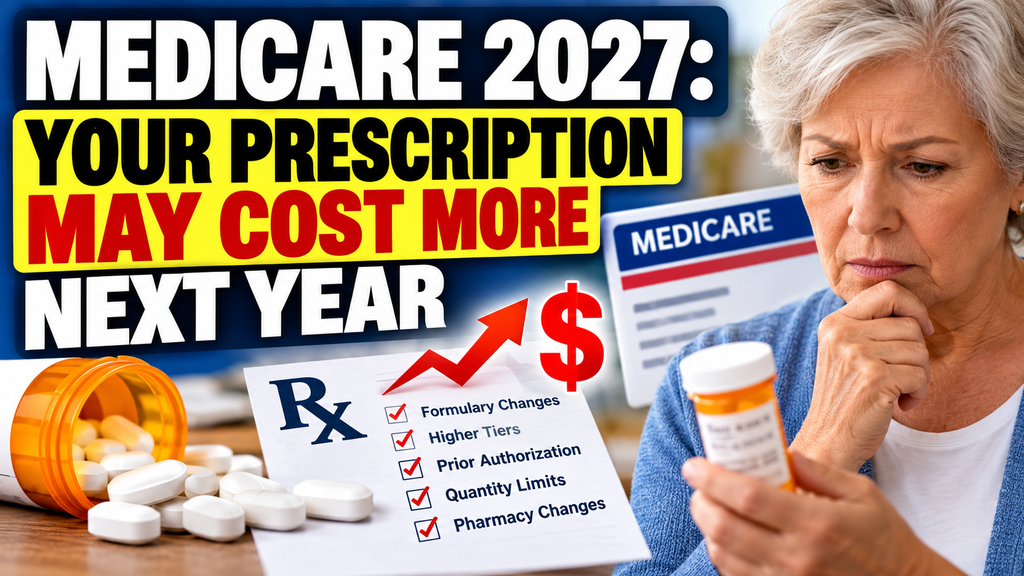
When most people compare Medicare plans, they naturally look at the monthly premium first.
That makes sense.
But in 2027, the monthly premium may be one of the least important numbers on the page if you regularly take prescription medications.
A Medicare plan can have an attractive premium and still become more expensive for you because of changes involving your prescriptions.
Your medication could move to a different tier.
Your preferred pharmacy could change.
A drug may require prior authorization.
The amount you can receive could be limited.
Or another medication may need to be tried first.
That is why one of the most important questions to ask during Medicare Open Enrollment is not simply:
“What does this plan cost?”
It is:
“What will this plan cost me based on the healthcare and prescriptions I actually use?”
That is a very different question.
Medicare Prescription Drug Coverage Is Changing in 2027
Medicare Part D continues to go through significant changes.
For 2027, the annual out of pocket threshold for covered Part D drugs increases to $2,400, compared with $2,100 in 2026.
The standard Part D deductible also rises from $615 in 2026 to $700 in 2027.
That does not mean everyone will pay those amounts.
Individual plans can structure their benefits differently, and your actual costs will depend upon the medications you use and the plan you select.
But these numbers are important because they show why prescription coverage deserves a careful review every year.
CMS is also continuing the redesigned Part D structure, including the elimination of the old coverage gap phase and no cost sharing once an enrollee reaches the catastrophic phase.
The rules may improve protection against extremely high prescription costs, but that does not eliminate the need to compare plans.
You still have to know what happens before you reach that protection.
The Same Prescription Can Cost Differently Next Year
Suppose you have taken the same prescription for three years.
Your doctor has not changed it.
Your health has not changed.
The pharmacy has not changed.
It would be reasonable to think your prescription cost should remain approximately the same.
Unfortunately, Medicare drug coverage does not necessarily work that way.
Each Medicare drug plan has a formulary.
A formulary is simply the plan’s list of covered medications.
Within that formulary, medications are generally placed into different pricing tiers.
A medication could be placed in a lower cost tier one year and a higher cost tier the next year.
That means the medicine did not change.
The plan changed.
This is one reason you should never assume that because your prescription was affordable in 2026, it will automatically remain affordable in 2027.
Do Not Look Only at the Premium
CMS projects that the weighted average Medicare Advantage premium will decline from $14.37 per month in 2026 to approximately $12 per month in 2027.
CMS also projects the average total premium for stand alone Part D plans at approximately $36 per month in 2027, less than one dollar higher than the 2026 average.
Those averages sound encouraging.
But averages do not tell you what your Medicare coverage will cost.
Imagine two Medicare Advantage plans.
Plan A has a $0 monthly premium.
Plan B costs $40 per month.
At first glance, Plan A appears to save you $480 per year.
But suppose your prescriptions cost $80 more per month under Plan A.
Now the supposedly cheaper plan could actually cost you considerably more.
That is why we use a simple rule at MedicareSelfEnroll.com:
Premium does not equal total cost.
The monthly premium is only one part of the Medicare equation.
Check Every Prescription You Take
Before comparing Medicare plans for 2027, make a complete medication list.
Do not try to do this from memory.
Write down:
• The exact medication name
• The dosage
• How often you take it
• The quantity you receive
• The pharmacy you currently use
Then use that information when comparing plans.
Even one incorrect dosage or drug name can affect the comparison.
If you take several medications, this becomes even more important.
A $10 change on one medication may not seem significant.
But five medications changing by $10 or $20 each can become hundreds or even thousands of dollars over the course of a year.
Small numbers have a habit of becoming large numbers when multiplied by twelve months.
Check the Drug Tier
When reviewing a plan, see where each medication is placed on the formulary.
Plans commonly organize drugs into tiers.
Lower tiers generally have lower cost sharing.
Higher tiers may involve larger copayments or coinsurance.
A drug that moves from one tier to another can substantially change your cost even though the medication itself is exactly the same.
Do not simply check whether your medication is covered.
Ask:
How is it covered?
Those are two different questions.
Look for Prior Authorization
Prior authorization means the insurance plan may require approval before it covers a particular medication.
Your doctor may have to provide information showing why the medication is medically necessary.
This does not necessarily mean you cannot receive the drug.
But it can create additional steps.
If you have been taking the same medication for years, discovering in January that your new plan requires authorization can be frustrating.
It is much better to know before enrollment.
Check for Step Therapy
Step therapy can require you to try another medication before the plan covers the medication originally prescribed.
In simple terms, the insurer may say:
“Try this medication first.”
If that drug does not work appropriately, you may then qualify for the other medication.
Again, step therapy does not automatically make a plan bad.
But if one of your important medications is subject to step therapy, you should understand that before choosing the plan.
Check Quantity Limits
Some plans place limits on how much of a medication they will cover during a particular period.
For example, the plan may cover a certain number of tablets every 30 days.
If your physician has prescribed a larger amount, additional approval may be required.
For most people, this may never become an issue.
But if it affects one of your medications, it becomes very important.
Your Pharmacy Matters Too
Here is another Medicare detail that is easy to overlook.
Two pharmacies can charge you different amounts under the same Medicare drug plan.
Many plans have preferred pharmacy arrangements.
You may receive a lower price at one pharmacy than another.
That means when comparing Medicare plans, you should not only enter your prescriptions.
You should also compare your pharmacy choices.
If you have used the same neighborhood pharmacy for years, check whether it remains preferred under the plan you are considering.
You may decide the convenience is worth paying slightly more.
That is perfectly reasonable.
The important thing is knowing before you enroll.
What About Mail Order?
Mail order can sometimes offer convenience or pricing advantages, particularly for maintenance medications.
But do not assume mail order is automatically cheaper.
Compare it.
Some people prefer getting a 90 day supply delivered directly to their home.
Others want to continue using their local pharmacy.
There is no universally correct answer.
The best choice depends upon your medications, your plan, the price, and your personal preferences.
Medicare Advantage Plans With Drug Coverage
Many Medicare Advantage plans include Part D prescription coverage.
These plans are commonly referred to as Medicare Advantage Prescription Drug plans.
When comparing one of these plans, you really need to evaluate two different pieces of coverage at the same time.
First:
How does the plan cover my doctors and hospitals?
Second:
How does the plan cover my medications?
A plan might have an excellent medical network but poor prescription coverage for your particular drug list.
Another could provide excellent drug coverage but exclude one of your important specialists.
That is why Medicare shopping cannot be reduced to a single premium number.
You need to look at the entire package.
What Should You Review for 2027?
Here is a simple Medicare prescription checklist.
Before keeping or changing your coverage, check:
- Are all my medications covered?
- Has any medication changed tiers?
- Has my copayment or coinsurance changed?
- Does any medication require prior authorization?
- Does step therapy apply?
- Are there quantity limits?
- Is my current pharmacy preferred?
- Would another pharmacy cost less?
- What is my deductible?
- What could I realistically spend during the year?
That last question is especially important.
You are not buying a premium.
You are buying healthcare coverage.
Do Not Automatically Renew
One of the easiest Medicare mistakes is doing nothing simply because the current plan worked well last year.
Sometimes doing nothing is exactly the correct choice.
But it should be an informed choice.
CMS specifically encourages beneficiaries to use Medicare Open Enrollment to review their coverage and compare their 2027 options. Medicare Open Enrollment runs from October 15 through December 7, 2026.
Your plan may remain excellent.
Your doctors may remain in network.
Your prescriptions may remain affordable.
If so, staying with your plan may make complete sense.
But verify it.
Do not assume it.
Medicare Is Changing
The Medicare market for 2027 is changing in several ways.
Premiums are changing.
Provider networks are changing.
Plans are changing.
Prescription costs are changing.
Benefits are changing.
And some plans may no longer be available in certain areas.
That is why the Medicare shopping process needs to change too.
Instead of asking:
“Which plan has the lowest premium?”
Ask:
“Which plan fits the way I actually use healthcare?”
That includes your doctors.
Your hospitals.
Your prescriptions.
Your pharmacy.
Your expected medical expenses.
And your personal preferences.
Educate Yourself First
At MedicareSelfEnroll.com, our philosophy is simple:
Education first. Enrollment second.
You should have an opportunity to learn before making a decision.
You can review Medicare information, ask questions, compare available plans, and take your time.
Ask our AI Agent as many questions as you need.
No question is too small.
Then, when you understand your choices, you can decide what makes sense for you.
Because Medicare is not about finding the plan with the prettiest brochure or the lowest number on the advertisement.
It is about finding coverage that works when you actually need it.
And in 2027, your prescription list may be one of the most important pieces of that decision.
Medicare is changing. The way you shop for Medicare should change also.
Before you enroll, educate yourself.
Then compare.
Decide.
And enroll with confidence at MedicareSelfEnroll.com.
MedicareSelfEnroll.com is not Medicare.gov and is not affiliated with the federal Medicare program. Plan availability, benefits, formularies, provider networks, premiums, and costs vary by location and can change annually. For official Medicare information, visit Medicare.gov or call 1 800 MEDICARE.

William Vargas brings over 50 years of financial and insurance expertise to every Medicare conversation. He operates MedicareSelfEnroll.com, helping seniors in Florida, New York, and North Carolina — with no pressure, no phone calls required.