In This Article
- The Big Number: Medicare Part B
- Most People Don’t Pay a Part A Premium
- What Will Medicare Part D Cost in 2027?
- A Major 2027 Part D Change: The Drug Cap Rises
- What About Medicare Advantage Premiums in 2027?
- Medicare Supplement Costs Are Different
- Don’t Forget IRMAA
- So What Should You Budget for Medicare in 2027?
- The Number I Would Not Use: Just the Premium
- Your 2027 Medicare Costs Aren’t Final Yet
- The Bottom Line
If you’re turning 65, already on Medicare, or helping a parent understand their coverage, one of the first questions you’re probably asking is:
How much is Medicare going to cost me every month in 2027?
It sounds like a simple question.
Unfortunately, Medicare has never been particularly good at simple answers.
There isn’t one Medicare monthly premium. Your actual cost depends on whether you choose Original Medicare or Medicare Advantage, whether you buy a Medicare Supplement, whether you need Part D prescription coverage, your income, and—in some cases—the county where you live.
And as of August 2026, some important 2027 Medicare costs have been announced, while others are still estimates.
So let’s separate what we know from what we don’t know yet.
The Big Number: Medicare Part B
For most Medicare beneficiaries, the starting point is the monthly Medicare Part B premium.
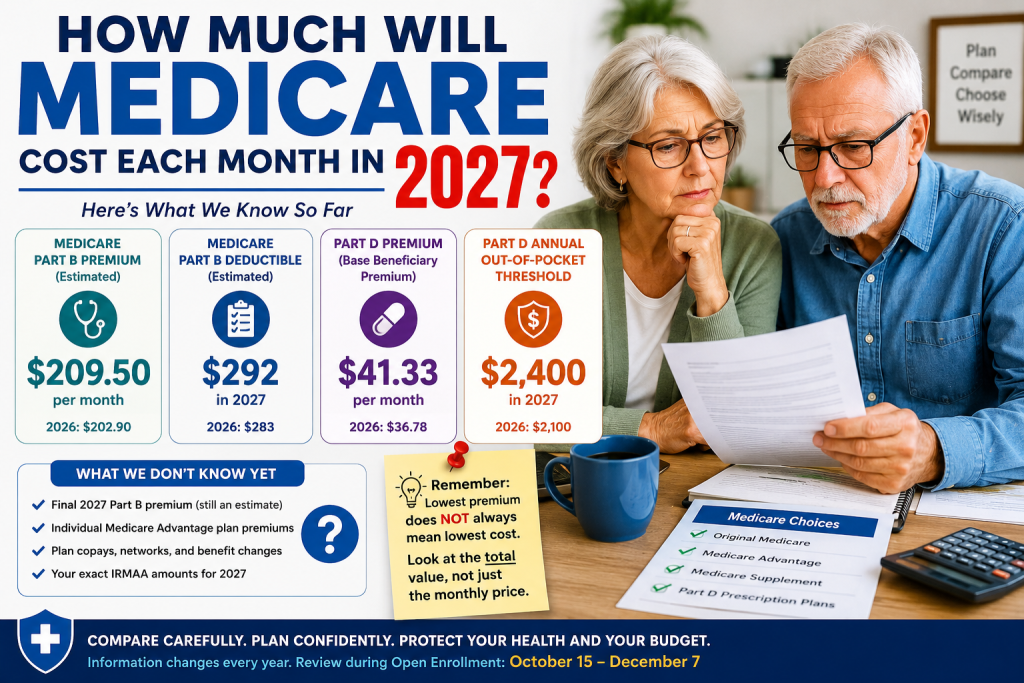
The standard Part B premium is $202.90 per month in 2026. CMS also set the 2026 Part B deductible at $283.
For 2027, the Medicare Trustees currently estimate:
- Standard Part B premium: $209.50 per month
- Part B annual deductible: $292
But there is an important word there:
Estimate.
The Trustees specifically state that projected future Part B amounts are based on intermediate assumptions and that actual amounts can be different as new information becomes available.
So don’t put $209.50 in permanent ink yet.
The final 2027 Part B premium will be announced later in 2026.
Still, $209.50 gives people planning for retirement a reasonable working number.
If that estimate becomes final, the standard Part B premium would rise about $6.60 per month from 2026.
That’s approximately $79 more per year.
For a married couple with both spouses on Medicare Part B, that would mean roughly $419 per month for Part B alone.
And remember: that is before adding any Medicare Advantage, Medigap, or prescription drug premiums.
Most People Don’t Pay a Part A Premium
Medicare Part A primarily covers inpatient hospital care.
Most people receive premium-free Part A because they or their spouse paid Medicare payroll taxes long enough while working.
So for many retirees, Part A adds $0 to the monthly premium bill.
That does not mean hospital care is free.
The Medicare Trustees currently estimate that the Original Medicare Part A inpatient hospital deductible could rise from $1,736 in 2026 to about $1,788 in 2027. That 2027 figure is also an estimate rather than the final announced amount.
That’s an important distinction when you’re evaluating Medicare Advantage versus Medicare Supplement coverage.
Premium and total healthcare cost are not the same thing.
A plan with a low monthly premium can still expose you to significant copayments and deductibles when you actually use healthcare.
What Will Medicare Part D Cost in 2027?
Here we have more concrete information.
CMS has officially announced that the 2027 Medicare Part D base beneficiary premium will be $41.33 per month.
But don’t make the mistake of assuming every Part D plan will cost $41.33.
It won’t.
The $41.33 figure is a national base amount used in calculating plan premiums. Your actual standalone Part D premium will depend on the specific plan available where you live.
Medicare itself explains that the premium you actually pay depends on the drug plan you select.
This is why prescription coverage should never be compared on premium alone.
A $10 Part D plan could potentially cost you more overall than a $40 plan if your prescriptions are placed on unfavorable tiers or aren’t covered the way you expected.
Before choosing a plan, compare:
- Your actual medications
- Dosages
- Preferred pharmacies
- Drug tiers
- Prior authorization requirements
- Deductibles
- Copayments and coinsurance
We’ve discussed this more fully in Why Your Prescription Drug Coverage Needs to Be Reviewed Every Year.
A Major 2027 Part D Change: The Drug Cap Rises
The prescription drug out-of-pocket limit is changing again.
For 2026, covered Part D prescription drug out-of-pocket spending is capped at $2,100.
For 2027, the annual catastrophic threshold will rise to $2,400.
The standard Part D deductible will also rise to $700 in 2027. These 2027 Part D amounts have already been finalized, according to the Medicare Trustees’ report.
That doesn’t mean everyone will pay a $700 deductible.
Individual Medicare drug plans can offer different benefit designs, including lower deductibles or no deductible for certain medications.
And the $2,400 threshold does not mean every Medicare beneficiary will spend $2,400 on prescriptions.
It is the maximum annual out-of-pocket threshold for covered Part D drugs before the catastrophic phase eliminates additional beneficiary cost sharing under the standard benefit structure.
That’s a substantial improvement compared with the old Medicare drug benefit, when people using expensive medications could face much larger annual expenses.
What About Medicare Advantage Premiums in 2027?
This is where we have to wait.
Individual 2027 Medicare Advantage plan premiums, copayments, provider networks, formularies, and supplemental benefits vary by plan and service area.
CMS has finalized the government payment methodology for Medicare Advantage plans for 2027 and projects an overall 2.48% increase in Medicare Advantage payments, representing more than $13 billion.
But that does not mean your Medicare Advantage premium is increasing 2.48%.
Those are payments to plans—not beneficiary premiums.
That’s a very important distinction.
Some 2027 Medicare Advantage plans may continue offering a $0 additional monthly plan premium.
Others may charge a premium.
Some plans may change copayments, drug coverage, provider networks, deductibles, maximum out-of-pocket limits, or supplemental benefits instead.
And even if your Medicare Advantage plan has a $0 plan premium, you generally must continue paying your Medicare Part B premium. Medicare makes this clear when explaining Medicare Advantage costs.
So:
A $0 Medicare Advantage premium does not mean $0 Medicare.
If the projected $209.50 Part B premium becomes final, someone enrolled in a $0-premium Medicare Advantage plan could still be paying approximately:
$209.50 per month
before considering copays, coinsurance, drug costs, IRMAA, or other expenses.
This is why we repeatedly make the point at MedicareSelfEnroll:
Premium ≠ Cost.
Medicare Supplement Costs Are Different
Suppose you choose Original Medicare and purchase a Medicare Supplement—also called Medigap—instead of Medicare Advantage.
Your monthly expenses could include:
**Part B premium
- Medigap premium
- Part D premium**
Unlike Medicare Advantage, Medicare Supplement premiums are set by private insurance companies and vary substantially based on location, company, plan type, and state rating rules.
Medicare.gov notes that Medigap premiums typically increase over time and are paid in addition to your Medicare Part B premium.
So there is no meaningful national answer to:
“How much will Plan G cost in 2027?”
A Plan G premium available to someone in one state can be very different from the premium available somewhere else.
That is also why someone approaching Medicare should understand the long-term financial differences between Medicare Advantage, Plan G, Plan N, and High-Deductible Plan G.
Medicare is not merely a medical decision.
It is also a financial decision.
Don’t Forget IRMAA
Higher-income beneficiaries may pay considerably more for Medicare.
The Income-Related Monthly Adjustment Amount—better known by the remarkably friendly name IRMAA—can increase both your Part B and Part D costs.
Social Security explains that higher-income beneficiaries pay an increased portion of Medicare Part B costs, with several income-based premium levels.
For 2026, the first IRMAA threshold begins above $109,000 for an individual tax return and $218,000 for a married couple filing jointly. Future thresholds are generally adjusted according to statutory rules.
The final 2027 income brackets and premiums should be checked once announced.
IRMAA is particularly important for new retirees because Medicare generally looks back at earlier tax information.
You might be earning far less today than you were while working.
If your income dropped because of a qualifying life-changing event—such as retirement, marriage, divorce, death of a spouse, or loss of income—Social Security provides a process for requesting a reduction in IRMAA.
Don’t simply assume the higher premium is permanent.
So What Should You Budget for Medicare in 2027?
Let’s use simple examples.
Example 1: $0-Premium Medicare Advantage Plan
Assume the projected Part B premium becomes final:
Part B: about $209.50
Medicare Advantage premium: $0
Your basic monthly premium would be approximately:
$209.50 per month
But you would still need to evaluate copayments, coinsurance, prescriptions, provider networks, and the plan’s maximum out-of-pocket exposure.
Example 2: Original Medicare + Medigap + Part D
Suppose:
Part B: about $209.50
Medigap: perhaps $150–$250+, depending on your actual market
Part D: perhaps $10–$60+, depending on the plan
Your monthly premiums might easily exceed:
$370–$520 per month
Again, those Medigap and Part D numbers are illustrations—not 2027 quotes.
The trade-off is that a good Medigap policy may substantially reduce your exposure to medical bills when you receive Medicare-covered services.
That’s the financial trade-off that matters.
The Number I Would Not Use: Just the Premium
This may be the biggest mistake people make when comparing Medicare plans.
They ask:
“How much is the premium?”
Instead, ask:
“What could this healthcare strategy realistically cost me over the entire year?”
Look at:
Premiums.
Deductibles.
Doctor copays.
Specialist copays.
Hospital costs.
Drug costs.
Provider access.
Out-of-network exposure.
Maximum out-of-pocket limits.
And how those costs fit your retirement budget.
The cheapest premium is not automatically the cheapest Medicare strategy.
Your 2027 Medicare Costs Aren’t Final Yet
Between now and Medicare Open Enrollment, more information will become available.
Medicare Open Enrollment runs each year from October 15 through December 7, with coverage changes taking effect January 1.
That’s when people already on Medicare should carefully examine their plan’s 2027 costs and benefits rather than automatically allowing their current coverage to renew.
If you’re approaching Medicare for the first time, start earlier.
Our Turning 65 in 2027 Medicare Guide explains what to prepare before comparing plans.
The Bottom Line
As of August 2026, here’s the clearest picture we have:
Projected 2027 Part B premium: $209.50 per month
Projected 2027 Part B deductible: $292
Official 2027 Part D base beneficiary premium: $41.33
2027 standard Part D deductible: $700
2027 Part D out-of-pocket threshold: $2,400
Individual 2027 Medicare Advantage premiums: Depends on the plan and location
2027 Medigap premiums: Depends on insurer, plan and location
The most important number isn’t necessarily the lowest monthly premium.
It’s the combination of what you pay every month and what you could pay when you actually need healthcare.
That’s why before you compare Medicare plans, you should first plan for your healthcare.
At MedicareSelfEnroll.com, our approach is simple:
Education first. Enrollment second.
Understand your doctors.
Understand your prescriptions.
Understand your financial risk.
Then compare the Medicare choices available to you.
Because the question isn’t simply:
“How much will Medicare cost each month in 2027?”
The better question is:
“What could my Medicare coverage cost me for the entire year—and what am I getting for that money?”
That is the number worth understanding.

William Vargas brings over 50 years of financial and insurance expertise to every Medicare conversation. He operates MedicareSelfEnroll.com, helping seniors in Florida, New York, and North Carolina — with no pressure, no phone calls required.