In This Article
- What Does Medicare Part B Cover?
- The 2026 Medicare Part B Premium: $202.90 Per Month
- Some People Pay More Because of Their Income
- The 2026 Part B Deductible: $283
- Medicare Part B Usually Uses Coinsurance, Not Copayments
- The 20% Has No Built-In Annual Maximum Under Original Medicare
- Not Every Part B Service Costs 20%
- What Does “Accepting Assignment” Mean?
- What About Copayments at Hospitals and Outpatient Facilities?
- Medicare Advantage Works Differently
- What If You Have Medigap?
- Can You Get Help Paying the Part B Premium?
- The Bottom Line
Medicare Part B has a way of making a fairly simple idea sound like an accounting exam.
You pay a premium. Then there is a deductible. Then Medicare generally pays 80%. You usually pay 20%. Sometimes you pay nothing. Sometimes there may be another facility charge. And if your income is high enough, your premium can suddenly become much larger.
No wonder people get confused.
The good news is that once you understand the basic structure, Medicare Part B becomes much easier to follow.
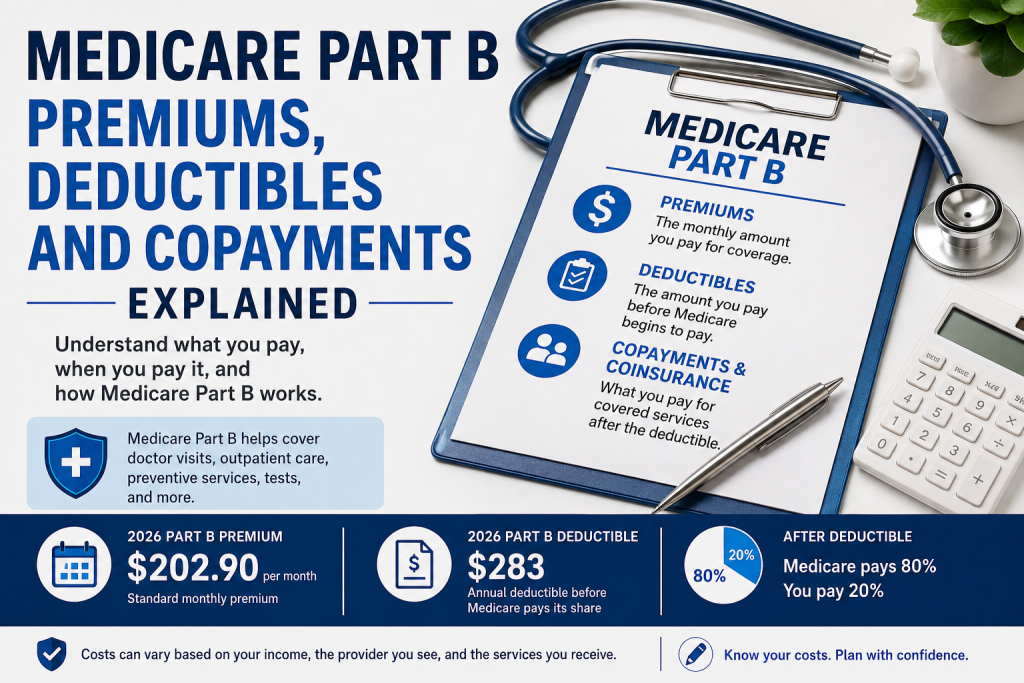
For 2026, the standard Medicare Part B premium is $202.90 per month, and the annual Part B deductible is $283. After that deductible is met, Original Medicare generally pays 80% of the Medicare-approved amount for covered Part B services, while you are responsible for the remaining 20%.
But those three numbers do not tell the entire story.
What Does Medicare Part B Cover?
Medicare Part B is sometimes called the medical portion of Original Medicare.
It generally covers services such as:
- Doctor visits
- Specialist visits
- Outpatient medical care
- Diagnostic tests
- Outpatient surgery
- Durable medical equipment
- Certain home health services
- Many preventive services
- Some medications administered in a doctor’s office or outpatient setting
Medicare describes Part B as covering doctors’ services, outpatient care, durable medical equipment and many preventive services.
Part B works together with Medicare Part A, which primarily deals with inpatient hospital coverage.
If you are new to Medicare, it helps to first understand how Medicare works before comparing plans. The alphabet soup of Parts A, B, C and D becomes much less intimidating once you know what each part actually does.
The 2026 Medicare Part B Premium: $202.90 Per Month
Most people enrolled in Medicare Part B pay the standard monthly premium.
For 2026, that amount is:
$202.90 per month
That works out to:
$2,434.80 per year
And here is an important point that people sometimes miss:
You pay the Part B premium whether you use medical services that month or not.
Think of the premium as the price of keeping the coverage active. It is not a payment toward a particular doctor’s visit.
The 2026 standard Part B premium increased from $185 in 2025. CMS says the increase reflects projected medical price changes and expected utilization.
For many beneficiaries receiving Social Security, the premium is normally deducted from their Social Security payment. Other beneficiaries may receive a Medicare bill.
Some People Pay More Because of Their Income
This is where Medicare starts getting a little more interesting.
Higher-income beneficiaries can pay more than the standard Part B premium through something called the Income-Related Monthly Adjustment Amount, better known as IRMAA.
For 2026, an individual with modified adjusted gross income of $109,000 or less, or a married couple filing jointly with income of $218,000 or less, generally pays the standard $202.90 Part B premium.
Above those income levels, the premium rises in steps.
For example, in 2026, total Part B premiums range from:
- $202.90 per month at the standard level
- $284.10
- $405.80
- $527.50
- $649.20
- Up to $689.90 per month at the highest income tier
That means two people with exactly the same Medicare coverage could be paying very different monthly premiums simply because of income.
IRMAA can also apply to Medicare Part D prescription drug coverage.
This is another reason Medicare should be viewed as a financial-planning decision, not merely an insurance decision.
The 2026 Part B Deductible: $283
After paying your monthly premium, you may still have to pay the annual Part B deductible.
For 2026, the deductible is:
$283
The deductible generally means that you pay the first $283 of Medicare-approved Part B expenses before Medicare begins paying its normal share.
The deductible resets each calendar year.
CMS increased the deductible from $257 in 2025 to $283 in 2026.
Here is a simplified example.
Suppose you have a Medicare-covered outpatient service early in the year and the Medicare-approved amount is $400.
If you have not yet satisfied any of your Part B deductible, you would first be responsible for the deductible.
After the deductible is met, Medicare’s normal cost-sharing rules begin to apply.
This is where the famous 80/20 split comes into the picture.
Medicare Part B Usually Uses Coinsurance, Not Copayments
People frequently use the words copayment and coinsurance interchangeably, but they are not technically the same thing.
A copayment is normally a fixed dollar amount.
For example:
$20 to see a doctor.
A coinsurance is a percentage of the approved cost.
For example:
20% of the Medicare-approved amount.
Under Original Medicare Part B, you will usually pay 20% coinsurance after meeting your deductible when your provider accepts Medicare assignment.
So if Medicare approves $200 for a covered service after your deductible has already been satisfied:
Medicare might pay approximately $160.
You might pay approximately $40.
That is very different from a health plan that charges a flat $20 or $40 doctor copayment.
The 20% Has No Built-In Annual Maximum Under Original Medicare
This is one of the most important facts about Original Medicare.
Original Medicare does not have a general annual out-of-pocket maximum for Part A and Part B expenses.
That means the 20% Part B coinsurance can continue throughout the year.
If you have $1,000 worth of Medicare-approved Part B services after your deductible, your approximate share could be $200.
If you have $10,000, your share could be approximately $2,000.
If you have $50,000 in Part B-covered services, 20% could become a much more serious financial number.
This is one reason many people pair Original Medicare with a Medicare Supplement policy.
You can learn more in our comparison of Medicare Advantage versus Medigap.
Neither approach is automatically better for everyone. The important question is how the costs and risks fit your particular situation.
Not Every Part B Service Costs 20%
This is another place where oversimplification causes trouble.
You often hear:
“Medicare Part B pays 80%, and you pay 20%.”
That is a useful rule of thumb.
But it is not universal.
Certain Medicare-covered preventive services can cost you $0 when the requirements are met and the provider accepts assignment.
For example, Medicare says the “Welcome to Medicare” preventive visit can cost nothing when the provider accepts assignment. But if additional tests or services are performed during the same visit, the deductible or coinsurance may apply.
Covered clinical laboratory services can also have $0 cost sharing in many situations.
So never assume that every service automatically carries the same 20% charge.
What Does “Accepting Assignment” Mean?
Here is a Medicare phrase worth understanding.
A provider who accepts assignment agrees to accept the Medicare-approved amount as full payment for the Medicare-covered service.
Medicare pays its share.
You pay your required deductible and coinsurance.
Simple enough.
But some providers do not accept assignment.
In many cases, a non-participating provider can charge as much as 15% above the Medicare-approved amount. This is known as the Medicare limiting charge.
These additional charges are sometimes called Part B excess charges.
That does not mean every provider who does not accept assignment will charge the full additional amount. But it is something worth asking about before receiving care.
A useful question is:
“Do you accept Medicare assignment?”
Six words can prevent one unpleasant surprise later.
What About Copayments at Hospitals and Outpatient Facilities?
Part B costs can also become more complicated when outpatient services are provided in a hospital setting.
You may owe the regular Part B coinsurance for the professional service and, depending on the situation, an additional amount to the outpatient facility.
For example, Medicare notes that some outpatient procedures can involve a separate facility copayment in addition to the Part B coinsurance.
That is why simply asking, “Does Medicare cover this?” is sometimes not enough.
A better question is:
“What will my estimated out-of-pocket cost be under Medicare?”
Coverage and cost are two different questions.
Medicare Advantage Works Differently
If you have a Medicare Advantage plan, you generally still must remain enrolled in Medicare Parts A and B and continue paying your Part B premium.
However, instead of Original Medicare’s standard 20% structure, your Medicare Advantage plan establishes its own copayments, coinsurance amounts, provider networks and annual out-of-pocket maximum.
You might see benefits such as:
- $0 primary-care visits
- A fixed specialist copayment
- Daily hospital copayments
- Outpatient surgery copayments
- Different charges for diagnostic tests
These costs vary by plan.
A $0 Medicare Advantage premium does not mean your health care costs are zero.
Premium and cost are not the same thing.
That distinction is worth remembering whenever you compare Medicare plans.
What If You Have Medigap?
Medigap works differently.
Medigap policies supplement Original Medicare rather than replace it.
Depending on the Medigap plan you choose, the policy may pay some or most of the deductibles and coinsurance that Original Medicare leaves behind.
For example, certain Medigap policies can cover the Part B 20% coinsurance after the applicable deductible.
This can make medical expenses more predictable, but you generally pay a separate Medigap premium for that protection.
Again, the financial decision is not simply:
“Which premium is cheaper?”
A better question is:
“How much financial risk am I keeping in exchange for the premium I am paying?”
Can You Get Help Paying the Part B Premium?
Some people with limited income and resources may qualify for a Medicare Savings Program.
Depending on eligibility, these state-administered programs may help pay the Part B premium and, in some cases, deductibles and coinsurance.
Medicare publishes current income and resource limits for these programs and encourages beneficiaries to apply even if they are unsure whether they qualify.
Do not assume your income is automatically too high without checking.
The Bottom Line
Medicare Part B does not have to be complicated.
For 2026, start with these numbers:
Part B standard premium: $202.90 per month
Part B annual deductible: $283
Typical Part B coinsurance after the deductible: 20%
Then remember the exceptions.
Some preventive care may cost $0.
Higher-income beneficiaries may pay a larger monthly premium.
Providers who do not accept assignment may sometimes charge more.
Hospital outpatient services can carry additional facility charges.
And Original Medicare does not provide a general annual out-of-pocket maximum for Part A and Part B costs.
That final point is especially important.
When comparing Medicare choices, do not look only at the monthly premium.
Look at the whole financial picture:
Premiums.
Deductibles.
Copayments.
Coinsurance.
Doctor access.
Hospital access.
Prescription coverage.
And your potential financial exposure during a bad health year.
Medicare is not about finding the plan with the lowest number printed on the front page.
It is about understanding what you pay, when you pay it, and how much risk you are willing to keep.
That is how you make Medicare a financial decision instead of a guessing game.
At MedicareSelfEnroll.com, you can compare Medicare Advantage, Medicare Supplement and Part D options privately and at your own pace. No pressure. No one needs to call you just because you want to investigate your choices.
And before making any Medicare decision, verify current coverage, costs and official rules at Medicare.gov. Medicare costs can change each year, so yesterday’s number may be tomorrow’s expensive mistake.

William Vargas brings over 50 years of financial and insurance expertise to every Medicare conversation. He operates MedicareSelfEnroll.com, helping seniors in Florida, New York, and North Carolina — with no pressure, no phone calls required.