In This Article
- First: What Exactly Is the $2,100 Medicare Part D Cap?
- Surprise #1: Your Part D Premium Is Separate
- Surprise #2: A Drug May Not Be on Your Plan’s Formulary
- Surprise #3: Discount-Card Purchases May Not Count
- Surprise #4: Pharmacy Choice Can Still Matter
- Surprise #5: The 2026 Deductible Can Still Be Significant
- Surprise #6: You Can Spread Drug Costs Out—but That Doesn’t Make Them Cheaper
- Surprise #7: Prior Authorization and Quantity Limits Haven’t Disappeared
- Part B Drugs Are a Different Category
- One Number Doesn’t Tell the Whole Story
- A Simple Medicare Prescription Checklist
- The Bottom Line
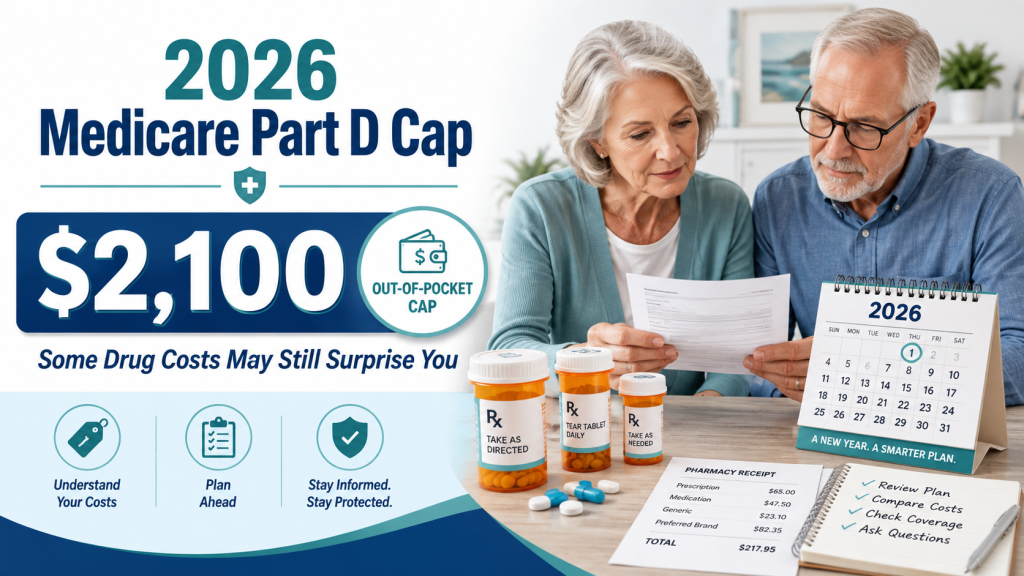
One of the biggest improvements to Medicare prescription drug coverage in years is now in effect.
In 2026, people enrolled in Medicare Part D have a $2,100 annual out-of-pocket limit for covered Part D prescription drugs. Once you reach that limit, you generally pay $0 in copayments or coinsurance for covered Part D drugs for the rest of the calendar year.
That is a major financial protection, particularly for people who take expensive medications.
But there is an important word in that sentence:
Covered.
The $2,100 limit does not mean that every dollar you spend involving prescriptions, premiums, pharmacies, or medications is included in the cap.
And that is where some Medicare beneficiaries may get an unpleasant surprise.
The better way to think about the new rule is this:
The $2,100 cap protects what you pay for Part D-covered medications under your Medicare drug plan. It is not necessarily a $2,100 ceiling on your total prescription-related expenses.
Understanding that distinction could save you both money and frustration.
First: What Exactly Is the $2,100 Medicare Part D Cap?
Medicare Part D underwent a major redesign beginning in 2025. For 2026, the annual out-of-pocket threshold increased to $2,100, reflecting the annual adjustment required under the law.
Once your qualifying out-of-pocket spending reaches $2,100, you enter catastrophic coverage and generally owe nothing for covered Part D drugs for the remainder of that calendar year.
That is dramatically different from the old Part D system, under which people taking extremely expensive medications could continue paying coinsurance even after entering catastrophic coverage.
For someone taking several costly drugs, this new protection can be worth thousands of dollars.
But don’t look at the number $2,100 and assume:
“My prescription drug expenses can never exceed $2,100.”
That’s not quite how it works.
Surprise #1: Your Part D Premium Is Separate
Your monthly Medicare prescription drug plan premium is not eliminated when you reach the $2,100 out-of-pocket drug limit.
You still have to keep paying your plan premium.
Medicare specifically notes that people using the Medicare Prescription Payment Plan must continue paying their normal health or drug plan premium in addition to payments for prescriptions.
For example, imagine your Part D plan costs $60 per month.
That’s:
$60 × 12 = $720 per year
If you also reach the $2,100 out-of-pocket drug cap, your overall spending could already be approximately:
$2,820
And that’s before considering other costs that might fall outside Part D.
That’s why I often tell Medicare beneficiaries:
Premium is not the same thing as total cost.
When comparing Medicare plans, looking only at the monthly premium can be a serious mistake.
At MedicareSelfEnroll.com, our philosophy is simple: understand the entire financial picture before choosing a Medicare plan.
Surprise #2: A Drug May Not Be on Your Plan’s Formulary
Every Medicare Part D plan has a list of covered medications called a formulary.
Two Medicare drug plans available in the same county can cover the same person’s prescriptions very differently.
Your medication might be covered by Plan A but not covered by Plan B.
Medicare explains that if a specific medication isn’t on your plan’s formulary, there will generally be a similar covered medication available. However, if you and your doctor believe the alternatives won’t work, you can ask the plan for a formulary exception.
This distinction becomes extremely important when discussing the $2,100 cap.
The protection applies to drugs covered by your Medicare Part D plan.
If you simply pay cash for a medication your plan doesn’t cover rather than obtaining an approved exception or otherwise having it treated as a covered Part D claim, you should not automatically assume that spending will move you toward the $2,100 limit.
Before paying hundreds—or thousands—of dollars for a medication, ask:
Is this prescription actually being processed through my Part D plan?
That one question may make a significant difference.
Surprise #3: Discount-Card Purchases May Not Count
Here’s another situation that can confuse people.
Sometimes GoodRx-type discount programs, manufacturer offers, or other cash-price alternatives can produce a lower price than running a prescription through your Medicare drug plan.
That’s not necessarily bad.
Saving money is saving money.
But understand the trade-off.
Medicare states that when certain drug discount programs are used instead of your Medicare plan, those purchases don’t count toward your Medicare drug deductible or annual out-of-pocket maximum.
Imagine this scenario.
Your Part D price for a medication is $100.
A discount program offers it for $60.
Naturally, you choose $60.
You’ve saved $40 today.
But that $60 may not move you $60 closer to your $2,100 Part D limit.
For someone who rarely uses medications, that may not matter at all.
For someone taking expensive medications who expects to reach the cap later in the year, it could matter considerably.
The lesson isn’t “never use a discount card.”
The lesson is:
Know which bucket your money is going into.
Surprise #4: Pharmacy Choice Can Still Matter
Having the right drug plan isn’t the end of the story.
You also need to pay attention to where you fill your prescriptions.
Medicare drug plans frequently distinguish between preferred pharmacies, standard network pharmacies, mail-order options, and out-of-network pharmacies.
Medicare’s 2026 handbook specifically notes that your prescription costs can vary depending upon which pharmacy you use and whether that pharmacy offers preferred or standard cost sharing.
That means the exact same drug, covered by the exact same Medicare plan, can sometimes cost you different amounts depending on the pharmacy.
This is one of the reasons Medicare beneficiaries should not simply ask:
“Does my plan cover my medicine?”
A better set of questions is:
Does my plan cover my medicine?
What tier is it on?
Is there a deductible?
Is my pharmacy preferred?
Would mail order cost less?
Medicare is increasingly becoming a system where the details matter.
Surprise #5: The 2026 Deductible Can Still Be Significant
The maximum Medicare Part D deductible in 2026 is $615. Some plans charge less, and some have no deductible at all.
Other plans may apply the deductible only to certain drug tiers.
This can create sticker shock early in the year.
Suppose you fill an expensive prescription in January and your plan has a $615 deductible.
You may be responsible for a sizable amount before normal plan cost-sharing begins.
The good news is that qualifying deductible spending on covered Part D drugs contributes toward your annual out-of-pocket spending.
But emotionally, knowing you have a $2,100 annual cap doesn’t make a $600 pharmacy bill in January feel inexpensive.
This brings us to another important change.
Surprise #6: You Can Spread Drug Costs Out—but That Doesn’t Make Them Cheaper
All Medicare Part D plans must offer the Medicare Prescription Payment Plan.
This program allows people to spread certain out-of-pocket prescription expenses over the calendar year rather than paying the entire amount at the pharmacy when they fill the prescription.
That can be extremely useful for someone who faces a large prescription bill early in the year.
But don’t confuse payment timing with savings.
Medicare makes clear that the program helps manage expenses—it doesn’t reduce the total cost of the medications.
Think of it like taking a large bill and dividing it into smaller pieces.
The pieces may be easier to swallow.
The pizza didn’t get smaller.
For someone on a fixed monthly Social Security income, however, spreading expenses over several months may make budgeting far easier.
You can learn more directly from Medicare’s Medicare Prescription Payment Plan information.
Surprise #7: Prior Authorization and Quantity Limits Haven’t Disappeared
Another misconception is that because Part D now has a $2,100 cap, getting an expensive medication should become simple.
Not necessarily.
Part D plans can still use coverage rules including:
- Prior authorization
- Step therapy
- Quantity limits
- Formulary restrictions
For example, Medicare explains that plans may limit how much of a drug they’ll cover over a certain period. A doctor can request an exception when a larger quantity is medically necessary.
So the question isn’t just:
“How much will this medication cost?”
It may also be:
“Will my plan approve it?”
That is a very different issue.
Part B Drugs Are a Different Category
Another important distinction is between medications covered under Medicare Part D and medications covered under Medicare Part B.
Part B covers certain drugs administered in medical settings, including some medications given in doctors’ offices and outpatient facilities.
Those aren’t automatically part of your Part D spending calculation simply because they’re prescription medications.
This is particularly important for people receiving chemotherapy drugs, infusion therapies, injections, biologic medications, or other physician-administered treatments.
Don’t assume that every medicine is a “Part D drug.”
Ask which part of Medicare is paying for it.
One Number Doesn’t Tell the Whole Story
The $2,100 limit is real.
It’s valuable.
And for people taking expensive medications, it may be one of the most important improvements Medicare Part D has ever made.
But the number should not cause beneficiaries to stop comparing plans.
In fact, I would argue the opposite.
You should still review your Part D coverage every year because your actual costs depend on several moving parts:
Your medications.
Your plan’s formulary.
The drug tiers.
Your deductible.
Copayments and coinsurance.
Your pharmacy.
Coverage restrictions.
Your monthly premium.
Medicare itself recommends using Medicare Plan Compare to examine specific plan costs and coverage.
A Simple Medicare Prescription Checklist
Before enrolling in a Medicare drug plan—or automatically renewing the plan you already have—write down every prescription you currently take.
Include the exact drug name, dosage, frequency, and pharmacy.
Then ask:
- Is each medication on the plan’s formulary?
- What tier is each medication?
- Is there a deductible?
- Does the deductible apply to my drugs?
- Is prior authorization required?
- Is step therapy required?
- Are there quantity limits?
- Is my pharmacy preferred?
- Would another pharmacy or mail order reduce the cost?
- What is my estimated total annual cost, not merely the monthly premium?
That last question may be the most important.
The Bottom Line
The 2026 Medicare Part D out-of-pocket cap of $2,100 is an enormous improvement.
But don’t mentally translate it into:
“The most I can possibly spend on prescriptions this year is $2,100.”
That’s too simplistic.
A more accurate statement is:
For 2026, qualifying out-of-pocket spending on drugs covered by your Medicare Part D plan is capped at $2,100. Once you reach that limit, you generally pay $0 for covered Part D drugs for the rest of the calendar year.
Your plan premium continues.
Non-covered medications can create additional expenses.
Cash and discount-card purchases may not count toward your Part D cap.
Pharmacy choice can affect pricing.
And coverage rules can still determine whether your prescription is approved in the first place.
That’s why Medicare decisions shouldn’t be based on one number.
At MedicareSelfEnroll.com, our approach is Education First. Enrollment Second.
Because an educated Medicare beneficiary isn’t simply looking for the cheapest premium.
They’re trying to understand:
What am I covered for? What could I actually pay? And what happens if my healthcare needs change?
The new $2,100 cap gives Medicare beneficiaries valuable financial protection.
Understanding what is—and isn’t—inside that protection makes it even more valuable.
This article is for educational purposes and isn’t intended as individualized Medicare, medical, tax, or financial advice. Medicare plan formularies, premiums, pharmacy networks, and coverage rules can vary by plan and location. Always verify current coverage through your plan and Medicare.gov before making enrollment or medication decisions.

William Vargas brings over 50 years of financial and insurance expertise to every Medicare conversation. He operates MedicareSelfEnroll.com, helping seniors in Florida, New York, and North Carolina — with no pressure, no phone calls required.